
Most advice on hiring Latin American developers starts with the wrong question. It asks which country is cheapest, which timezone is closest, or which marketplace can produce the fastest shortlist. Those questions matter, but they won't protect you from the expensive failure mode: hiring someone who can write tickets yet can't understand an unfamiliar codebase, document decisions, protect intellectual property, or leave the project in a maintainable state.
The better question is whether the developer can create durable engineering value after you account for compensation, recruiting, compliance, equipment, management time, retention, and handoff. Latin America offers serious depth, but cheap talent isn't automatically good value. You need a sourcing strategy, an evaluation process that tests adaptability, and an operating model that protects the code after the contract is signed.
Table of Contents
- Why Hiring Latin American Developers Is a Strategic Decision
- Where to Find and Source Latin American Developers
- Screening and Technical Evaluation That Predicts Real Performance
- How LatHire Can Help
- Compensation, Contracting, and Legal Exposure
- Time Zones, Communication, and Async Workflows
- Retention, Culture, and Knowledge Handoff
- Templates, Checklist, and Your First 30 Days
Why Hiring Latin American Developers Is a Strategic Decision
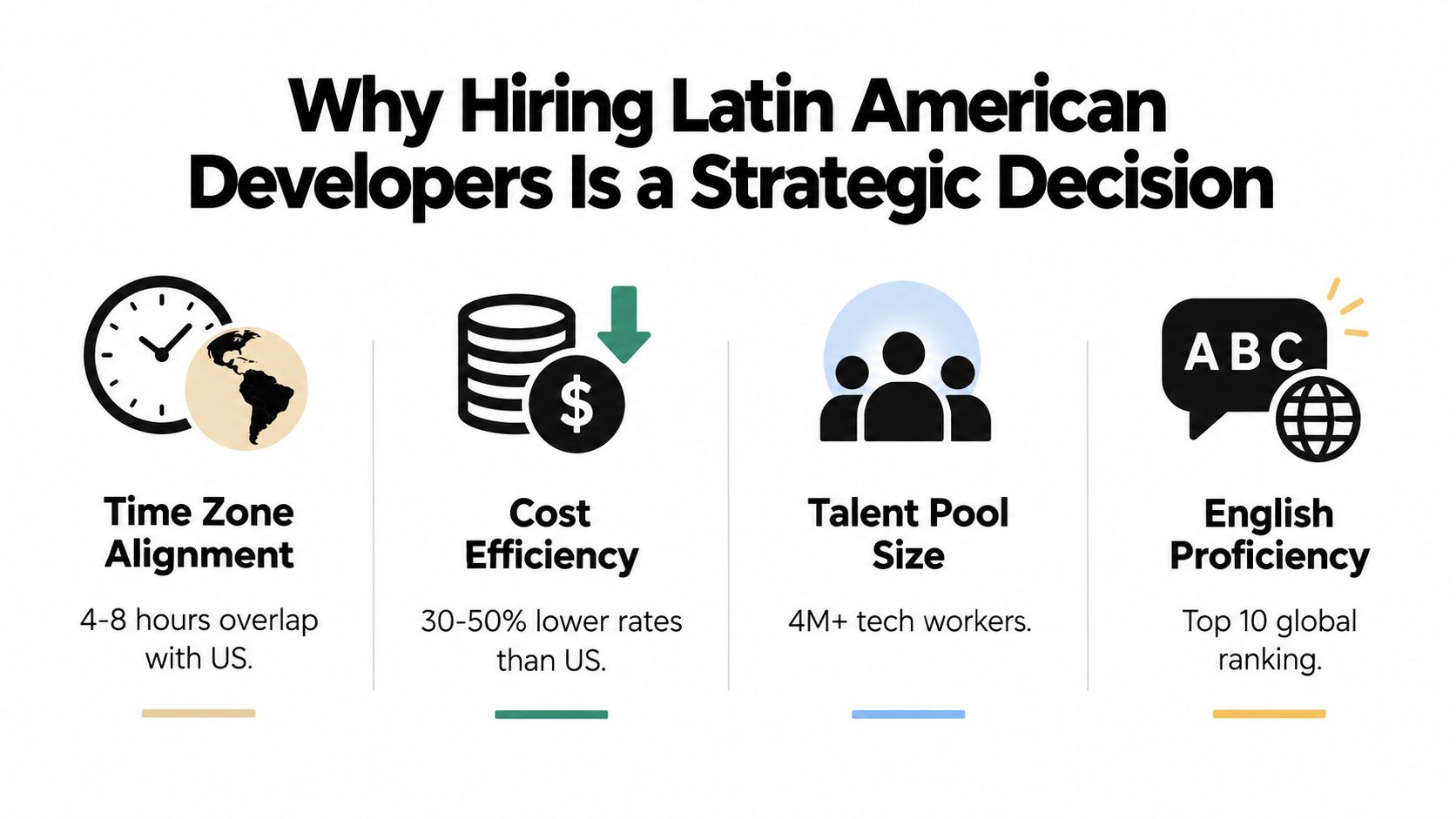
Latin America is a concentrated hiring market, not one uniform talent pool. A 2024 aggregation estimated approximately 2 million software developers across the region, with Brazil at about 759,278, Mexico at 563,075, and Argentina at 167,414. Together, those three countries represented roughly 1.49 million developers, or approximately 75% of the estimated regional total. The figures come from an aggregator rather than a national statistical agency, so use them for market sizing and sourcing priorities, not as a definitive census. The country-level developer estimates still provide a useful map.
Brazil and Mexico should be your first markets when you need volume. Together they account for approximately 1.32 million developers, or about two-thirds of the regional estimate. Brazil gives you the largest workforce and deep coverage across engineering profiles. Mexico combines scale with proximity to U.S. business hours, which can simplify collaboration for teams that rely on frequent live interaction.
Argentina is smaller in absolute terms but remains a prominent technology market. Colombia and Chile expand your reach when you need additional specialization or want to diversify sourcing. The practical sequence is straightforward: start with Brazil or Mexico for scale, then add Argentina, Colombia, or Chile when the role, communication requirements, or candidate supply calls for it.
Scale doesn't remove the quality problem
A large market doesn't guarantee a strong hire. A 2024 report analyzed more than 185,000 software developers who joined a pre-vetted Latin American talent network between January 1, 2022, and June 21, 2024, across 12 countries. Within that network, full-stack developers represented 23%, front-end developers 21%, and back-end developers 18%, making those groups 62% of candidates combined. The dataset is drawn from one talent network, not the entire region, but it gives buyers a useful picture of the available cross-border hiring pool. The report's candidate breakdown supports the view that Latin America has meaningful depth in mainstream product engineering.
The same dataset found that nearly half of developers had at least three years of experience, while 56% of full-stack and back-end developers met that threshold. React.js was the most common front-end framework in the network, with 41% of front-end developers proficient in it. Those facts are useful for initial planning, but they shouldn't replace individual assessment. A resume can show framework exposure without showing whether someone can safely extend a fragile template or challenge a flawed requirement.
Practical rule: Choose a country for access, then choose a person for judgment.
Cheap is not the same as efficient
The headline rate hides the work surrounding the hire. Recruiting fees, employer-of-record charges, contractor administration, benefits, foreign-exchange friction, equipment, management time, security controls, and eventual handoff all affect the cost of a productive engineering month.
The World Economic Forum reports that 84% of employers in Latin America and the Caribbean plan to upskill existing workers themselves to meet rising digital-talent demand. That finding points to a hiring principle many rate comparisons miss: learning velocity matters. A developer who adapts quickly to a new product, AI-assisted workflow, cloud environment, or security standard can be a better investment than a cheaper developer who requires constant supervision.
For companies assembling products from templates, scripts, and starter code, the distinction is decisive. Your risk isn't only slow delivery. It's undocumented customization, unsafe dependencies, weak tests, unclear ownership, and a codebase nobody else can maintain.
Where to Find and Source Latin American Developers
Treat sourcing channels as different instruments, not interchangeable websites. Open platforms give you reach but require more screening. Curated networks reduce evaluation work but narrow the funnel. Local communities and university relationships can uncover strong candidates before they enter crowded international searches.
Start by defining the role in operational terms. “React developer” is too broad. Specify whether the person will extend an existing Next.js application, repair a third-party module, own deployment, work directly with customers, or lead architecture decisions. The more clearly you describe the actual environment, the less likely you'll attract candidates who match keywords but not the work.
Build a channel mix
Use Brazil and Mexico first when you need a broad full-stack funnel. Add Argentina for senior product engineers and technical leadership, then consider Colombia and Chile for additional coverage. Don't filter by country alone. Filter by city, previous international work, written communication, and evidence of maintaining production systems.
Useful channel categories include:
- Curated talent networks: Best when you need pre-screened candidates quickly and want support with cross-border administration.
- Professional networks: Strong for targeted outbound searches, especially when you can identify engineers from relevant product companies.
- GitHub and technical communities: Valuable for finding people who can show code, documentation, issue discussions, or maintained projects.
- Local meetups and developer groups: Useful for country-specific relationships and referrals, though they require more patience.
- University partnerships: Better for building a junior or early-career pipeline than for filling an urgent senior role.
- Specialist agencies: Appropriate when the role is difficult, confidential, or tied to a specific stack and delivery deadline.
For broader remote-role context, review remote job categories worth exploring, then narrow the posting to the engineering responsibilities you need.
Compare channels by operating trade-off
| Channel type | Time to shortlist | Vetting depth | Cost model |
|---|---|---|---|
| Curated talent network | Fast | High before client interviews | Placement fee, subscription, or staffing margin |
| Professional network outreach | Moderate | Low before your process | Recruiter time and sourcing tools |
| GitHub and communities | Variable | Evidence-based, but inconsistent | Internal time and outreach effort |
| University partnerships | Slow for senior hiring | Educational and interview-based | Relationship and program cost |
| Specialist agency | Fast to moderate | Depends on the agency | Recruiting fee or staffing margin |
Write outreach that earns a reply
A generic message signals generic work. Tell the candidate what they would own, what kind of code they would inherit, how the team makes decisions, and what you won't pretend is easy.
A concise message can follow this structure:
Context: We maintain a customer-facing application built with [stack], and we're replacing several fragile modules.
Ownership: You'd own [specific area], including tests, observability, and technical documentation.
Working model: The team has a defined collaboration window, with written decisions outside meetings.
Why you: Your work on [relevant system or repository] suggests experience with [specific challenge].
Next step: If this sounds relevant, I'd like to discuss the codebase, constraints, and what you'd change first.
Don't hide the difficult part of the job. Candidates who understand that they will inherit starter code, unclear requirements, or technical debt can make an informed decision. That honesty improves both the shortlist and retention.
Screening and Technical Evaluation That Predicts Real Performance
A resume and a half-hour conversation measure presentation. They don't reliably measure adaptability. Your evaluation should force the candidate to work with unfamiliar code, make trade-offs, explain risk, and leave behind documentation another engineer can use.

Use a realistic technical exercise
Give the candidate a small, sanitized repository. It can contain a broken feature, incomplete tests, a confusing data flow, or a dependency that needs replacement. Ask them to:
- Read the existing code and write down assumptions.
- Implement a narrowly defined change.
- Add or improve tests.
- Identify one security or reliability concern.
- Document trade-offs and remaining work.
- Explain how they'd monitor the change after release.
Don't grade only the final code. Watch how the developer explores the repository, whether they ask clarifying questions, and whether they can distinguish a safe incremental fix from an unnecessary rewrite.
For a candidate's professional background, use a resume bullet point guide as a reminder to look for evidence of outcomes and ownership rather than lists of technologies.
Run a structured interview loop
Use the same rubric for every candidate. A practical 90-minute loop can include:
- Repository walkthrough: Ask the candidate to explain what they changed, what they didn't change, and why.
- Failure analysis: Present a production issue involving latency, authorization, data integrity, or an unstable dependency.
- Adaptability discussion: Replace one requirement midway through the conversation and ask how the design changes.
- AI-assisted development review: Ask which AI tools they use, what they delegate, and how they validate generated code.
- Documentation test: Request a short README or handoff note explaining setup, architecture, risks, and rollback.
Score each area from weak to strong using written observations, not instinct:
| Rubric area | What strong evidence looks like |
|---|---|
| Code judgment | Small changes, clear boundaries, sensible trade-offs |
| Testing | Tests target behavior and failure modes, not only the happy path |
| Security | Candidate questions authorization, secrets, dependencies, and data exposure |
| Observability | Candidate identifies logs, metrics, traces, or alerts needed after release |
| Communication | Explanations are concise, candid, and understandable in writing |
| Adaptability | Candidate revises the plan without becoming defensive |
| AI usage | Candidate treats generated output as untrusted and verifies it |
Ask direct questions: “What did you distrust in this repository?” “Which AI-generated suggestion would you reject?” “What would you document before handing this to another engineer?” “What would make you stop and ask for product clarification?”
The best candidates won't claim certainty where the code doesn't support it. They'll expose uncertainty, reduce risk, and make their work transferable.
How LatHire Can Help
LatHire is an AI-powered hiring platform connecting U.S. and Canadian companies with pre-vetted Latin American professionals across technology, marketing, sales, and operations. Its stated process combines AI assessments, skills evaluations, and human-led background checks, with a talent pool of more than 800,000 candidates described by the company. It also supports importing an existing job description or generating one with AI, candidate matching as fast as 24 hours, and services covering HR, international payroll, benefits, and legal compliance.
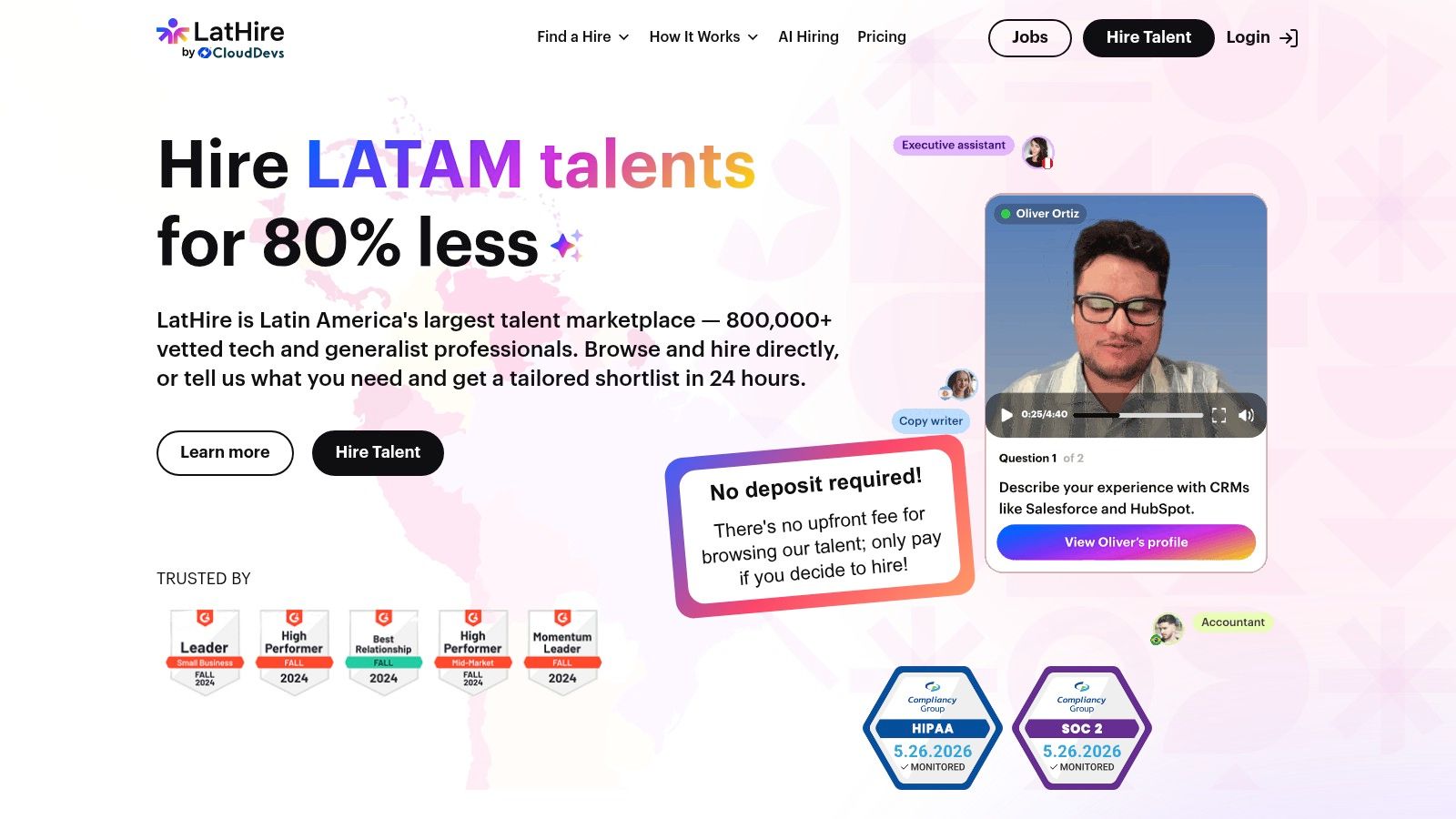
The platform is most useful when your bottleneck is operational complexity rather than knowing where developers live. It can reduce the work involved in sourcing, initial assessment, payroll, benefits, and cross-border administration. Profiles include validated skills and availability information, while flexible engagement models can suit both specialist engineering roles and broader operational hiring.
For a buyer comparing direct contracting with an Employer of Record, LatHire's value is less about a headline salary and more about packaging the surrounding work. A managed provider may help with worker classification, payment processes, benefits, and documentation, but you should still review the agreement carefully. Confirm who owns deliverables, who controls access, how confidential information is protected, what happens at termination, and whether the engagement structure matches the day-to-day relationship.
LatHire is a reasonable shortlist option when you need to hire latin american developers without building country-specific recruiting and administrative capability internally. It isn't a substitute for your technical evaluation. Ask the provider for sample assessment criteria, replacement terms, data-protection commitments, IP language, and a clear explanation of every fee.
Compensation, Contracting, and Legal Exposure
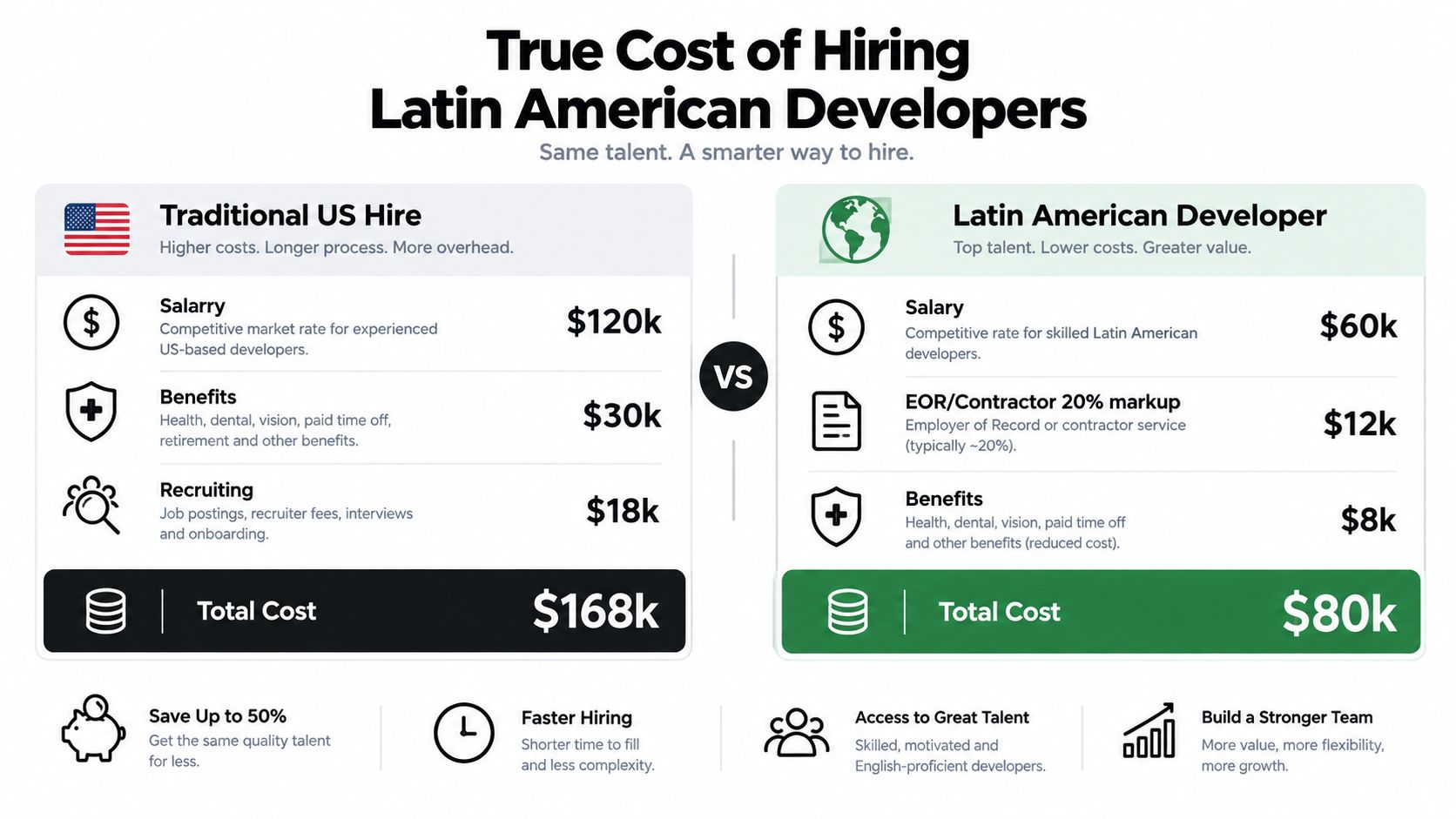
Advertised salary is a planning input, not a budget. A recent market summary estimates that senior Latin American engineers cost roughly $4,000 to $8,000 per month, compared with $10,500 to $19,500 per month in the United States. Another 2025 report claims average Latin American IT salaries could rise 12% to 18% during the year. Treat those figures as market context, not a promise for a specific role or country. The compensation and operating discussion makes the central point: international demand can narrow savings for senior AI, cloud, security, and product-engineering talent.
Build your budget around fully loaded productive cost. Include:
- Recruiting and assessment: Agency fees, platform charges, internal interviewer time, and paid exercises.
- Employment structure: Contractor administration, EOR charges, statutory contributions, benefits, and payroll support.
- Operating equipment: Laptop, access management, security tooling, replacement hardware, and connectivity support.
- Management overhead: Onboarding, meetings, reviews, documentation, and coordination across teams.
- Retention reserve: Compensation reviews, professional development, benefits, and backup coverage.
- Exit and continuity: Offboarding, access removal, knowledge transfer, code review, and replacement time.
A low base rate doesn't remain low if the developer leaves with undocumented knowledge or if you need to rebuild the system after an unsafe customization.
Select the operating model deliberately
| Criterion | Contractor | Employer of Record |
|---|---|---|
| Legal employer | Usually the individual or their business | EOR is the local legal employer |
| Administrative burden | Your team or provider manages contracts and payments | EOR manages payroll and employment administration |
| Control risk | Higher if the relationship resembles employment | Lower, though daily practices still matter |
| Benefits | Negotiated or separately provided | Structured through the employment arrangement |
| Best fit | Defined deliverables and genuine independence | Integrated, ongoing roles requiring formal employment |
A contractor agreement doesn't cure an employment-like relationship. If you set fixed hours, supervise methods closely, require exclusivity, and treat the person like an employee, ask local counsel whether the structure creates reclassification exposure. An EOR reduces administrative burden, but it doesn't remove your responsibility for security, access, product management, or clear ownership terms.
Protect the deliverables
Your agreement should address:
- Present and future IP assignment: Cover source code, documentation, designs, tests, configurations, and derivative work.
- Pre-existing materials: Require disclosure of libraries, snippets, or tools the developer brings into the project.
- Confidentiality: Define customer data, credentials, product plans, and internal documentation.
- Open-source compliance: Require approval for licenses that create distribution or disclosure obligations.
- Security duties: Cover device protection, access control, incident reporting, and data handling.
- Exit procedures: Require return or deletion of data, credential rotation, repository transfer, and handoff documentation.
- Dispute and governing law: Use counsel familiar with the relevant country rather than copying a U.S. template.
Legal review is cheaper than discovering that your company cannot clearly prove ownership of the code it paid to create.
Time Zones, Communication, and Async Workflows
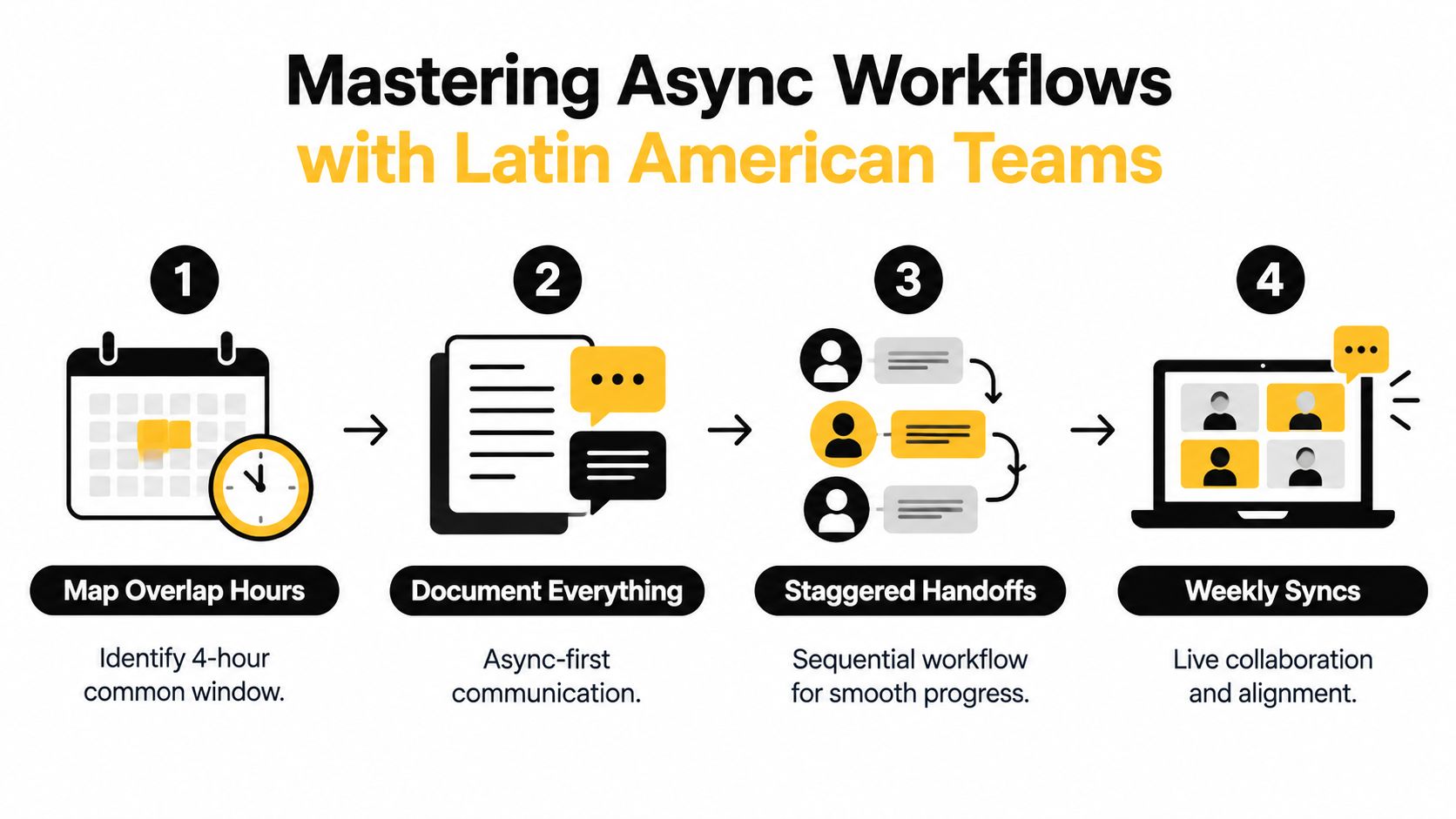
Time-zone overlap helps only when your team uses it intentionally. A developer who is technically available during your workday can still become isolated if every decision happens in private calls, requirements arrive without context, and nobody writes down what changed.
A product team I worked with once brought a developer into a starter codebase that had inconsistent naming, limited tests, and several third-party modules. The first mistake would have been assigning a large feature immediately. Instead, the team used the overlap window for a repository tour and a short architecture discussion, then gave the developer ownership of one small, bounded change.
The developer wrote an initial decision note, identified an unsafe assumption in the template, and opened a pull request with tests and a rollback plan. The U.S. team reviewed the change during the shared window. The developer then used the remaining workday to update documentation and prepare the next handoff. That rhythm created momentum without turning every hour into a meeting.
Make collaboration explicit
Use a written operating agreement that covers:
- Overlap expectations: Define when the team should be reachable for blockers, reviews, and customer-impacting incidents.
- Async default: Put requirements, decisions, risks, and status updates in the project system rather than private chat.
- Decision records: Capture the problem, options considered, chosen approach, consequences, and owner.
- Review windows: Set a predictable period for pull requests so developers don't wait an entire workday for feedback.
- Escalation rules: State what qualifies as urgent and which channel handles it.
- Meeting discipline: Give each meeting an agenda, decision owner, and written follow-up.
English fluency should be tested through work, not national assumptions. Ask the candidate to explain a technical trade-off, write a short incident update, and disagree with a proposed design respectfully. A person who speaks smoothly in conversation may still write vague tickets. Another candidate may speak more cautiously yet produce excellent documentation and precise technical reasoning.
Good managers make participation easier. Share questions before architecture reviews, allow written follow-up, avoid interrupting, and assess whether the person communicates clearly rather than whether they sound native.
Retention, Culture, and Knowledge Handoff
Retention isn't only the ability to keep a developer. It's the ability to keep the value of the developer's work after the person changes roles or leaves. That distinction matters most when someone is customizing a template, integrating a third-party module, or making architectural decisions that aren't obvious from the final code.
Give the hire a clear first-month path. During the first week, they should understand the product, repository, environments, access rules, release process, and decision history. In the following weeks, assign a bounded production change, schedule a technical review, and ask for a short runbook. By the end of the first month, you should know how the developer reasons, communicates risk, and documents their work.
Retention requires visible growth
Senior engineers don't stay because you offer remote work alone. They stay when they can own meaningful problems, improve their technical judgment, and see how their work affects the product.
Use regular conversations to discuss:
- Scope: Which decisions does the developer own without approval?
- Growth: Which skill or responsibility should expand next?
- Feedback: What should the manager, product team, or developer change?
- Recognition: Which contribution improved reliability, delivery, or team capability?
- Sustainability: Is the workload, schedule, and communication pattern workable?
A compensation review should be a deliberate process, not a surprise triggered by an external offer. If market conditions change, explain the criteria and timeline. Ambiguity encourages quiet job searches.
Make handoff a normal engineering practice
For a starter-code project, require a handoff package that includes:
- System overview and important boundaries.
- Local setup and deployment instructions.
- Dependency inventory and license notes.
- Known defects, shortcuts, and security concerns.
- Test coverage and areas that still need validation.
- Monitoring, alerts, and rollback steps.
- Open decisions and recommended next actions.
- Recorded walkthrough or live handoff with the successor.
The handoff should happen while the original developer is still available. Have another engineer reproduce setup, deploy a safe change, and explain the architecture back to the author. If the successor can't do that, the documentation isn't finished.
For teams building around reusable front-end assets, knowledge management with JavaScript UI components offers a useful reminder: documentation is part of the product, not an administrative afterthought.
Templates, Checklist, and Your First 30 Days
Use the following materials as working drafts. Have local counsel adapt legal language before signing, especially for employee classification, IP assignment, privacy, and termination.
Job posting template
Role: Product Engineer, [primary stack]
Mission: Extend and maintain [product or system] while improving reliability and documentation.
First responsibilities: Understand the existing repository, ship a bounded feature, add tests, document trade-offs, and identify maintenance risks.
Required evidence: Production experience with [stack], written technical communication, code review experience, and the ability to work in an unfamiliar codebase.
Working model: [overlap expectations], async documentation, scheduled reviews, and clear escalation rules.
Evaluation: Repository exercise, technical discussion, communication sample, and reference or work-history review.
Success: Safe releases, maintainable code, visible decisions, and a handoff another engineer can execute.
Contract and NDA checklist
Don't paste a generic clause and assume it solves ownership. Confirm that the agreement covers:
- Confidential information and permitted use.
- Assignment of code, documentation, tests, designs, and derivative work.
- Disclosure of pre-existing code and third-party dependencies.
- Open-source approval and license compliance.
- Security controls, incident notification, and credential handling.
- Repository access, device return, and data deletion.
- Handoff obligations and a practical transition period.
- Escrow or repository continuity arrangements where appropriate.
- Governing law, classification, payment, and termination terms.
A plain-language IP provision should state that work created for the engagement is assigned to the client to the maximum extent permitted by applicable law, while separately identifying any pre-existing materials and the license granted for approved inclusions. Counsel should draft the final clause.
First 30 days
Days one through five: Complete access setup, security training, product orientation, repository mapping, and written introductions to key teammates.
Days six through ten: Review the architecture, identify unknowns, run the application locally, and submit a small documentation change.
Days eleven through twenty: Ship a bounded production change with tests, review, monitoring, and a rollback plan.
Days twenty-one through thirty: Own a small feature or maintenance area, present one improvement proposal, and complete a runbook plus handoff exercise.
Four decisions buyers usually postpone
- Contractor or full-time? Use a contractor structure only when the work and relationship are independent. Choose an EOR or local employment route when the person is integrated into ongoing operations and you need formal employment.
- How do you verify English fairly? Use job-related writing, technical explanation, and collaboration exercises. Judge clarity and reasoning, not accent or idiom.
- What if performance drops in the second month? Document the gap, define observable expectations, provide support, and set a review date. If the gap remains, follow the contract and protect the handoff.
- How do you end safely? Revoke access, transfer repositories, rotate secrets, collect equipment, export documentation, complete a live handoff, and confirm deletion or return of confidential data.
The strongest way to hire Latin American developers is to stop treating the decision as a country or salary comparison. Define the work, test adaptability, price the full operating model, protect ownership, and make knowledge transfer part of delivery from the first day. If you're building with templates, scripts, or starter code, browse Code Market's curated catalog at Code Market to identify reusable assets before you write the role, then hire for the engineering judgment required to make those assets safe, maintainable, and yours.
This article was inspired by Outrank.