Remote work isn't a job title. It's a work style that changes how you communicate, document decisions, manage time, and prove your value. A full-stack engineer, a technical writer, a Unity specialist, and a customer support professional may all work remotely, but they don't share the same schedule, evidence requirements, autonomy, or relationship with clients.
This guide compares types of remote jobs by the work they involve, the proof employers expect, the working style they suit, and the trade-offs they bring. It covers nearshore staffing through Virtustant, software development, mobile and game production, WordPress, SaaS, reusable digital products, technical education, and cloud infrastructure. Each path includes the skills to build, portfolio evidence to create, tools or platforms to know, and a practical way to become a credible applicant.
Salary and freelance rates shouldn't be treated as universal figures. Research them for your location, seniority, employment type, language skills, and specialization before you negotiate. The remote labor market favors digital output, but access remains uneven. In April 2025, more than 60% of U.S. computer and mathematical workers worked outside the office at least partly, while remote participation was much lower in service, construction, production, and transportation occupations, according to recent remote-work labor data.
The list starts with the fastest way to compare a managed remote hiring route, then moves through technical, creative, entrepreneurial, and infrastructure paths. Each H3 heading identifies a distinct career option, while the H2 sections focus on the work model and proof that make each option realistic.
Table of Contents
- 1. Virtustant
- 2. Full-Stack Web Developer
- 3. Frontend Developer and UI Engineer
- 4. Backend and API Developer
- 5. Mobile App Developer
- 6. WordPress Developer and Specialist
- 7. Game Developer and Unity Specialist
- 8. SaaS Developer and Technical Co-Founder
- 9. Freelance Template and Theme Developer
- 10. Technical Writer and Developer Educator
- 11. DevOps Engineer and Cloud Architect
- 11 Remote Job Roles: Side-by-Side Comparison
- Turn a Remote Job Category Into a Workable Plan
1. Virtustant
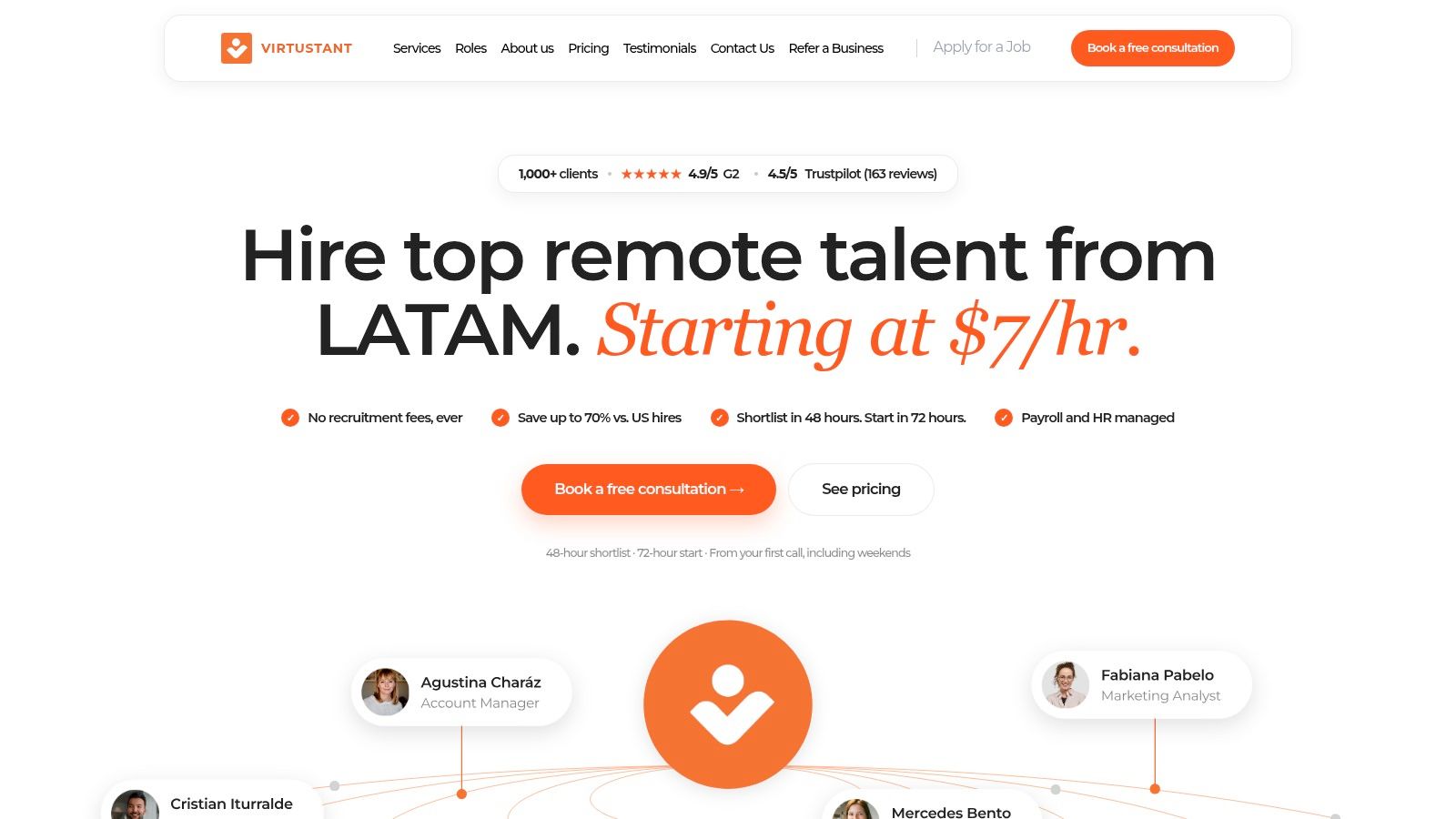
Virtustant is a remote staffing agency that connects U.S. companies with vetted professionals across Latin America for full-time remote roles. It's a useful option when the core challenge isn't identifying types of remote jobs, but finding a qualified person quickly while handling contracts, payroll, HR, and cross-border compliance.
The service supports roles including virtual assistants, executive assistants, customer support specialists, sales development representatives, bookkeepers, marketers, social media managers, designers, developers, project managers, data analysts, and recruiters. That breadth makes it different from a specialist job board. A business can use one managed staffing relationship for administrative, commercial, creative, and technical work instead of coordinating several sourcing channels.
Virtustant says it provides a shortlist within 48 hours, generally presenting three to five pre-vetted candidates with CVs, skills results, and video introductions. Its screening process includes an English interview, cognitive assessment, role-specific skills testing, and experience or reference verification. Candidates are selected for strong English communication and time-zone overlap, which matters when a remote role depends on same-day collaboration with U.S. teams.
When this route makes sense
Choose a managed staffing agency when you're an employer with more applicants than screening capacity, a small team without an internal HR function, or a company that wants nearshore talent without creating a foreign entity. The consolidated hourly invoice and provider-managed local compliance reduce administrative work, while account management gives the client a point of contact after placement.
It's also practical for candidates who want access to full-time remote roles with U.S. companies but don't want to manage every part of international contracting alone. You'll still need a strong CV, reliable communication, role-specific evidence, and the ability to work independently. Vetting can open a door, but it doesn't replace performance during the client interview.
Practical rule: Use managed staffing to reduce hiring friction, not to avoid defining the role. Clear deliverables, working hours, reporting lines, and tool expectations still determine whether the placement succeeds.
Virtustant's all-in pricing starts at $7 per hour, with no separate recruitment, setup, or placement fee stated in its service materials. The company also describes a lifetime replacement guarantee with unlimited replacements. Treat those terms as service details to confirm directly, since pricing, availability, and policy conditions can change. Review the available remote roles when you want to compare the agency's supported job categories and hiring model.
2. Full-Stack Web Developer
Full-stack development is a poor choice for anyone who wants a narrow, predictable role. It suits builders who can move between the interface, server, database, and deployment process without losing sight of the product.
A full-stack developer may create a React or Vue interface, build a Node.js or PHP backend, design the data model, connect third-party APIs, and deploy the application. Remote teams value that range because one person can take a feature from a written requirement to a working release without waiting for several specialists.
Choose this path if you enjoy switching between visible product work and abstract system problems. Framework familiarity is only the starting point. Employers look for database design, authentication, API integration, testing, deployment, version control, and sound judgment about when a simple solution is safer than an elaborate one.
Build a portfolio around complete products rather than isolated screenshots. A small SaaS dashboard, booking system, or internal operations tool can demonstrate a working login flow, documented API, seeded database, error states, and deployment notes. A starter from the Code Market catalog can reduce setup time. Your portfolio must still explain what you changed, why you changed it, and how you tested the result.
Proof and working style
Full-stack work offers autonomy, but claiming expertise in every technology weakens your positioning. Pick a primary stack and show supporting knowledge in deployment, databases, and product delivery. A hiring manager should quickly see what you can build without supervision.
The work produces visible digital output, which makes remote collaboration practical. Context switching is the main cost. You may refine a component, investigate a slow query, fix a failed deployment, and address a security issue in the same day. Disciplined written updates and recorded architectural decisions keep that variety from becoming confusion.
Portfolio evidence: Include a live demo, repository structure, setup instructions, architecture diagram, and a short explanation of one trade-off. Together, these materials show delivery ability more clearly than a list of technologies.
Apply to product companies, agencies, and freelance projects by matching your evidence to the advertised stack. If a role mentions Next.js, PostgreSQL, Docker, and a payment provider, lead with a project using those tools. Keep unrelated languages out of the foreground. The strongest application makes the relevant proof easy to find.
3. Frontend Developer and UI Engineer
Frontend developers turn product requirements and design files into fast, accessible interfaces. Their work includes component architecture, responsive layouts, state management, browser testing, performance tuning, and accessibility. React, Vue, and Next.js are common choices, but the durable skill is understanding how browsers render interfaces and how users move through them.
This is one of the clearest paths for showing work publicly. A recruiter can open a landing page, test a navigation flow, resize the browser, and see whether your implementation feels finished. That visibility helps new developers, but it also creates intense competition. A polished screenshot isn't enough when many applicants can produce one.
Build a portfolio around interfaces that solve different problems. Create a responsive marketing site, a data-heavy dashboard, and an accessible form flow. Demonstrate keyboard navigation, loading states, empty states, error handling, semantic HTML, and mobile behavior. Explain how you reduced unnecessary rendering or handled a difficult design constraint.
The proof employers notice
Frontend candidates often overemphasize visual polish and underexplain engineering decisions. Show both. Include component organization, tests, performance checks, and a short note about browser compatibility. If you use Bootstrap, a React starter, or another template, customize the interaction model and document the work instead of presenting the unchanged package.
The work can feel rewarding because results are visible immediately. It can also become frustrating when designs change late, browser behavior differs, or performance problems appear only on slower devices. A strong UI engineer stays calm when the first implementation doesn't survive real usage.
Hiring signal: Build one interface that looks attractive and one that handles complexity. The second project should include filtering, validation, loading states, accessibility considerations, and a clear component strategy.
For applications, send a short portfolio link with three relevant examples, not a gallery of unrelated experiments. Mention the exact design or development problem you solved. Companies hiring for frontend work want evidence that you can collaborate with designers, interpret incomplete requirements, and maintain a codebase after launch.
4. Backend and API Developer
Backend developers build the systems users rarely see but every product depends on. They design data models, implement business rules, expose REST or GraphQL APIs, manage authentication and permissions, and protect sensitive information. PHP, Python, Java, and Node.js are common choices. Clear reasoning and dependable execution matter more than collecting languages.
Choose this path if you prefer system behavior, careful investigation, and focused work over visual iteration. Your portfolio must make invisible work easy to evaluate. Document the request flow, database decisions, validation rules, authorization boundaries, test coverage, and failure handling.
Build a service with a clear real-world boundary. A booking API, billing module, inventory service, or team permission system demonstrates more judgment than a basic CRUD tutorial. Add rate limiting, input validation, structured errors, migrations, automated tests, and API documentation. A reusable backend script can speed up the first version, but your project earns credibility through the safeguards and decisions you add.
Advantages and pressure points
Remote backend work suits asynchronous collaboration. You can investigate an issue, commit a focused change, and explain the result in writing. The trade-off is prolonged debugging, particularly when a failure crosses application code, a database, and an external service.
Security belongs in the core implementation. Learn password storage, session handling, authorization boundaries, secrets management, dependency updates, and common API abuse patterns. Production roles may also include incident response or on-call work, so state clearly whether your portfolio project includes monitoring, recovery procedures, or only local development.
Use the Code Market backend scripts and SaaS resources for reference points on practical product structures, then audit any code before adopting it. Check dependencies, permissions, configuration, error paths, and license terms. Explain why you rejected or changed a component. That shows stronger engineering judgment than presenting an unmodified script.
Apply with one project that resembles the employer's domain. Include a readable API specification and describe a bug you discovered through testing. Do not claim production readiness unless you can explain monitoring, backups, deployment, and recovery. A focused project with documented trade-offs beats several unfinished endpoints.
5. Mobile App Developer
Mobile developers build for iOS, Android, or both through cross-platform frameworks such as Flutter and React Native. Their work covers interface behavior, local persistence, API integration, notifications, device permissions, performance, release management, and maintenance after publication.
Choose native development if you want deep platform specialization with Swift or Kotlin. Choose Flutter or React Native if you prefer sharing much of the product code across platforms and want to deliver broader prototypes. Neither route removes platform complexity. You still need to understand screen sizes, lifecycle behavior, offline states, permissions, accessibility, and the expectations of each app ecosystem.
A portfolio that survives contact with a device
Build a mobile product with a complete flow, not five disconnected screens. An expense tracker, delivery dashboard, habit tool, or appointment app can show navigation, data persistence, network failure, loading behavior, and thoughtful empty states. Test it on multiple screen sizes and document what you tested.
A mobile starter can shorten the first implementation, especially for authentication, navigation, or common layouts. Explore Flutter libraries and development resources to identify useful building blocks, then demonstrate your own integration work. Your evidence should include a short video, install instructions, test account details, and notes about decisions that affect battery life, performance, or privacy.
Mobile work has visible outcomes and a wide client base, but releases bring operational responsibility. App review can delay launches, operating-system changes can break behavior, and some bugs appear only on physical devices. Keep a maintenance plan in your portfolio, including how you'd handle crash reports and dependency updates.
For applications, state whether you can work with native tools, cross-platform frameworks, or both. Point to a published app if you have one, but a well-tested private demo can still work if the reviewer can access it easily. Employers need confidence that you can finish the release process, not just create a prototype.
6. WordPress Developer and Specialist
WordPress specialists customize themes, extend plugins, build WooCommerce stores, improve performance, and maintain sites after launch. The role ranges from page-builder configuration to serious PHP development involving hooks, custom post types, database queries, integrations, and security controls.
It's a practical entry point because clients need many different levels of help. A small business may need a responsive theme adjusted and a form repaired. An agency may need a custom block, a WooCommerce workflow, or a migration that preserves URLs and content. A developer who can explain the difference between a quick configuration and maintainable custom code can serve both markets.
Create portfolio projects that show business outcomes without inventing performance figures. Build a WooCommerce catalog with custom product fields, a membership site with permission rules, and a content site with a custom block or post type. Include staging instructions, backup procedures, plugin decisions, and a list of known limitations.
The less glamorous work matters
WordPress maintenance is where many clients need the most help. Plugin conflicts, outdated themes, broken updates, spam, slow queries, and security vulnerabilities can turn a simple site into a recurring support burden. Learn how to use staging environments, backups, logging, access controls, caching, image optimization, and safe update processes.
Code Market's catalog includes WordPress themes, plugins, WooCommerce integrations, and vertical-specific assets. Those resources can help you prototype a client solution faster, but don't promise customization until you've checked the code quality, compatibility, licensing, and update path.
The trade-off is price pressure. Many providers compete on low-cost implementation, so specialization is your defense. Focus on a niche such as WooCommerce operations, membership sites, multilingual publishing, or performance and security maintenance. Show before-and-after code decisions, not just attractive homepages.
Your application or proposal should state what you'll maintain, what the client must provide, and how you'll handle backups and rollback. That clarity separates a dependable WordPress specialist from someone who only installs themes.
7. Game Developer and Unity Specialist
Game developers create interactive systems with engines such as Unity and Unreal. The work combines programming, game physics, animation, input handling, level design, audio integration, performance optimization, and player feedback. A Unity specialist commonly works with C#, scenes, prefabs, physics components, asset pipelines, and platform-specific builds.
This path suits people who enjoy experimentation and visible results. It also demands patience. A playable concept can require many iterations before movement feels right, the interface becomes understandable, or performance remains stable on the target device.
Build a playable proof
A portfolio should let someone play the work quickly. Create a focused prototype with a clear objective, responsive controls, a restart flow, and basic feedback. Then explain the technical choices. Did you use object pooling, a finite-state machine, custom collision handling, or a particular approach to save data?
Unity templates and source projects can accelerate prototyping. Browse Unity game templates and development resources, then replace enough of the original structure to show your own design and engineering decisions. Document imported assets, modified systems, performance testing, and any third-party dependencies.
The advantages are creative ownership and several possible routes to income, including studio employment, contract development, asset creation, and independent releases. The risks are equally clear. Projects can take a long time, hardware requirements can expand, platform optimization can become specialized, and revenue from an independent game is difficult to predict.
Remote studios also need excellent written communication because visual and gameplay decisions can be hard to review asynchronously. Include short gameplay clips, issue notes, build instructions, and a development log. If you apply to a studio, tailor the portfolio to its platform and genre rather than sending one general reel.
8. SaaS Developer and Technical Co-Founder
A SaaS developer builds software that customers access continuously, usually through an account-based web application. The work combines product discovery, full-stack implementation, billing, authentication, permissions, analytics, monitoring, customer support, and iteration. A technical co-founder carries those responsibilities while also helping decide what the business should build.
This route is for people who want product ownership, not just assigned tickets. You'll need to interview users, narrow the problem, choose a viable first release, and resist building features that nobody needs. Technical ability gets the product online, but product judgment determines whether anyone returns.
A credible project should show a complete commercial loop. Build a narrow tool with onboarding, a useful core action, account management, billing or a simulated subscription flow, error reporting, and a support channel. Add analytics that answer a specific product question, such as whether new users complete the first workflow. Explain which features you postponed and why.
Ownership comes with ongoing work
SaaS can support a global customer base and recurring revenue, but early results are uncertain. You'll spend time on support requests, documentation, failed payments, data migrations, uptime, and security. The product doesn't become passive because customers access it through a browser.
Use a Code Market SaaS script or starter when it removes routine setup, but inspect the authentication, billing, permissions, and data model before relying on it. Replace placeholder content, test edge cases, and document every significant customization. An unchanged template shows procurement. A thoughtfully adapted product shows engineering judgment.
For applications, frame yourself around a problem and an operating model. Explain how you prioritize customer feedback, measure reliability, and decide whether a feature belongs in the next release. If you're seeking co-founder work, show that you can discuss trade-offs in business terms as well as technical ones.
9. Freelance Template and Theme Developer
Template and theme developers create reusable products for common web, mobile, and design needs. Their customers may be developers, agencies, site owners, or small businesses that need a strong starting point without commissioning a complete custom build.
This path bridges design and engineering. You must understand layout, typography, responsive behavior, component reuse, documentation, customization boundaries, and version management. A product that looks good but breaks when a buyer changes content will generate support problems rather than durable sales.
Choose a narrow product category and build it as if a stranger will install it. A React admin dashboard, WordPress business theme, mobile interface kit, or Next.js landing system should include sensible defaults, clear customization points, responsive states, and useful documentation. Test the package from a clean environment.
Reusable work still needs maintenance
The attraction is scale. One product can serve multiple customers, and you can work on products alongside client engagements. The trade-off is delayed and unpredictable revenue. Popular categories can be crowded, while framework updates and browser changes create ongoing maintenance.
Use the Code Market guide to website templates and custom design to sharpen how you explain the boundary between reusable products and bespoke work. That distinction belongs in your sales page and documentation. Buyers need to know what the template includes, what requires customization, and what support you provide.
Your portfolio should include a product page, preview, documentation sample, changelog, and a short installation video. Employers and clients will look for evidence that you can think beyond the first build. Show naming conventions, accessibility considerations, update discipline, and how you respond to a reasonable customization request.
This is a strong path for independent developers who like packaging solutions. It's a weaker fit if you dislike documentation, customer questions, or maintaining older versions.
10. Technical Writer and Developer Educator
Technical writers make complex products usable. They create API references, setup guides, tutorials, troubleshooting pages, code examples, release notes, videos, and courses. Developer educators perform similar work while placing more emphasis on teaching, community engagement, and learning outcomes.
The role rewards people who can move between code and language. You must test the commands you publish, identify the reader's assumptions, structure information logically, and update content when the product changes. Fluency isn't enough. Technical credibility comes from accurate examples and honest explanations of limitations.
Build a documentation portfolio around a real or well-designed fictional product. Include a quickstart guide, reference page, troubleshooting article, tutorial, and changelog entry. Add runnable examples and state the environment clearly. A reader should be able to follow the guide without guessing which version, credentials, or dependencies you used.
Communication is the deliverable
Remote technical writing is highly compatible with asynchronous work because the output is written and reviewable. It still requires collaboration with engineers, product managers, support teams, and users. You'll need to ask precise questions, manage review cycles, and resolve disagreements about what the product does.
A useful educator portfolio can include a short screencast, a framework tutorial, or a workshop outline. Choose a subject you can demonstrate rather than summarize. If you write about React, Flutter, WordPress, or an API, show the code, test it, and explain the failure modes.
The benefits include several employment and freelance routes, but content revenue can be uncertain. Framework updates can also make older work inaccurate. Build a maintenance habit by adding version notes, review dates, and a process for reporting errors.
Apply with a writing sample that resembles the employer's product. Don't send only general blog posts if the role involves API documentation. Show that you can help a user complete a task, diagnose a problem, and understand a technical choice.
11. DevOps Engineer and Cloud Architect
DevOps engineers connect development with reliable operations. They design deployment pipelines, manage cloud infrastructure, write infrastructure as code, configure containers, monitor systems, improve observability, and implement security controls. Cloud architects make broader decisions about environments, service boundaries, resilience, cost management, and governance.
This path suits people who like systems, automation, and failure analysis. It also carries more operational pressure than many other types of remote jobs. A production incident can arrive outside normal working hours, and a small configuration error can affect customers, data, or availability.
Build a reproducible environment instead of a collection of cloud screenshots. Use Docker, a CI/CD pipeline, Terraform or another infrastructure-as-code tool, structured logging, health checks, alerts, and a documented rollback path. Deploy a small application and write a runbook that explains what someone else should do when a service fails.
Reliability is the portfolio
Cloud providers such as Amazon Web Services, Google Cloud, and Microsoft Azure offer broad infrastructure ecosystems. You don't need to present every service as a skill. Choose a practical stack and explain why you selected it, what you automated, how you secured it, and how you would recover from a bad deployment.
Remote collaboration depends on precise incident notes and clear handoffs. Tools such as Microsoft Teams, Slack, and Zoom support different parts of distributed work, but the tool matters less than the habit of recording context. A good handoff includes symptoms, scope, current impact, actions taken, and the next decision.
The benefits are portability across products and strong responsibility for business-critical systems. The drawbacks include a steep learning curve, on-call disruption, security consequences, and constant change in cloud services. Don't apply for senior infrastructure work with a portfolio that only shows a static server. Show automation, observability, security, and recovery.
11 Remote Job Roles: Side-by-Side Comparison
| Item | Implementation complexity | Resource requirements | Expected outcomes | Ideal use cases | Key advantages |
|---|---|---|---|---|---|
| Virtustant | Low for client (provider-managed hiring) | Minimal internal HR; budgeted hourly rate; no local entity needed | Rapid placement of vetted nearshore hires; payroll/compliance handled | Fast scaling of remote teams, nearshore full‑time roles | End-to-end hiring + compliance, fast shortlists, lifetime replacements |
| Full-Stack Web Developer | High (frontend + backend mastery) | Skilled developer, dev tools, hosting, CI/CD | End-to-end product delivery, deployable web applications | Startups building MVPs or SaaS, solo projects requiring full ownership | Versatility to build complete products; reduced coordination overhead |
| Frontend Developer / UI Engineer | Medium–high (complex UI/UX, performance) | Design assets, browsers/devices for testing, JS frameworks | Polished, responsive, accessible user interfaces | UI/UX-focused products, component libraries, feature frontends | Strong UX/visual results, faster iteration, accessibility expertise |
| Backend / API Developer | High (architecture, data integrity) | Databases, servers/cloud, security tooling, API frameworks | Scalable, secure server logic and APIs | Data-driven services, integrations, API-first platforms | Reliable performance, security, complex business logic handling |
| Mobile App Developer | Medium–high (platform specifics, testing) | Device testing, SDKs, app store accounts, platform tooling | Native or cross-platform mobile apps ready for stores | Mobile-first products, consumer apps, cross-platform solutions | Platform expertise, tangible product presence, cross-platform options |
| WordPress Developer / Specialist | Medium (ecosystem & customization) | WP hosting, themes/plugins, PHP skills | CMS sites, WooCommerce stores, maintainable sites | Content sites, small/medium businesses, ecommerce stores | Large market, fast deployments, abundant extensions and themes |
| Game Developer / Unity Specialist | High (engines, graphics, performance) | Powerful hardware, game assets, engine licenses, testing devices | Interactive games or simulations for target platforms | Indie games, interactive experiences, monetized game projects | Creative output, multiple monetization channels, strong tooling ecosystems |
| SaaS Developer / Technical Co-Founder | Very high (product + business + scale) | Cloud infra, billing/payments, analytics, cross-functional team | Recurring‑revenue product, scalable platform | Founders building subscription products, startups seeking PMF | Ownership of product and revenue, high upside potential |
| Freelance Template / Theme Developer & Designer | Medium (design + reusable code) | Design tools, marketplaces, documentation, demo content | Sellable templates/themes, passive licensing income | Niche templates, marketplace distribution, productized services | Passive income potential, scalable product reuse, low ongoing support |
| Technical Writer / Developer Educator | Low–medium (domain expertise + writing) | Access to code examples, publishing platforms, recording tools | Clear docs, tutorials, courses, improved developer onboarding | API docs, tutorials, course creation, developer experience roles | Growing demand, multiple monetization paths, builds credibility |
| DevOps Engineer / Cloud Architect | Very high (infrastructure, reliability) | Cloud platforms, IaC, containers, monitoring and security tools | Automated deployments, resilient scalable infrastructure | Scaling SaaS, high-availability systems, complex deployments | High market value, operational reliability, cost and performance optimization |
Turn a Remote Job Category Into a Workable Plan
The right remote path depends on the work you want to repeat, not the title that sounds most impressive. Choose full-stack development if you enjoy owning a product from interface to database. Choose frontend work if you want visible outcomes and can develop a strong eye for interaction quality. Choose backend development if you prefer systems, data, and concentrated problem-solving. Mobile and game development suit people who enjoy device-specific or interactive products, while WordPress can provide a practical route through client work and maintenance.
Your working rhythm matters just as much. Technical writing, backend development, template production, and some cloud tasks can support long periods of asynchronous focus. Customer-facing staffing roles, SaaS ownership, freelance implementation, and account-oriented work require more responsiveness. DevOps can involve on-call work. Game development can involve long creative cycles. Be honest about whether you want predictable assignments, client variety, product ownership, or operational responsibility.
Remote work is also a proof problem. Employers can't rely on office visibility, so your portfolio must reduce uncertainty. A finished project with a live demonstration, readable documentation, and a clear explanation of decisions gives a hiring manager something concrete to evaluate. A long list of courses and technologies does not.
Use this sequence:
- Select one primary category: Choose the path that matches your existing strengths and preferred working rhythm. Don't apply broadly across unrelated roles while your evidence remains thin.
- Choose a narrow specialization: Combine a role with a stack or market. Examples include WordPress and WooCommerce, Flutter apps for operational teams, React dashboards, PHP API development, Unity mobile games, or developer documentation for cloud products.
- Create two or three demonstrable projects: Build different kinds of proof. One project can show implementation, another can show maintenance or testing, and a third can show communication, documentation, or product judgment.
- Document the decisions: Explain the problem, constraints, architecture, tools, trade-offs, testing approach, and remaining limitations. Employers want to know how you work when the requirements aren't perfectly clear.
- Match applications to workflow: Tailor your CV, message, and portfolio to the employer's tools, communication habits, deployment process, and business model. Put the most relevant project first.
- Track responses: Record which roles produce interviews, which portfolio links receive attention, and where employers ask follow-up questions. Use that evidence to improve your specialization and presentation.
Code Market can help you accelerate development with templates, scripts, themes, mobile starters, and game resources. Use those assets as starting points, not as substitutes for skill. Customize the product, inspect dependencies, test the important flows, replace placeholder content, document the changes, and add original problem-solving. An unchanged starter may prove that you can install software. A tested and thoughtfully adapted solution proves that you can deliver.
If you're an employer, define the output before choosing the hiring route. A managed nearshore placement may be right for recurring operational work, while a specialist contractor may be better for a complex infrastructure migration or product build. Set expectations around time-zone overlap, written updates, meetings, access, security, and ownership of deliverables.
Finally, verify current salary and rate information for your location, seniority, employment type, and specialization before negotiating. Start with one credible category, build evidence that mirrors real work, and apply with a clear explanation of the problem you can solve. That approach is more reliable than chasing a generic list of the “best” remote jobs.
This article was inspired by Outrank.