Your team ships an AI feature through a model router, and everything works until a request hits a rate limit, a model disappears, or a client asks why yesterday's usage cost more than expected. Changing the endpoint looks easy. Reproducing the same model behavior, billing visibility, and fallback rules is the harder part.
The best OpenRouter alternatives solve different problems. A managed gateway can preserve provider-neutral access without adding infrastructure work. A self-operated gateway lets you control credentials and routing policies. A direct inference vendor removes the aggregation layer, but it doesn't replace access to independent providers.
That distinction matters more than catalog size. If your application switches between Claude, Gemini, and open-weight models, moving to a vendor that serves only its own catalog changes your architecture, not just your API configuration.
- Managed gateways fit teams that want shared access, routing, and operational controls without running a proxy.
- Self-operated gateways fit teams prepared to own deployment, security, and availability.
- Direct inference or model vendors fit applications whose requirements already match a particular catalog.
The options below are judged on that basis: what they route, how billing works, what changes during migration, and which operational responsibility stays with your team. An API-compatible interface helps, but it doesn't guarantee compatible tool calls, streaming events, usage fields, or media workflows.
Table of Contents
- 1. UberLLM
- 2. Vercel AI Gateway
- 3. Cloudflare AI Gateway
- 4. LiteLLM
- 5. Portkey
- 6. Helicone AI Gateway
- 7. Together AI
- 8. Fireworks AI
- 9. DeepInfra
- 10. Google Gemini API
- 11. GroqCloud
- How the ten OpenRouter alternatives differ on model coverage, pricing approach, and API compatibility
- Matching the Gateway to Your Stack and Risk Tolerance
1. UberLLM

Category: Managed marketplace gateway. UberLLM connects API users with third-party model providers and sellers offering unused inference capacity. It's a closer architectural substitute for OpenRouter than a single inference vendor because it consolidates access across model families and sellers.
Its appeal is the combination of text and media access under a shared endpoint and prepaid balance. The catalog spans families such as Claude, GPT, Gemini, DeepSeek, FLUX, Kling, and Veo, with OpenAI-compatible and Anthropic-compatible interfaces for supported integrations.
Where the marketplace approach helps
UberLLM selects the cheapest healthy seller for the requested model and reroutes when a seller becomes slow or unavailable. That can simplify applications that would otherwise maintain separate provider integrations, balances, and availability checks.
Text streaming and asynchronous media need different application logic, though. UberLLM supports media task tracking, polling, and webhooks, so a video-generation feature should persist task identifiers rather than treat every request like a synchronous chat completion.
- Integration benefit: Existing compatible SDK patterns can remain, while credentials, endpoint configuration, and model identifiers change.
- Billing distinction: Usage comes from prepaid credit, with no separate request fee according to its stated terms. Failed requests or generations aren't charged, while card funding carries a disclosed checkout fee.
- Operational constraint: Seller availability and marketplace pricing still need validation against your exact models and traffic.
Choose UberLLM when you want consolidated multimodal access and marketplace routing, not merely a cheaper chat endpoint. Before committing, test streaming interruptions, webhook retries, seller substitutions, and refund behavior. Its stated encryption, scoped keys, and non-training policy are useful starting points, but they don't replace reviewing upstream processing and contractual obligations.
2. Vercel AI Gateway
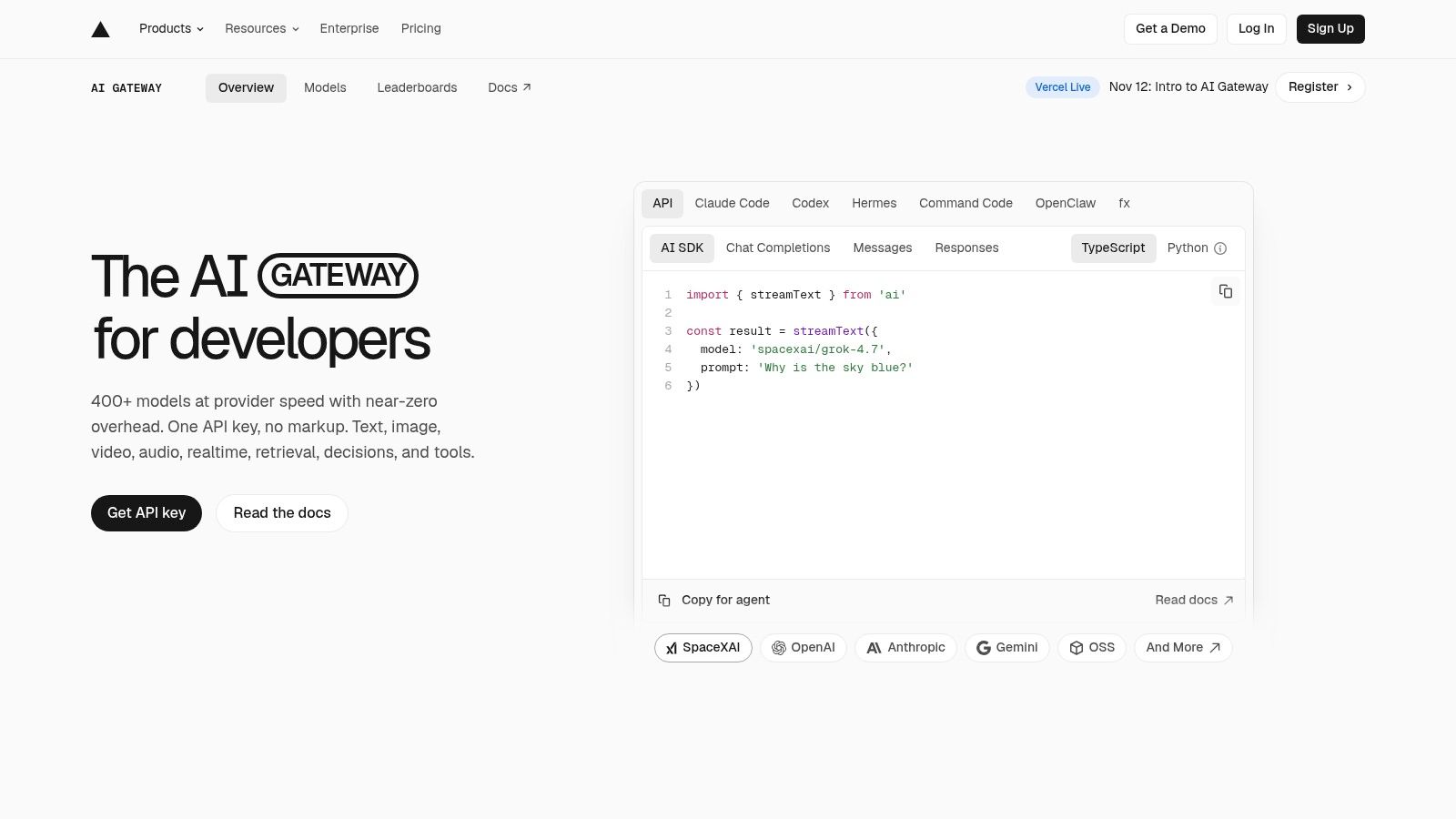
A Next.js application already using the Vercel AI SDK has a different migration problem from a backend running custom provider adapters. For the former, Vercel AI Gateway is a natural managed candidate because model access, provider fallbacks, and usage reporting sit close to the existing integration.
Category: Managed gateway. It provides access across providers rather than restricting you to a single inference vendor. Its supported integration paths include OpenAI-compatible requests, Anthropic Messages, OpenResponses, and the AI SDK.
Best when the SDK is already part of your stack
Vercel states that gateway token pricing follows provider-list pricing without token markup. Still, compare the complete account terms rather than assuming that every billing configuration, model, and limit behaves identically.
The migration can be small for supported SDK calls, but keep model selection in configuration. Test structured output, tool execution, cancellation, and usage reporting before treating an endpoint change as finished.
Migration rule: API compatibility reduces adapter work. It doesn't prove that every model supports the same application behavior.
You'll need a Vercel account even if the application runs elsewhere. Choose it for managed provider-neutral access with strong AI SDK alignment, but skip it when running the gateway inside your own infrastructure is a firm requirement.
3. Cloudflare AI Gateway
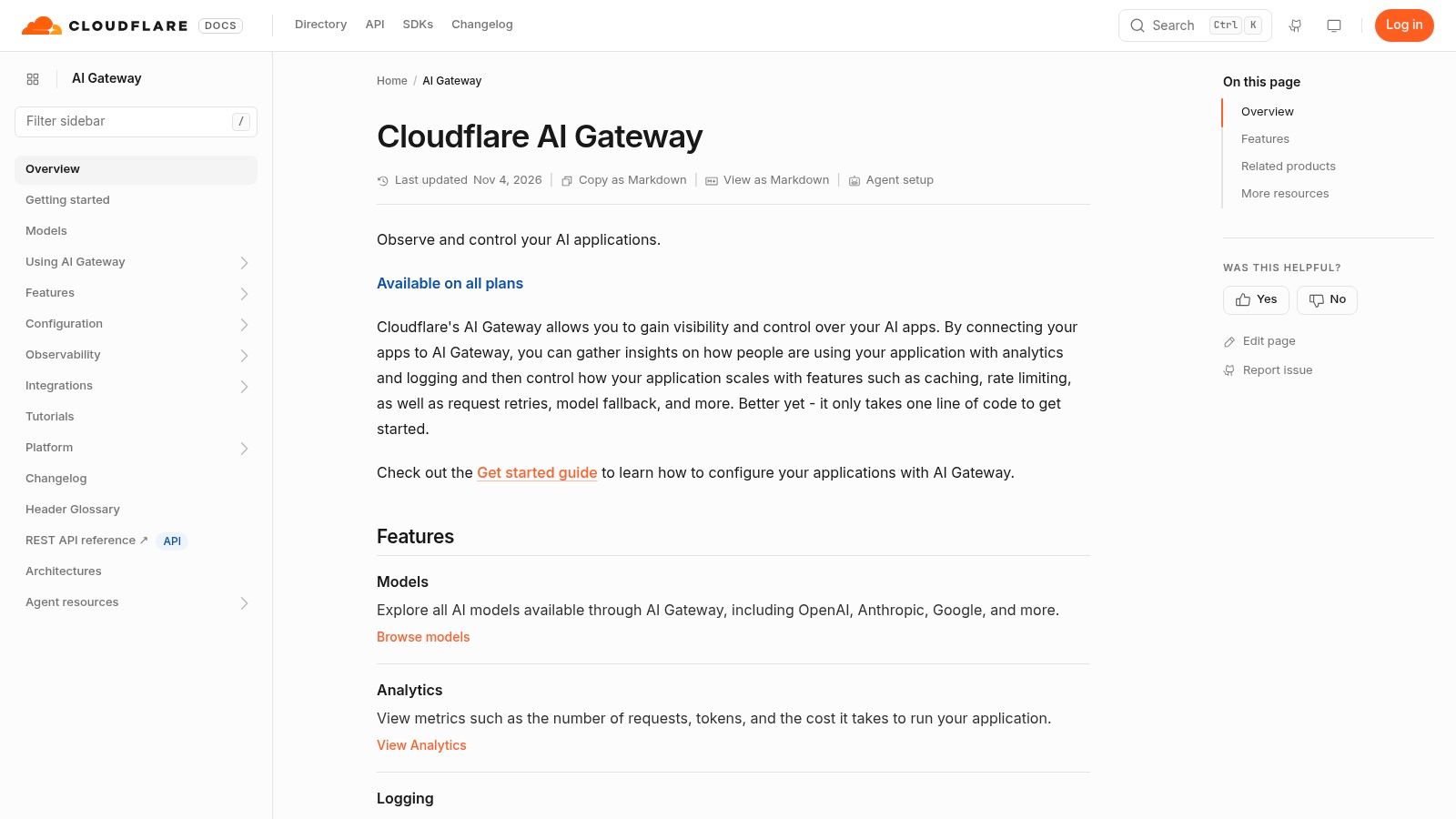
Category: Managed gateway and control layer. Cloudflare AI Gateway makes sense when you already have provider relationships but lack consistent analytics, caching, retries, and rate limits.
That's a different purchase from a model marketplace. Cloudflare can route requests to third-party providers and Cloudflare-hosted inference, but model access and billing depend on your configuration. Don't assume adding the gateway automatically consolidates every provider charge.
Its operational controls are the main reason to shortlist it. Request, token, cost, and error metrics help separate an expensive model choice from excessive retries or unexpectedly long outputs.
- Caching: Useful for identical supported inputs, not a universal discount for prompts that merely resemble one another.
- Retries and timeouts: Configure them around your application's deadline, rather than allowing retry chains to consume the entire response budget.
- Rate limiting: Apply limits by application or tenant so a noisy customer doesn't exhaust shared capacity.
Cloudflare is a credible provider-neutral routing layer, especially for teams already operating in its ecosystem. The constraint is configuration responsibility: you still need to understand provider credentials, supported routes, billing arrangements, and logging.
Choose it to add controls around inference traffic. If your primary need is buying every model through a shared prepaid balance, verify the supported unified-billing routes before migrating.
4. LiteLLM
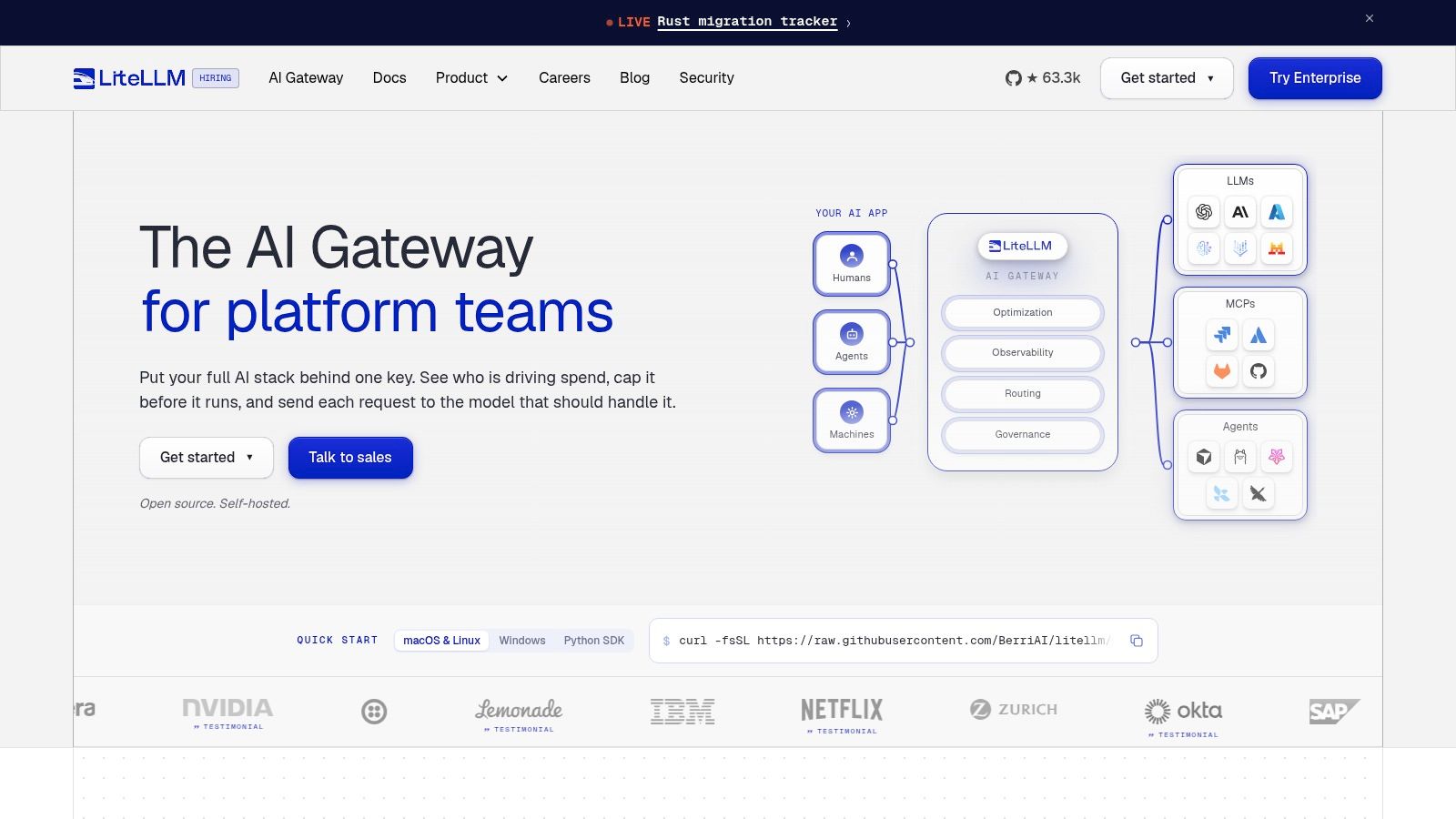
Category: Self-operated gateway. LiteLLM is the clearest fit when provider-neutral access must run under your team's control. You configure provider credentials, deploy the proxy, and expose a consistent interface to applications.
Its routing, retries, fallbacks, virtual keys, budgets, and cost tracking address the same coordination problems a hosted router handles. The difference is ownership: you operate the component that holds provider credentials and mediates production traffic.
Control comes with an on-call obligation
The open-source version doesn't require a software subscription to run, but infrastructure and engineering aren't free. Plan for deployment updates, secret rotation, configuration review, observability, and recovery when a dependency fails.
Keep upstream credentials out of application repositories. Issue virtual keys to individual services, assign budgets deliberately, and test what happens when shared state or a provider endpoint becomes unavailable.
- Strong fit: Agencies separating client budgets, platform teams standardizing provider access, and organizations requiring private deployment.
- Weak fit: Small teams adopting a gateway specifically to stop maintaining infrastructure.
- Important boundary: A self-hosted proxy doesn't make upstream model inference self-hosted.
LiteLLM is a genuine OpenRouter substitute for provider abstraction, but not for managed operations or automatic access to provider accounts. Choose it when owning routing policy is worth the maintenance burden, and assign a named operational owner before production rollout.
5. Portkey
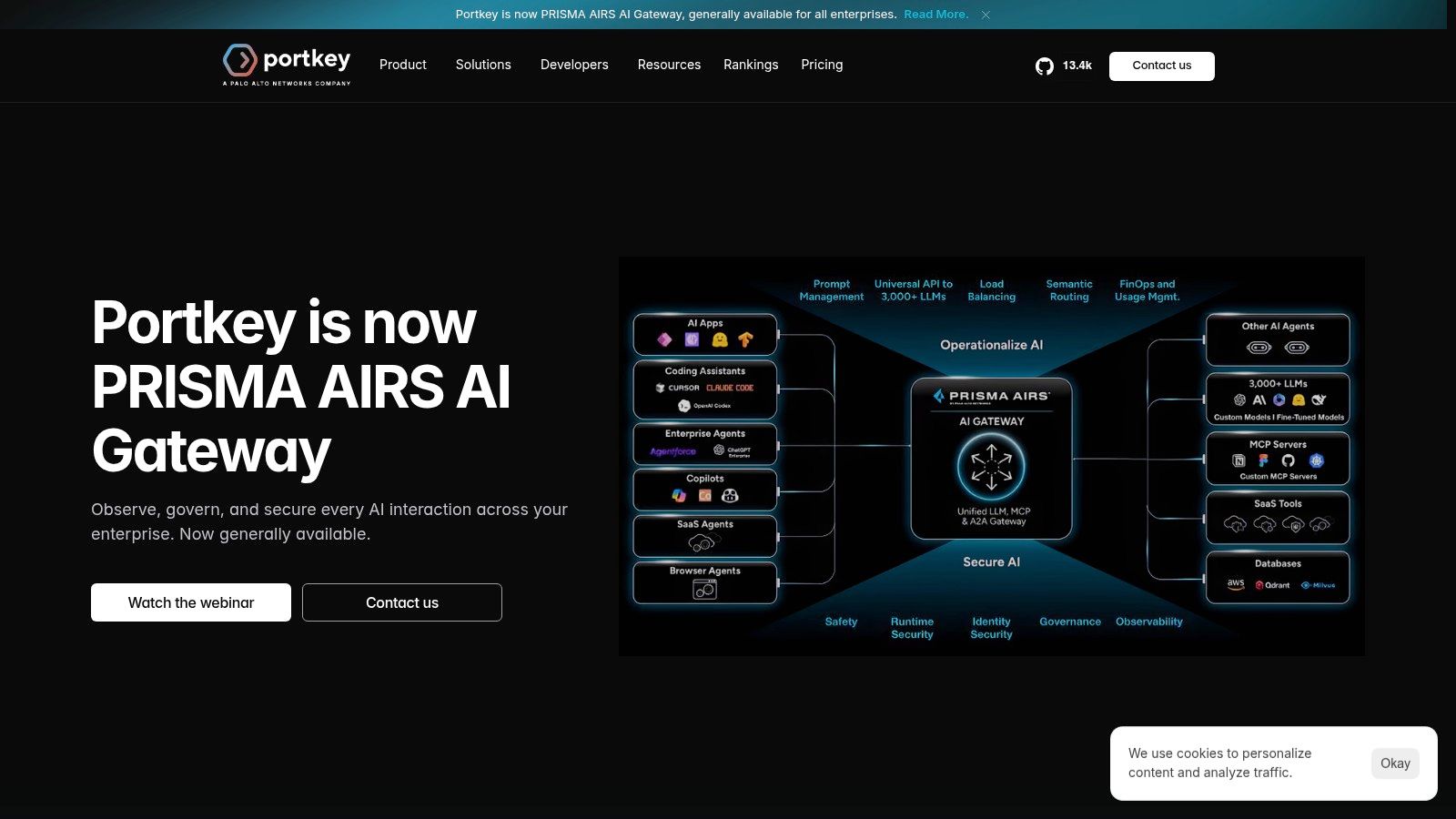
An agency with several AI applications may need to answer more than which model handled a request. It may need the prompt version, tenant metadata, retry history, and an alert when failure rates change.
Category: Managed gateway with self-hosting options. Portkey combines multi-provider routing with observability, prompt management, caching, and governance. Its value is strongest when those controls replace separate tooling or custom engineering.
The gateway supports fallback routing, load balancing, and retries. Request logs, traces, metadata, and alerts help investigate failures, while prompt templates and versioning support controlled changes.
Buy the controls you'll actually use
Portkey offers an evaluation path, but its free plan isn't intended for production workloads. Production operations and advanced governance can require paid tiers, while deployment and enterprise requirements may need a sales discussion.
- Useful for platform teams: Shared routing policy and traceable prompt changes across applications.
- Useful for agencies: Metadata that separates client traffic and makes incident investigation less ambiguous.
- Potential overkill: A small feature that needs little beyond model access and basic usage totals.
Portkey matches the provider-neutral requirement, but its broader control plane is the reason to pay attention. During evaluation, trace a failed tool call through retries and fallback, then check whether an engineer can identify the cause without reconstructing events from application logs.
6. Helicone AI Gateway

Category: Managed gateway with a self-hosting path. Helicone AI Gateway is worth evaluating when debugging and cost attribution matter as much as routing. It combines a unified model interface with logging, traces, usage analytics, load balancing, and failover.
The useful question isn't whether a dashboard displays tokens. It's whether you can connect a costly request to the user action, agent loop, retry, or model selection that caused it.
For comparison, OpenRouter's usage-accounting documentation describes response-level input and output counts, credit cost, cached tokens, and reasoning tokens where applicable. Preserving that accounting detail should be a migration requirement, not an optional improvement.
Logging helps only when you can connect a provider request to the application operation that triggered it.
Helicone's storage and usage charges can affect total cost, so compare observability spending alongside inference spending. Review retention and payload capture before logging source code or customer information.
If your immediate problem is an AI coding budget that runs out early, use request traces to distinguish expensive models from repeated context submission and runaway loops. Choose Helicone when those investigations are recurring engineering work, not when you only need an inexpensive API endpoint.
7. Together AI
Together AI isn't a neutral gateway across commercial model providers. Together AI is a direct inference provider whose open-weight model catalog can nevertheless replace the part of OpenRouter your application uses.
Category: Direct inference vendor. Its OpenAI-compatible API supports hosted serverless inference, with reserved or dedicated capacity options for workloads that need a different serving arrangement.
Say your SaaS uses an open-weight model for extraction and another for code generation. If Together serves suitable models, direct integration can remove an intermediary without forcing your team to provision inference hardware.
Catalog fit comes before endpoint compatibility
Together publishes per-model serverless pricing, including cached-token rates for some models. Compare the specific model and serving mode, not a generic claim that direct inference is cheaper.
- Serverless advantage: Start without provisioning GPUs or operating the inference runtime.
- Capacity decision: Reserved or dedicated serving introduces utilization and capacity-planning questions.
- Replacement limit: Models outside Together's catalog still require another integration.
Its offerings also extend beyond text, but each modality needs its own compatibility checks. Choose Together when its catalog covers your application, especially if you want a path from serverless experimentation to more deliberate capacity planning.
Keep a provider adapter in your application if portability matters. Direct access simplifies the request path, but your team must implement cross-vendor fallback elsewhere.
8. Fireworks AI
A routing gateway isn't always the missing component. If your next step is deploying a customized model rather than comparing commercial APIs, Fireworks AI addresses a more relevant problem.
Category: Direct inference and model-deployment vendor. It combines hosted inference for open models with customization, fine-tuning, and deployment options. Serverless access avoids initial infrastructure setup, while dedicated and on-demand deployments offer different capacity arrangements.
That makes it a conditional OpenRouter replacement. It can replace access to models your application needs, but it doesn't preserve a provider-neutral commercial catalog.
- Customization fit: Useful when you need to serve a post-trained or custom model rather than only select a public model identifier.
- Integration fit: Advertised OpenAI- and Anthropic-compatible paths can reduce adapter work for supported operations.
- Operating constraint: Dedicated deployments require decisions about capacity, utilization, and serving availability.
Don't select Fireworks on a blanket performance promise. Test your prompt lengths, output sizes, structured responses, concurrency, and cancellation behavior against the intended serving mode.
Its published serverless and GPU-deployment pricing supports a concrete comparison, but those are different cost models. Choose Fireworks when model customization and serving control matter more than access to unrelated providers, and confirm that your chosen model is available in the deployment mode you intend to use.
9. DeepInfra
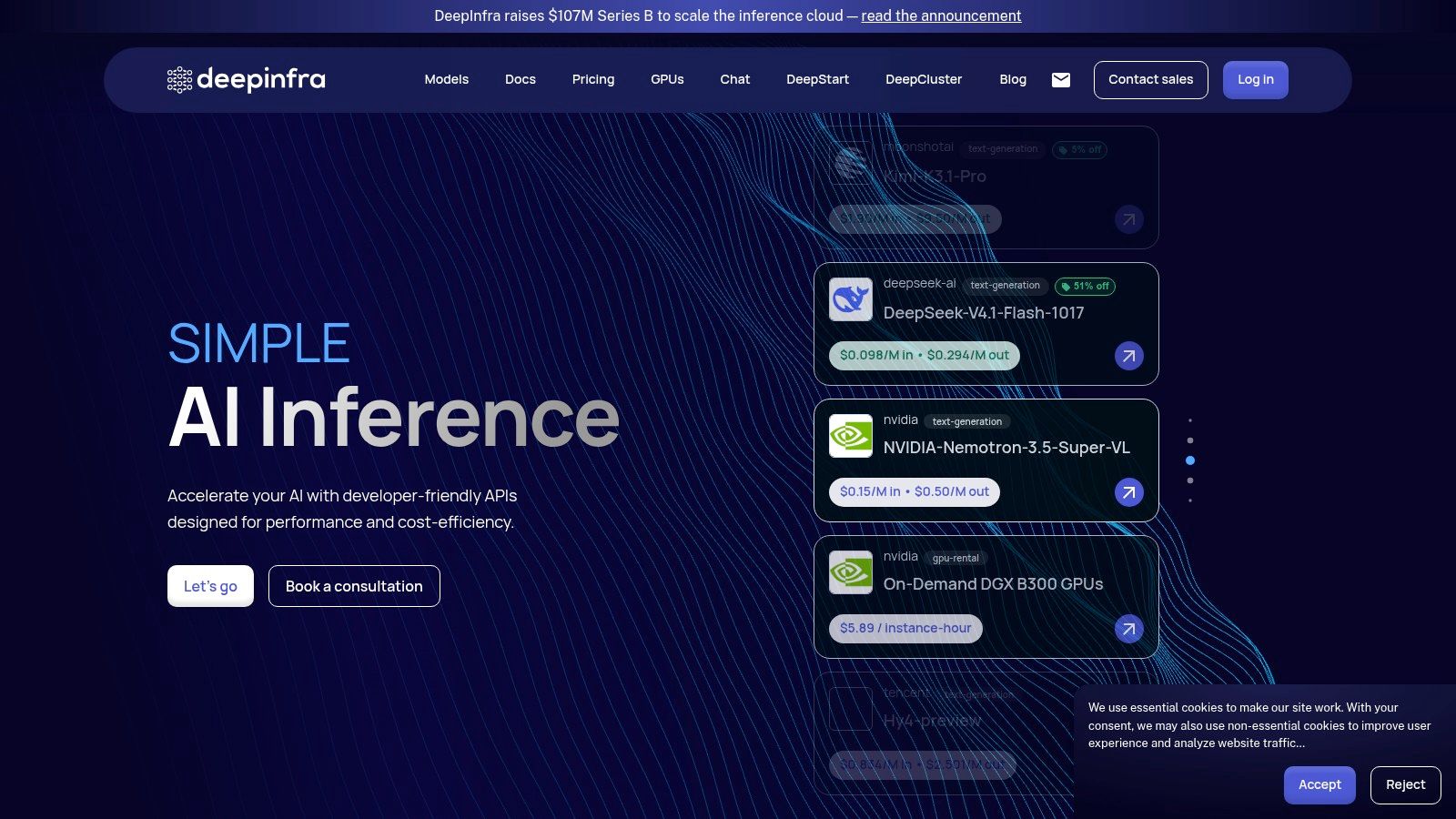
Category: Direct inference vendor. DeepInfra is a practical candidate when you already know which hosted models you need and want usage-based access without operating the serving infrastructure.
Its distinguishing decision is request priority, not provider neutrality. Supported models offer Standard, Priority, and Flex tiers, allowing you to assign different serving expectations to interactive and delay-tolerant work.
A background tagging job and a customer-facing assistant shouldn't necessarily use the same scheduling tier. The tagging job can tolerate delays that would make the assistant feel broken.
Match the tier to the deadline
Flex is positioned below base pricing for eligible requests, but requests may be slower or unavailable. Priority schedules ahead of standard traffic at a higher cost, so it needs a workload-specific justification rather than a blanket application setting.
- Background processing: Consider Flex when jobs can wait, retry, or resume later.
- Interactive requests: Compare Standard and Priority using completed responses within your application's deadline.
- Custom deployments: Dedicated GPU instances provide another option, but require capacity planning.
DeepInfra doesn't replace cross-provider routing. Choose it when its model catalog and scheduling options match your workloads, and keep tier selection explicit in configuration.
Measure queueing separately from generation time. Otherwise, you won't know whether to change priority, reduce output length, or select a different model.
10. Google Gemini API
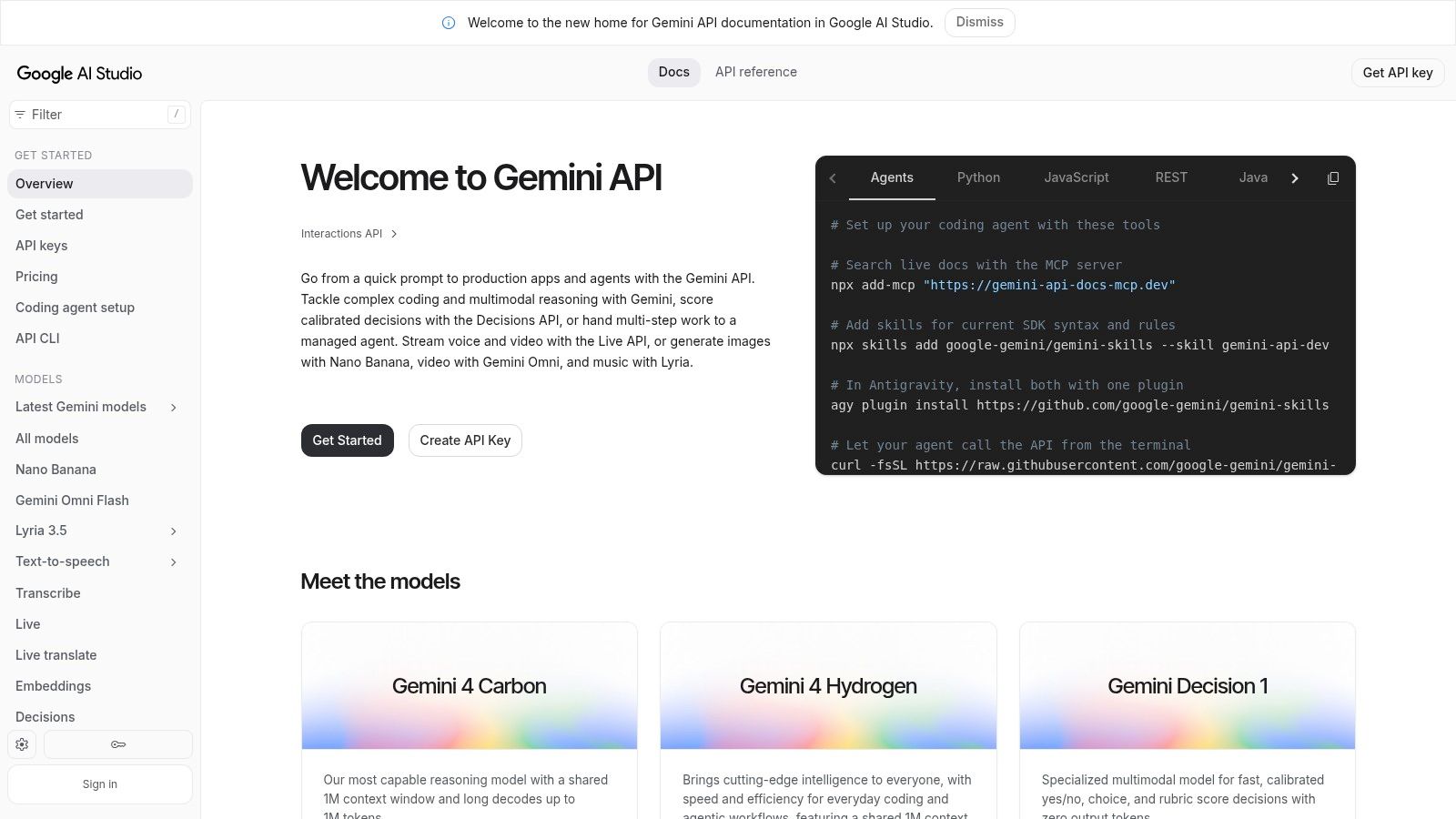
If your application already relies primarily on Gemini, routing every request through an aggregator may add a dependency you don't need. The Google Gemini API provides direct access to Google's models, with AI Studio available for experimentation.
Category: Direct model vendor. Its text, image, audio, and real-time offerings depend on the selected model. Eligible models have free and paid access tiers, subject to their documented limits and terms.
The main benefit is direct alignment with Gemini's capabilities and tooling. The main limitation is equally clear: this isn't provider-neutral access, and moving here won't preserve routes to other model companies.
Data-handling caution: Review the terms for the selected access tier. A free experiment and a production integration shouldn't automatically share the same data policy.
Use the Code Market guide to free AI tools for broader discovery, but evaluate production suitability separately. Free access can support prototyping without satisfying your capacity, privacy, or continuity requirements.
Choose the Gemini API when Gemini is a deliberate model commitment. Test media input handling, real-time behavior where relevant, tool calls, and billing dimensions before removing your existing gateway path, and retain an application-level abstraction if future provider switching is likely.
11. GroqCloud
Response speed matters for conversational interfaces, but a fast endpoint is useful only if its available models perform the task correctly. GroqCloud is a direct inference API built around Groq's hardware and supported catalog.
Category: Direct inference vendor. It offers free development access and paid usage tiers, with documented spend controls and higher capacity available through paid access.
GroqCloud belongs on a shortlist for latency-sensitive applications, not on an unconditional list of equivalent routers. Its catalog is the constraint: you can't assume your current model is available just because the API integration looks familiar.
Test the complete interaction
For an assistant, evaluate tool-call correctness and response quality alongside speed. For voice applications, measure transcription, model response, and speech generation together, because improving one stage doesn't guarantee a responsive conversation.
The speech-to-text API integration guide is useful when defining that wider voice pipeline. Keep audio handling and inference measurements separate so you can identify the actual bottleneck.
- Development fit: Free access can support experiments within account and model limits.
- Production fit: Confirm paid-tier capacity and set spend limits before sending live traffic.
- Replacement boundary: Implement routing elsewhere if the application still needs other vendors.
Choose GroqCloud when its supported models pass your quality tests and latency materially affects the user experience. Don't trade away task accuracy merely to improve token-generation speed.
How the ten OpenRouter alternatives differ on model coverage, pricing approach, and API compatibility
The alternatives split into three categories, and the distinction matters more than any feature checklist. Managed gateways (UberLLM, Vercel, Cloudflare, Portkey, Helicone) give you provider-neutral access, which is the actual problem OpenRouter solves. LiteLLM gives you the same routing role but transfers gateway ownership to your team. The direct inference vendors (Together, Fireworks, DeepInfra, Gemini, GroqCloud) are substitutes only when their catalog already contains the models you need.
| Item | Model Coverage | Pricing Approach | API Compatibility | Best For |
|---|---|---|---|---|
| UberLLM | Multiple providers; text, image, and video models | Provider charges, prepaid balance; no separate request fee; failed generations not charged | OpenAI-compatible and Anthropic-compatible | Multi-provider and multimodal access with marketplace routing |
| Vercel AI Gateway | Multi-provider catalog managed by Vercel | Provider-list pricing with no gateway token markup, according to Vercel | OpenAI-compatible, Anthropic Messages, OpenResponses, and AI SDK | Managed model access, especially for Vercel users |
| Cloudflare AI Gateway | Cloudflare-hosted and third-party providers | Provider billing varies; inference charges may be separate | OpenAI-style API | Analytics, caching, retries, and request controls |
| LiteLLM | Many providers and models | Open-source gateway can be self-hosted; provider usage billed separately | OpenAI-compatible | Teams needing self-hosting and control over credentials and policies |
| Portkey | Multiple providers | Free plan for evaluation; advanced features may require paid tiers | Unified API | Production teams needing routing, observability, and governance |
| Helicone AI Gateway | Models across multiple providers | Free and paid access tiers | Unified model interface | Teams combining model routing with logging and analytics |
| Together AI | Open-weight models in Together AI's catalog | Per-token serverless pricing; reserved or dedicated capacity available | OpenAI-compatible | Hosted inference for open models |
| Fireworks AI | Open models in Fireworks AI's catalog | Published serverless and GPU deployment pricing | OpenAI-compatible and Anthropic-compatible paths | Open-model inference, customization, and deployment |
| DeepInfra | Hosted models, including open models | Usage-based pricing with Standard, Priority, and Flex tiers | OpenAI-compatible API | Model-specific inference with options to trade cost for priority |
| Google Gemini API | Google Gemini models | Free and paid tiers for eligible models; model-specific pricing and limits | Native Gemini API and Google SDKs | Applications suited to Gemini and Google's developer tooling |
| GroqCloud | Models available in GroqCloud | Free and pay-as-you-go tiers with spend limits | OpenAI-compatible API | Fast inference when supported models meet requirements |
Read the API Compatibility column as a migration-cost indicator. OpenAI-compatible endpoints let you switch by changing a base URL and key; unified interfaces and native APIs require touching request formatting, streaming handling, and sometimes SDK dependencies. The pricing column shows a similar split: gateways either pass through provider charges or add their own billing layer, while direct vendors bill per token against a fixed catalog.
Matching the Gateway to Your Stack and Risk Tolerance
Start by deciding whether you need provider-neutral access, self-operated control, or direct access to a suitable model catalog. That decision sorts the field before any feature comparison does. UberLLM and Vercel are managed-access candidates; Cloudflare adds traffic controls; Portkey and Helicone emphasize production visibility. LiteLLM transfers gateway ownership to your team, while Together, Fireworks, DeepInfra, Gemini, and GroqCloud require accepting a vendor-specific catalog. Only the managed and self-operated gateways replace what OpenRouter does. The direct vendors solve adjacent problems: if your workload fits a single provider's catalog, they can be the right choice, but they are not substitutes for provider-neutral access.
Don't interpret this ordering as a reliability ranking. These comparisons reflect a review of published features, pricing, and documentation rather than independent latency or uptime benchmarks. Feature lists can't establish which service will complete your requests predictably.
That gap is what your own testing has to close.
Test behavior before moving traffic
Run competing candidates against representative prompts and actual application operations. Include long inputs, structured output, tool calls, interrupted streams, rate limits, and requests that approach your timeout.
- Measure successful completion: Record usable responses within the application deadline, not just successful HTTP status codes.
- Count retry costs: Include repeated requests, fallback attempts, and partial generations in cost analysis.
- Verify migration details: Keep model mappings in configuration and inspect usage fields, finish reasons, and streaming events.
- Exercise rollback: Preserve a tested route back to the previous service until the new integration behaves predictably.
Make failover deliberate. A fallback model may return valid JSON while making a worse classification, and retrying after a tool has executed can duplicate a customer-facing action.
Treat privacy as a deployment requirement
Review where prompts are processed, who retains logs, which subprocessors receive data, and how credentials and deletion requests are handled before adoption.
Self-hosting the gateway doesn't keep prompts local if it forwards them to remote inference. Likewise, a hosted gateway's retention policy doesn't automatically describe the upstream provider's policy, so check both layers of the chain rather than assuming one policy covers the whole request path.
For agencies and micro-SaaS teams, the sustainable choice is usually the least complex architecture that meets the requirements. Don't operate a proxy merely to avoid a visible service fee, and don't buy a broad governance platform when you only need reliable model access.
Pick competing candidates from the right category and run a controlled pilot with your real prompts. Confirm current pricing, inspect the resulting logs and charges, test failure recovery, and move production traffic only after you've verified both application behavior and operational ownership.
This article was inspired by Outrank.