
Tallora | Flutter Budget Expense Tracker App Template
Description
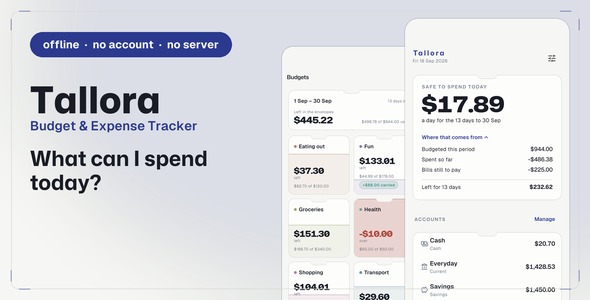
Tallora is an offline budget and expense tracker for Flutter. Every other tracker on the shelf answers “where did the money go”. Tallora answers the question people actually open a budget app to ask: what can I spend today? It works the figure out on the device from your envelopes, what you have already spent and the bills still to come — and then prints all four amounts underneath it, so the answer can be checked rather than believed.

Demo Instructions
The app opens straight into a worked example. Sign in with demo@tallora.app and password demo1234, or simply tap Sign in with both fields left empty: the sign-in is a mock and accepts anything. No registration, no API key, no network connection and no backend are needed to see every screen. A sample ledger of 158 transactions, 3 accounts, 6 envelopes and 7 recurring rules is seeded on first run, so nothing is empty.
One number, and its working
The figure on Today is never a black box. Underneath it, by default, are the four amounts it came from: what every envelope allows this period, what has already gone against them, what the bills still to come will take, and what is therefore left over the days that remain.

Nothing is stored. Edit a transaction from three weeks ago and all four move, because none of them is a running total that could go stale.
See the dip before you reach it
A balance does not drift — it sits still, then falls by a month’s rent in one morning. Tallora expands your recurring rules into dates and steps the balance through them, over 30 or 60 days, so the day you run thin has a name on it.

Nothing on that chart is written to the ledger. It is what your rules say is coming, recomputed every time you look at it.
Six levels, read in a second
Each envelope is a money box, and what has risen inside it is what you have spent. Overspending is shown rather than hidden, and what is left at the end of a period is carried into the next one — as is what was overspent, because a budget that forgives overspending is not a budget.

Area is what it cost
A squarified treemap, laid out on the device from your own entries. Transfers between your own accounts are left out — moving money is not spending it. Tap a block for the entries behind it, or step back through earlier months.

Logging something takes seconds
Type the amount on the keypad, tap a category, save. The account, the date and the note all have working defaults, so the only two things you have to supply are the two only you know.

Amounts are held as integer cents everywhere in the app, never as floating point — a ledger built on doubles drifts by a penny after a few hundred additions and then disagrees with itself.
A bill on the 31st
Anchor a recurring rule to the 31st and it has to fall on the 30th in April and the 28th in February — and then go back to the 31st in May. Tallora clamps at the moment it expands the rule, so the number you typed is never quietly lost.

Zero network requests
No account, no server, no analytics, no ads and no bank connection. The whole dependency list is four packages long and none of them is an HTTP client. Your ledger lives in the phone’s encrypted store — the Keychain on iOS, EncryptedSharedPreferences on Android — as JSON with a schema version on it, so the first time you change the model your users do not open the app to an empty screen.

Because the only copy is the phone, backup ships as a first-class feature rather than a footnote: the whole ledger goes out as one JSON file through the system share sheet and comes back from the clipboard, and a round trip is byte-identical — there is a test that asserts exactly that. The ledger also exports as CSV, with account and category names in it instead of ids.
What you get

- Full, commented Flutter source — GetX, Material 3, light and dark,
flutter analyzeclean - 18 screens and 5 bottom sheets, all reachable in the demo with no setup
- 76 passing tests, including 31 for the cash-flow engine alone
- A pure-Dart cash-flow engine with no clock and no plugin behind it
- A worked example of 158 transactions, seeded on first run and reproducible
- Quick entry with a keypad, multi-account support and mirrored transfers
- Recurring rules with weekly, monthly and yearly cadences, pause and resume
- Backup, restore and CSV export, all through the system share sheet
- A mock paywall wired to a limit the code actually enforces
- Offline HTML documentation, a re-skinning guide and a license file for both bundled typefaces
What is not included
Named here so nobody has to find out after buying.
- One currency at a time. The symbol is configurable; nothing is converted, because the app holds no exchange rates.
- No cloud sync and no multi-device. The ledger is on the phone. Moving it is the backup file.
- No bank feeds. Entry is manual, by design — connecting a bank means a provider, an account and a running cost.
- No debt tracking, no savings goals and no biometric lock.
- No push notifications. Bills that are due are shown inside the app; nothing is scheduled on the system.
- The paywall is a mock. No payment code ships: the purchase call is a stub. Wire your own products and receipt validation into
SubscriptionService.purchase— the documentation walks through it. - Budget periods start on day 1 to 28. A period starting on the 30th has no valid start in February.
- Storage is a JSON blob, not a database. Comfortable for a few thousand records; past that,
LocalStoreis the one class to swap, and every screen already goes through it.
Requirements
Flutter SDK 3.29 or newer. Builds for Android and iOS from the same source. No paid service, no API key and no account are required to run the app or to ship it — there are no third-party services in it at all. If you later connect a backend of your own, that service will involve its own separate costs, which are yours and not covered by this item.
Support
Questions about setup, re-skinning or the engine are answered through the item’s comments. Item support covers the template itself: getting it to build, understanding how a screen or a calculation works, and the documentation. It does not cover a backend you add later, third-party packages you introduce, or changes to your own fork.
Changelog
v1.0 — first release.
| Type | Flutter App |
|---|---|
| Author | coderqh |
| Price | $28 |
| Sales | 0 |
| Rating | 0 (0) |
| Published | Sep 4, 2026 |
| Last Update | Sep 4, 2026 |
| Compatible Software | Flutter 3.x |
| Mobile Files Included | Dart, YAML, JavaScript JSON, .kotlin, .swift |
Categories
Tags
External listing. code.market does not sell this product and does not process payment for it. Pricing, payment, delivery, licensing, refunds, and support are handled by the third-party merchant on its own website. We may earn an affiliate commission from a referral. Details.