
Sluice | Flutter App - Token Distribution With Holder Snapshots
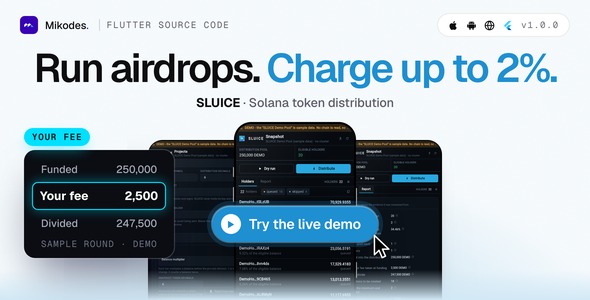
Description
AI disclosure: AI tools were used to assist with parts of the code, documentation and graphics of this item. The author directed, reviewed and tested every part before release. SLUICE is not affiliated with, endorsed by or sponsored by Solana, Helius, QuickNode, Alchemy, Dexscreener, Solscan, Apple, Google or Flutter; their names are used only to describe compatibility.
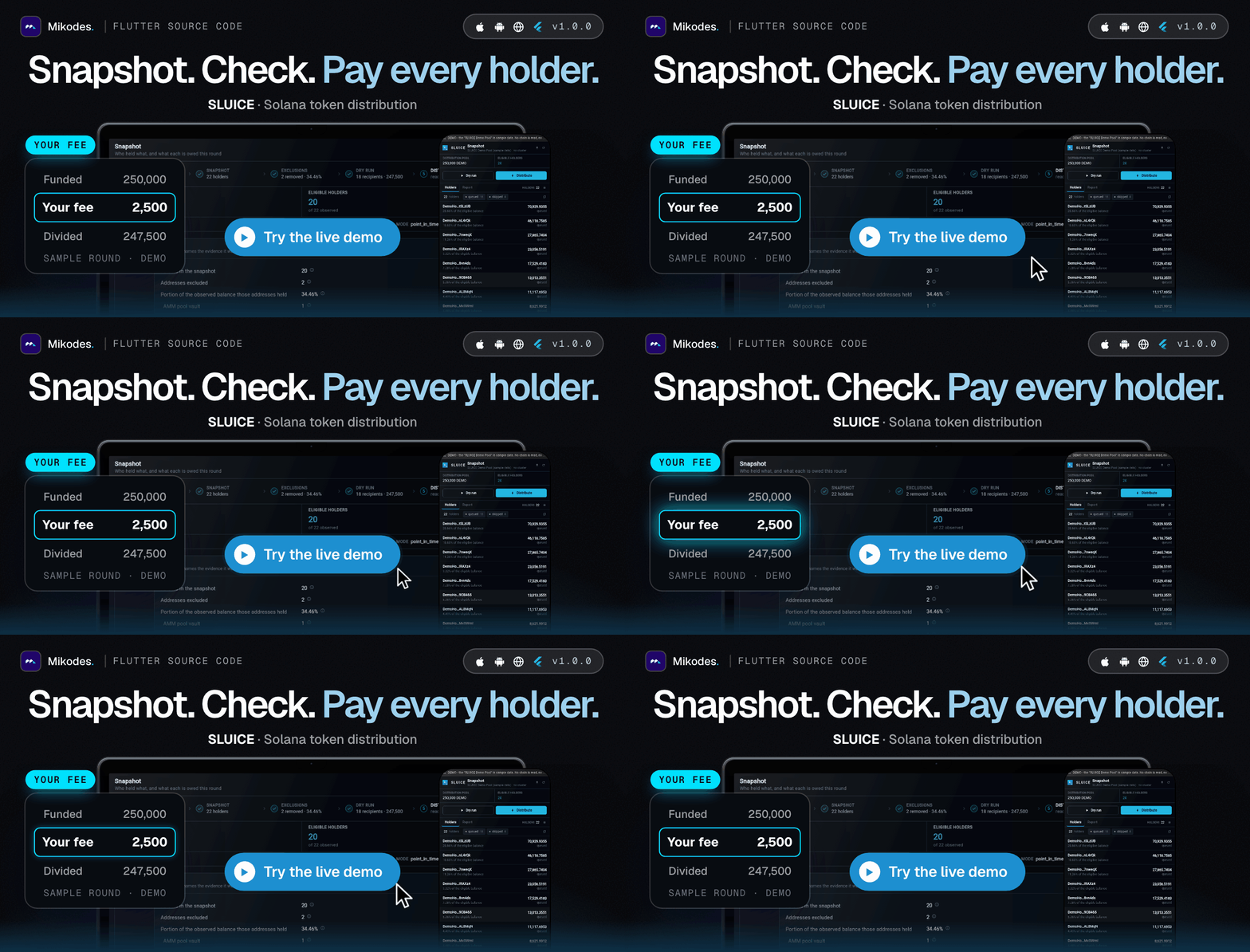
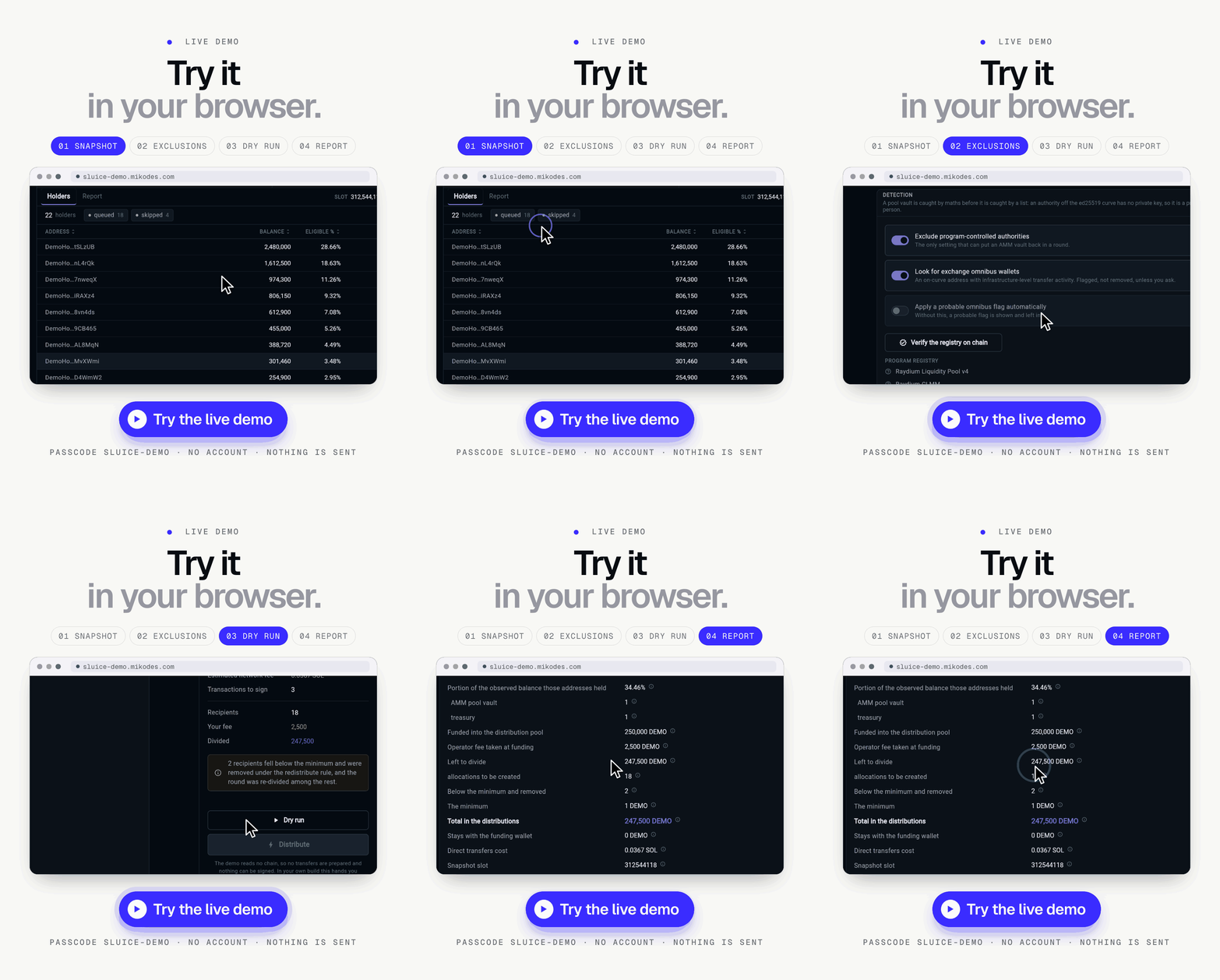
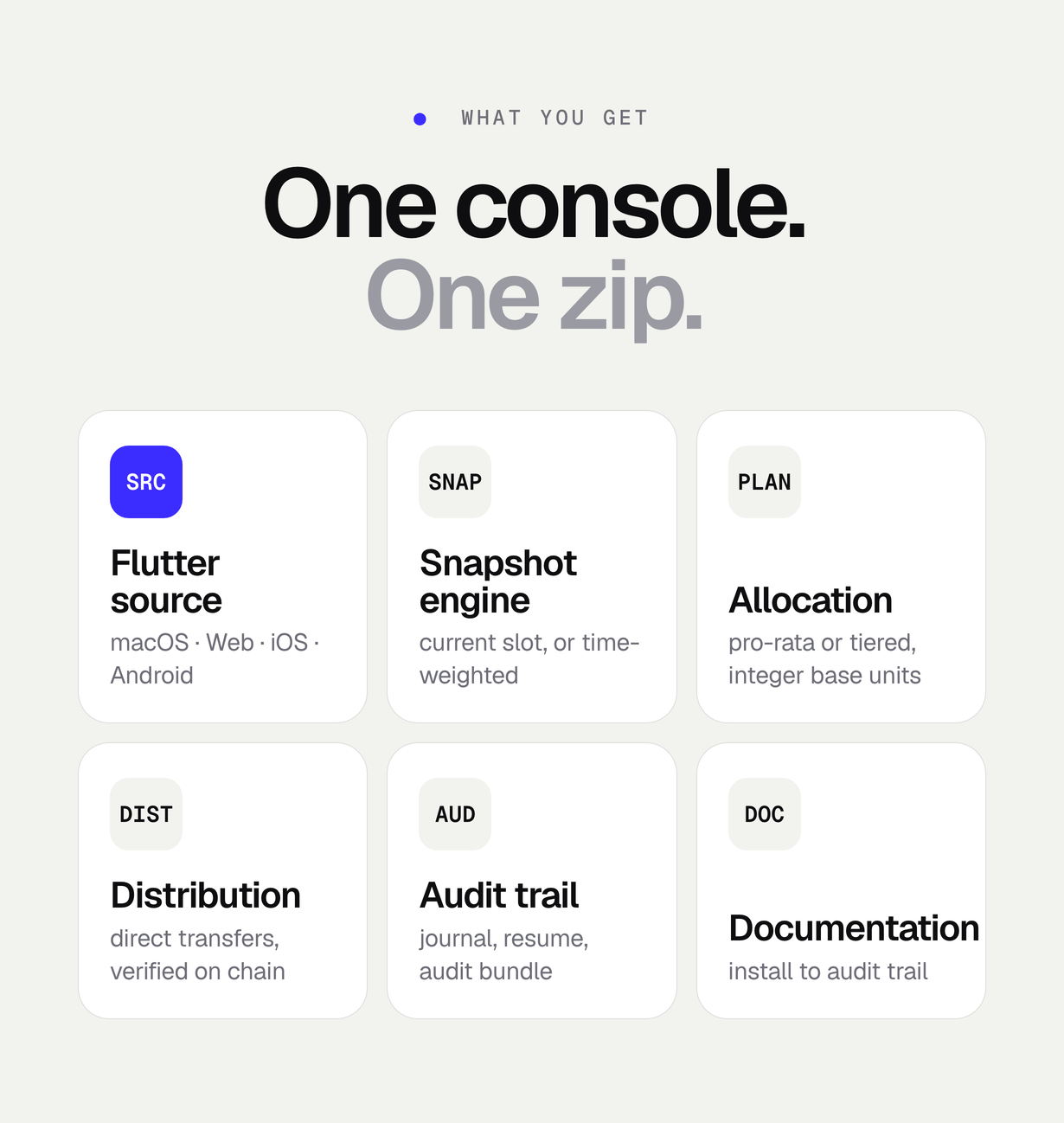
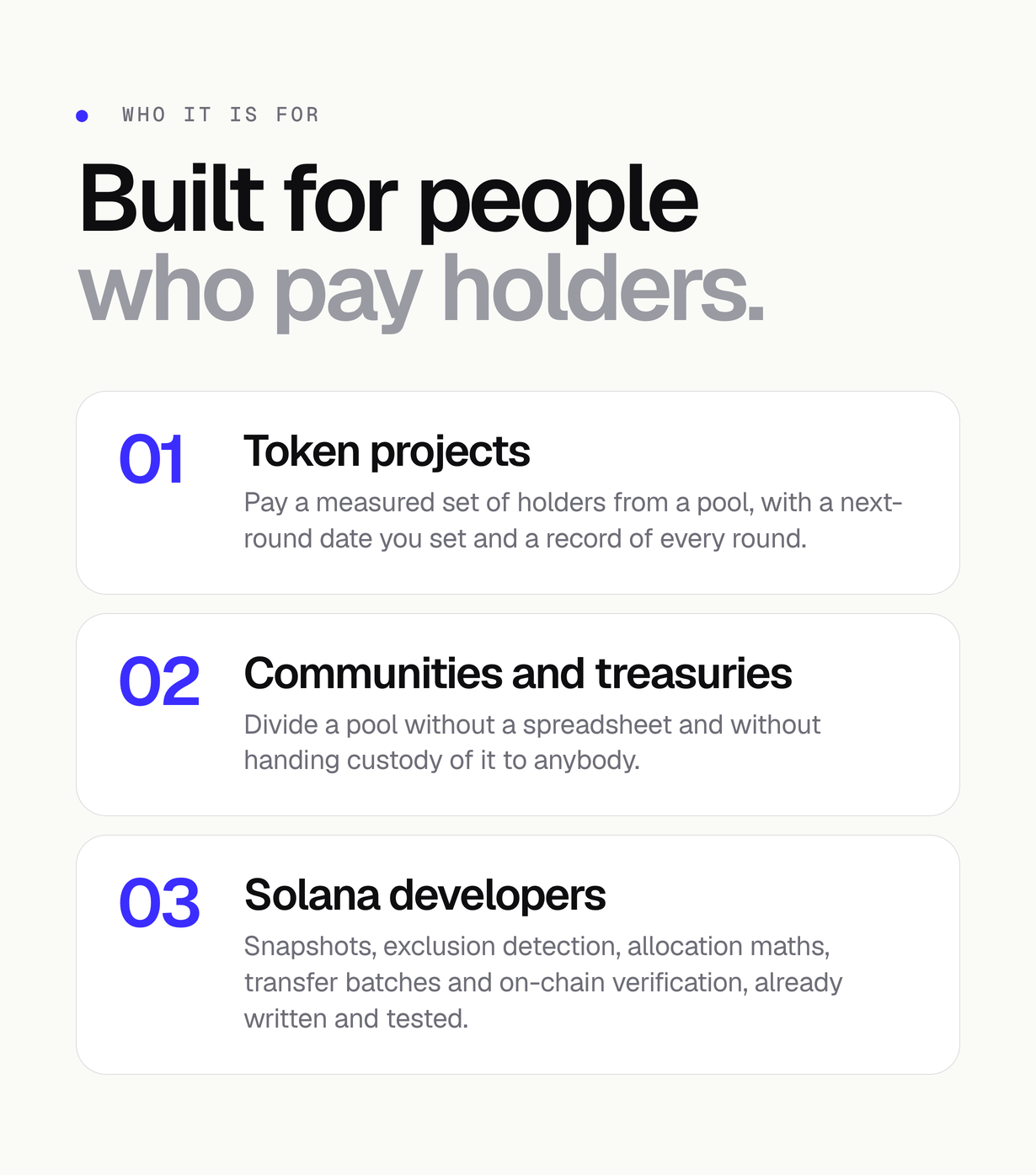
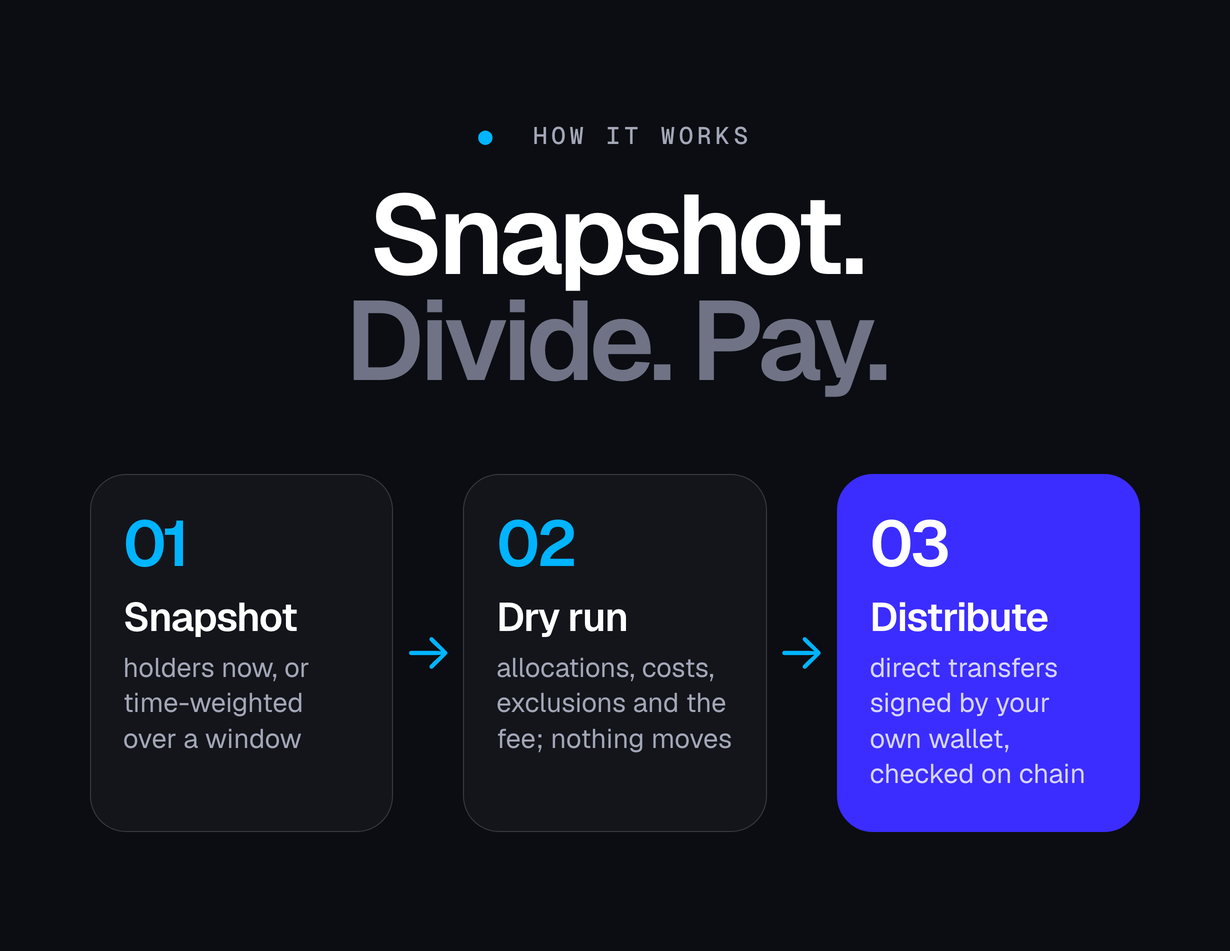
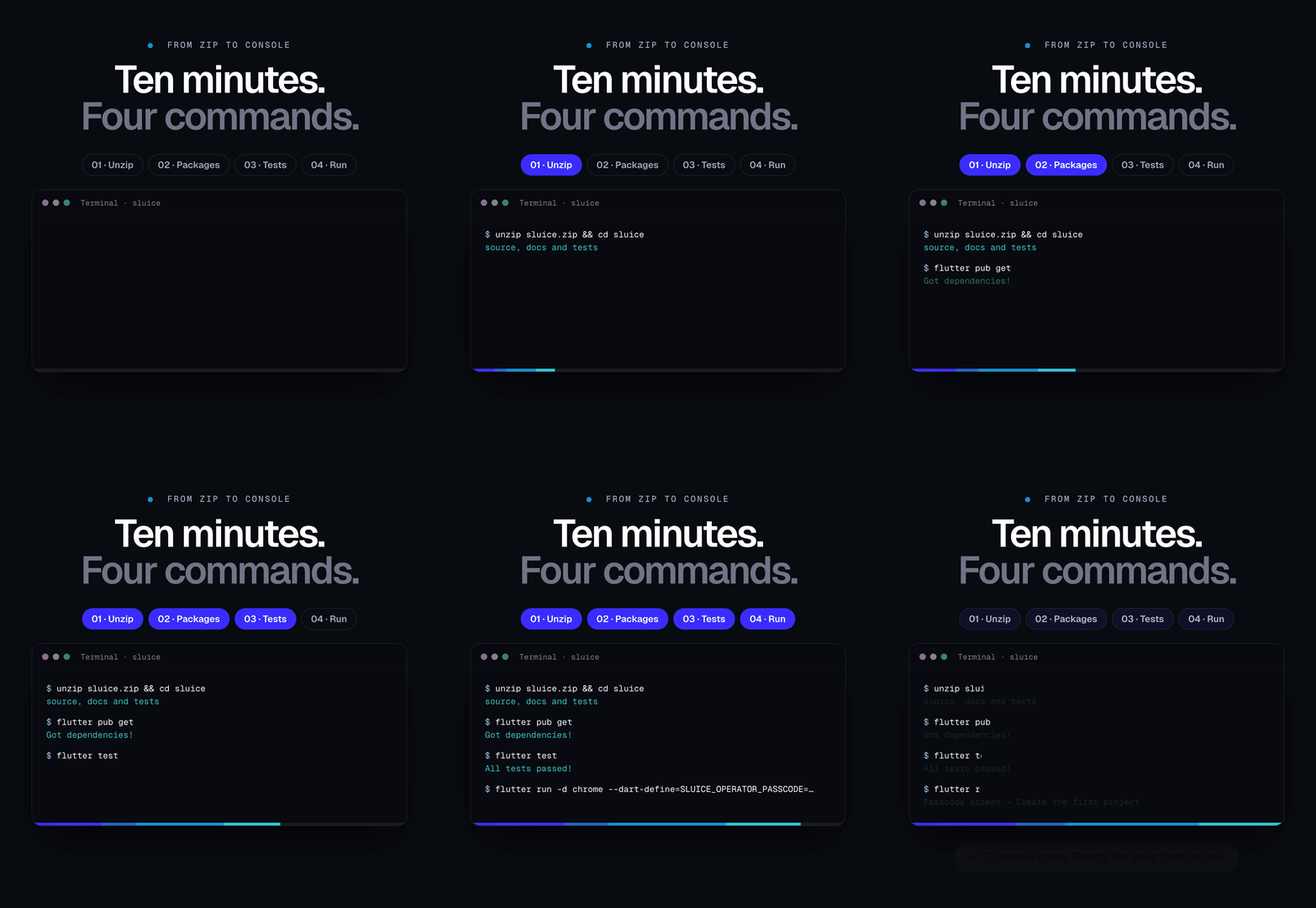
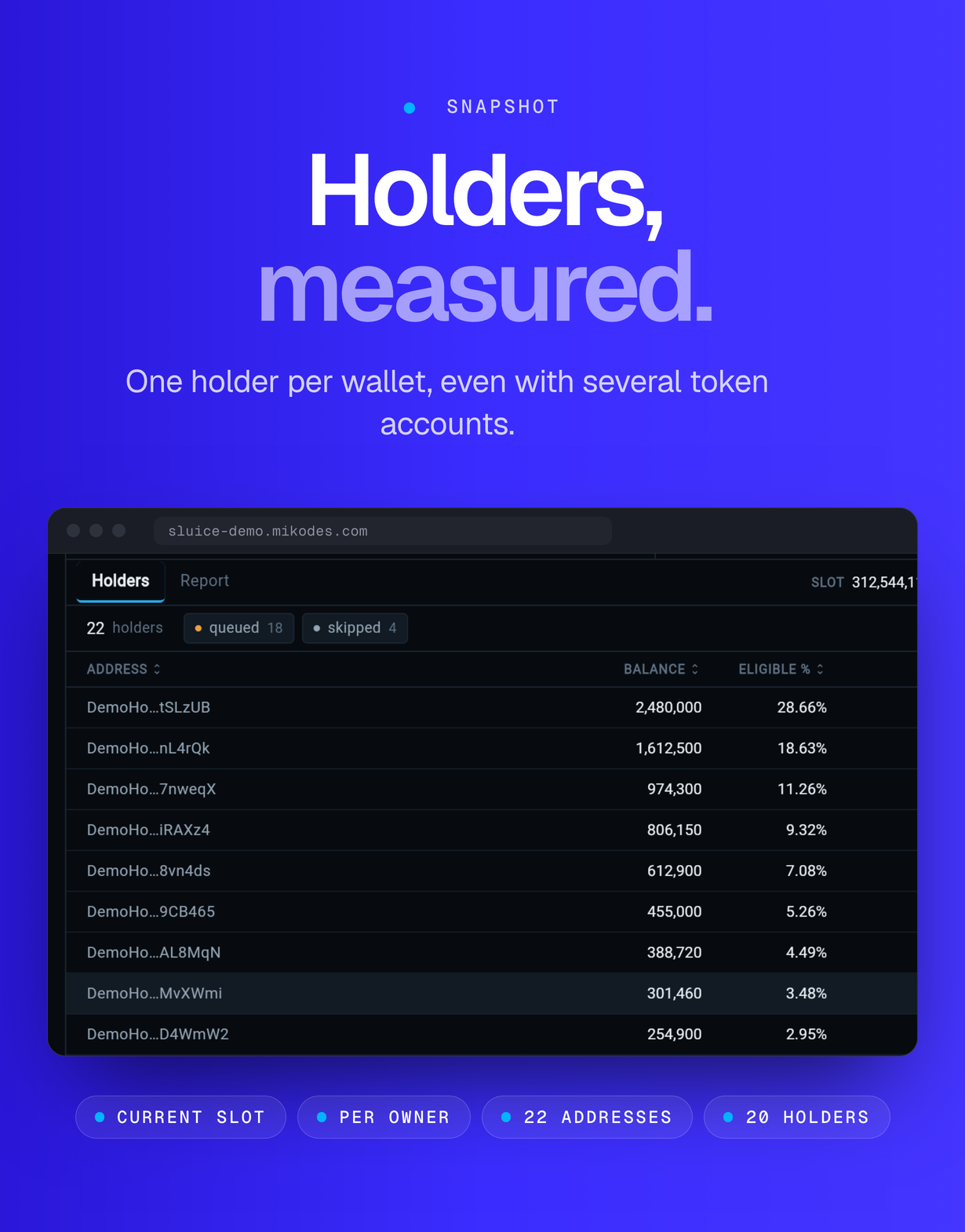

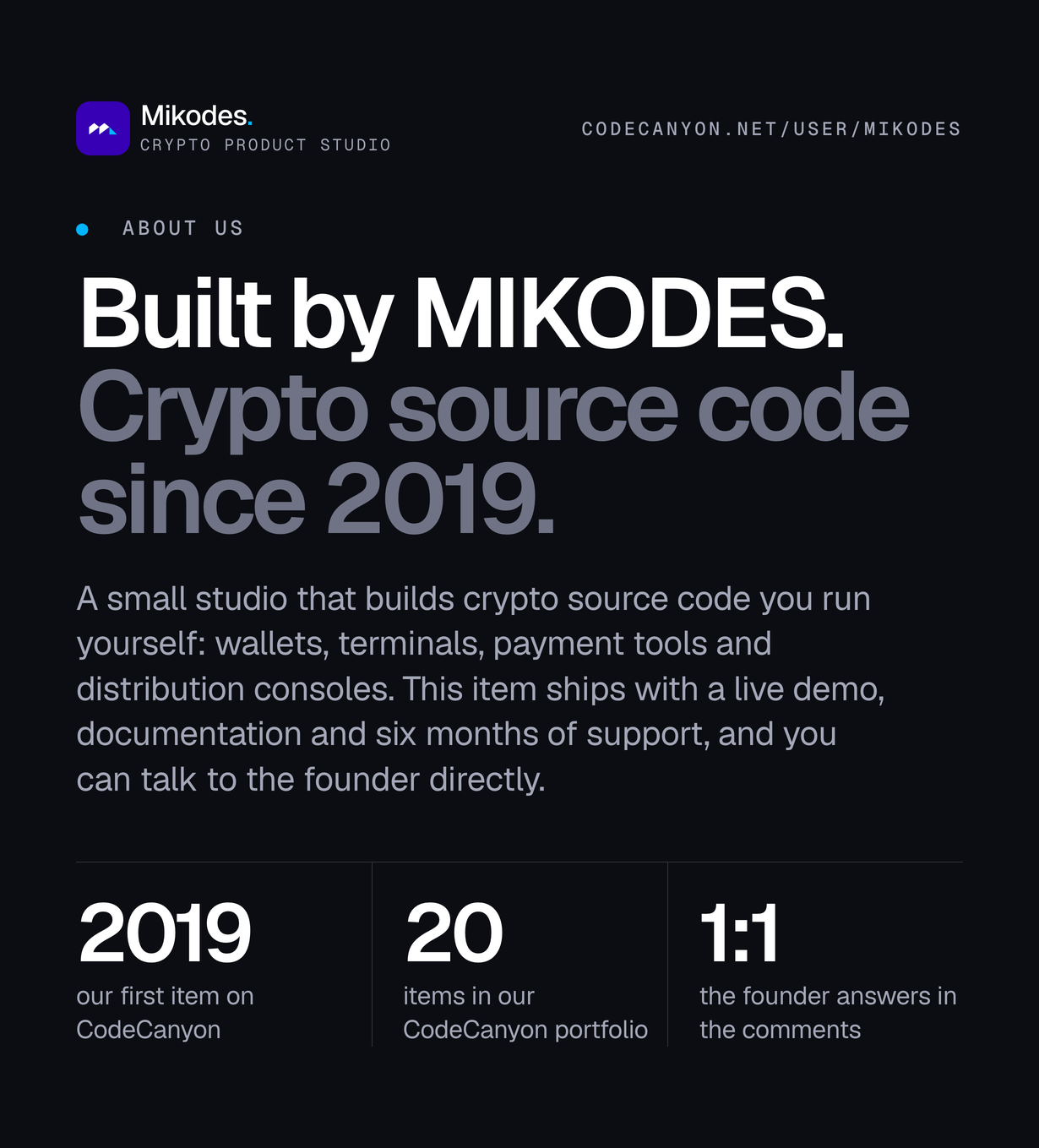
SLUICE is complete Flutter source code for running Solana airdrops and SPL token distributions: snapshot the holders, remove liquidity pools and burn wallets automatically, split the pool pro-rata or by tier, and pay every holder by direct transfer that your own wallet signs. You can charge an operator fee of up to 2% per round. No server and no keys in the code. Web, macOS, iOS and Android.
Live demo
| App | Link | Access |
|---|---|---|
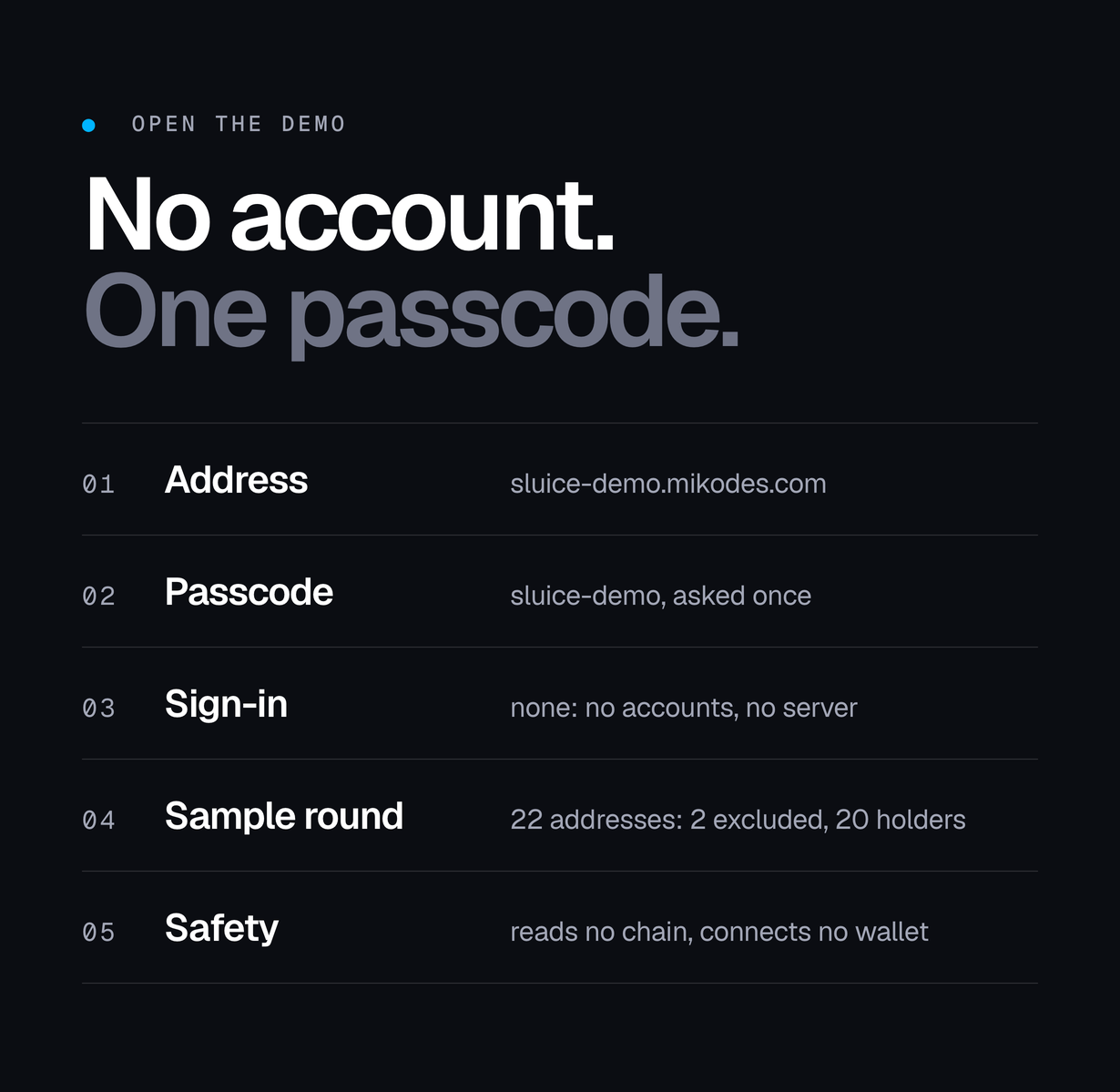
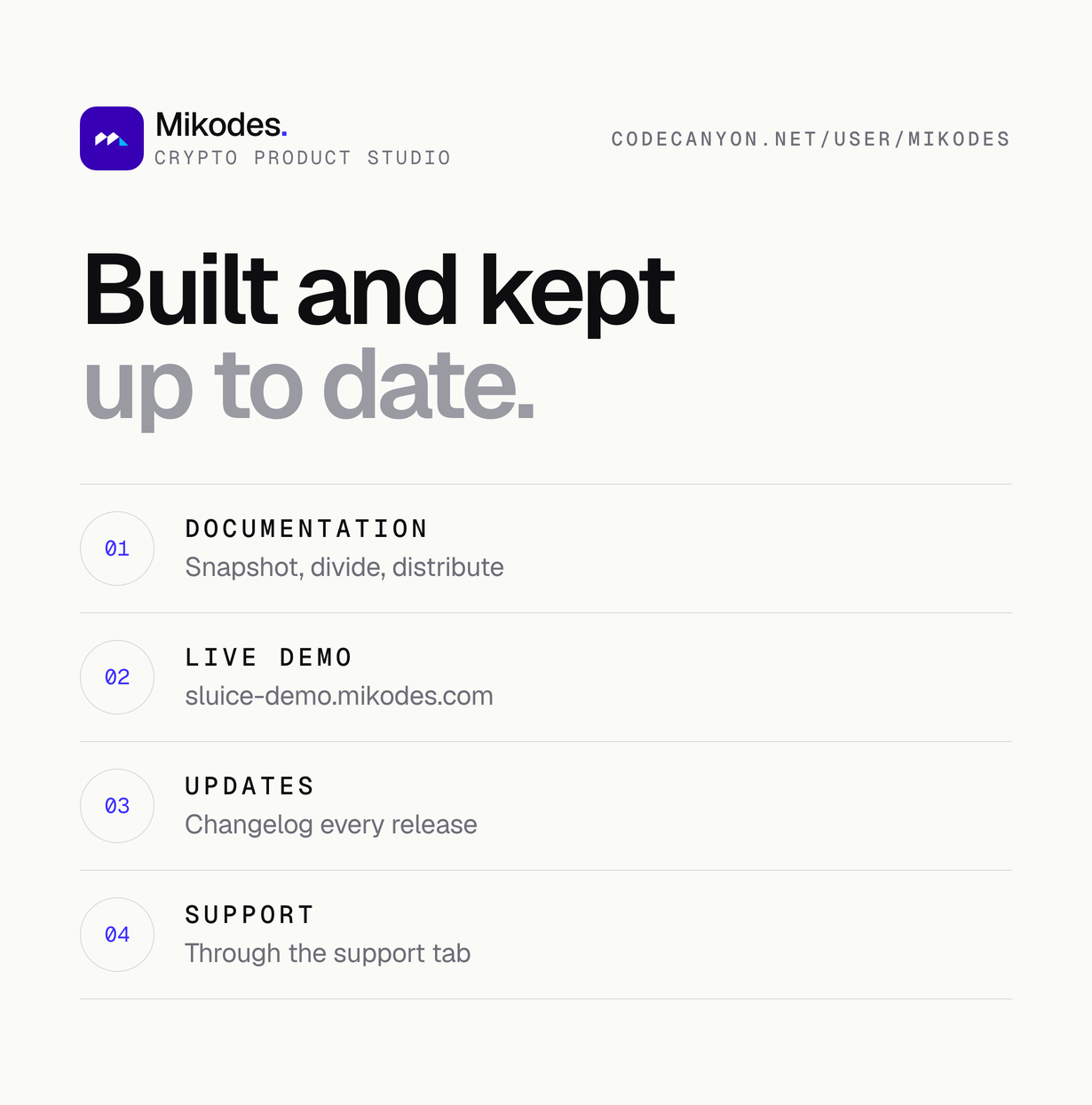
| SLUICE console, web build (live demo) | sluice-demo.mikodes.com | The real Flutter web build in demo mode: a DEMO strip on every screen, one sample round, no chain access, nothing can be signed or sent. Operator passcode: sluice-demo. |
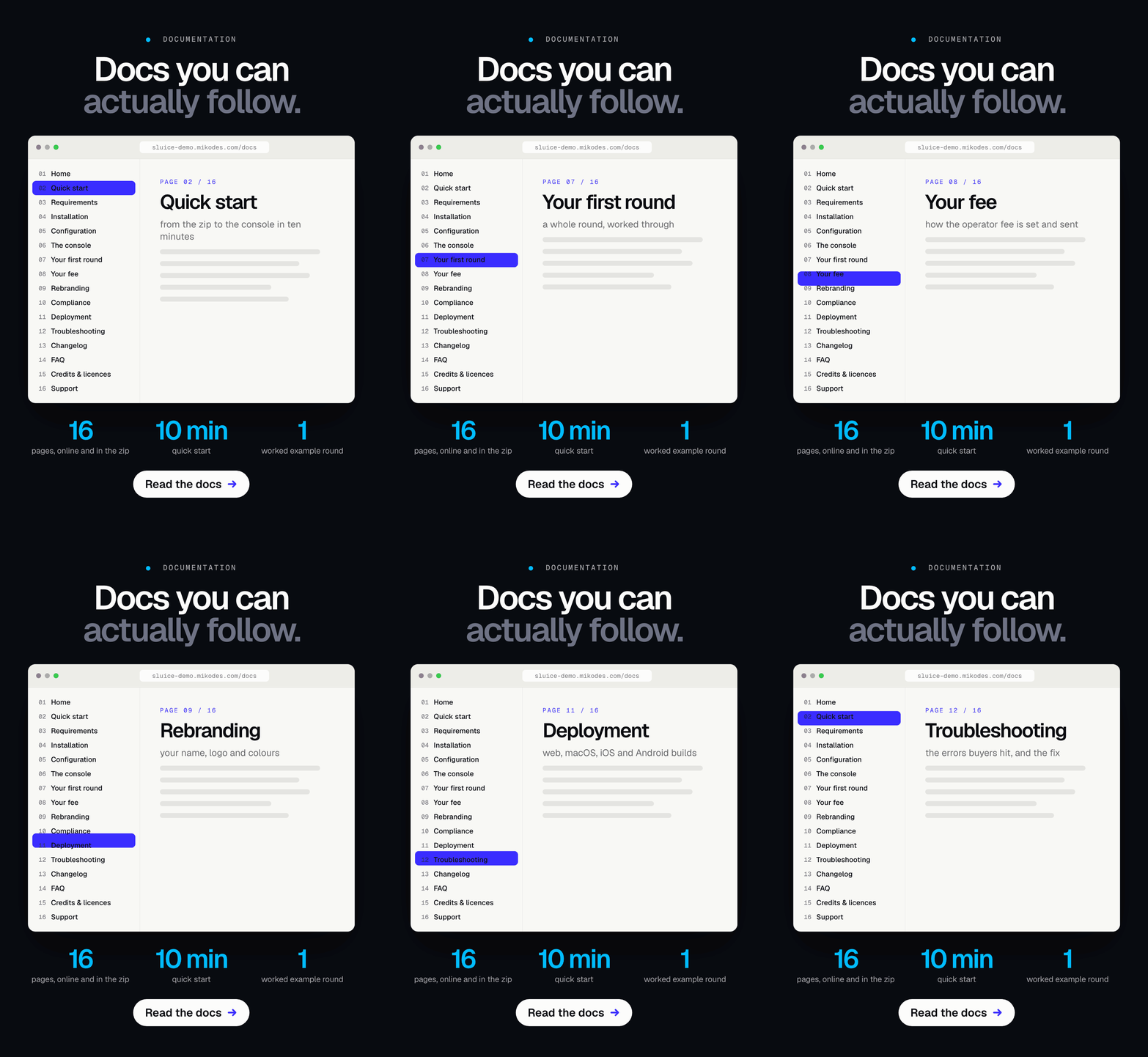
| Documentation | sluice-demo.mikodes.com/docs/ | Install, snapshots, exclusions, allocation, distribution, the fee and the audit trail. Public, no purchase needed. |
Demo instructions
Open sluice-demo.mikodes.com. It is the real Flutter web build, compiled in demo mode (SLUICE_DEMO=true).
- E-mail and password: none – the app has no accounts and no server to sign in to.
- Operator passcode: sluice-demo – the console asks for it first. In the demo the operator settings are read-only, so one visitor cannot change what the next one sees.
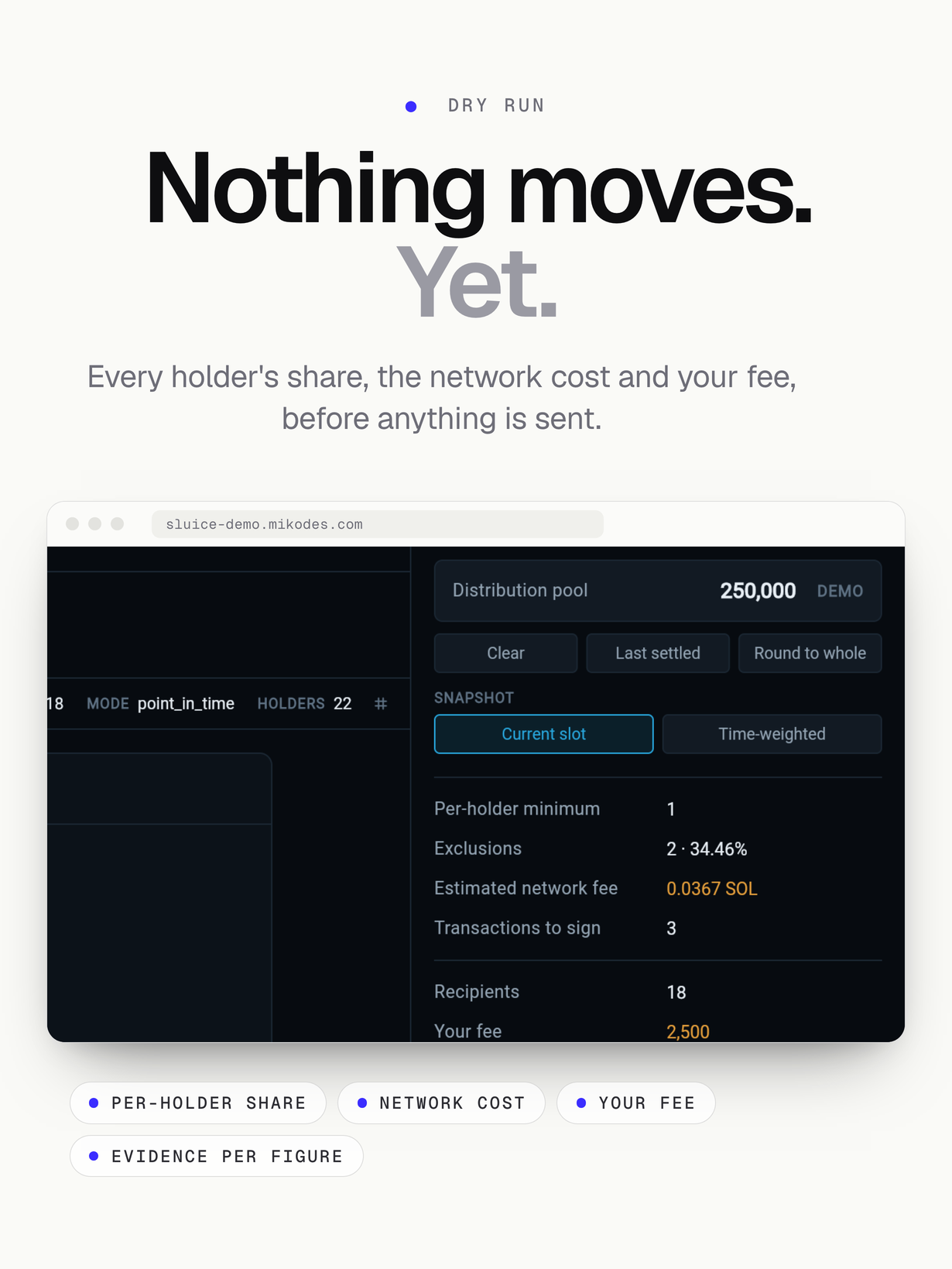
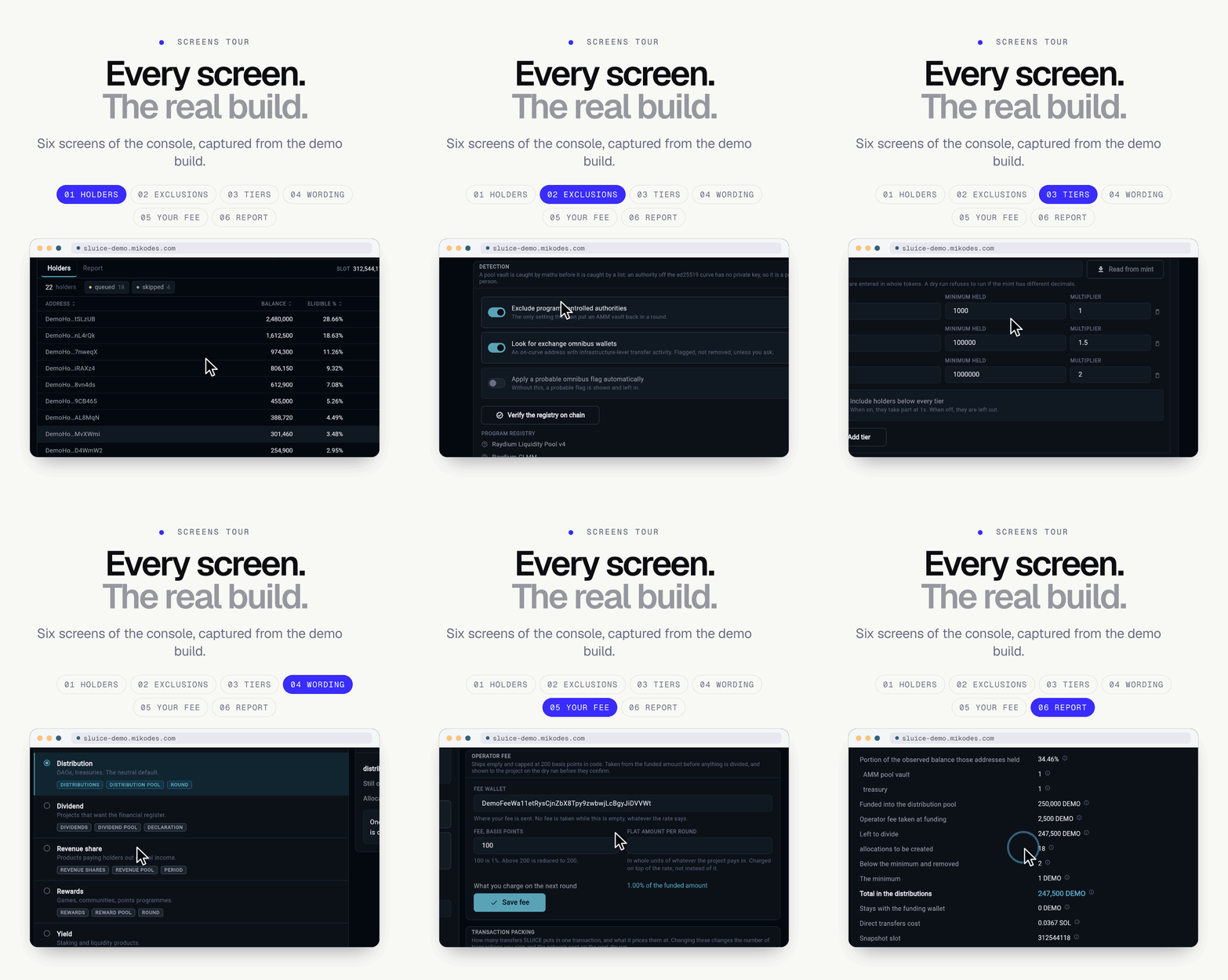
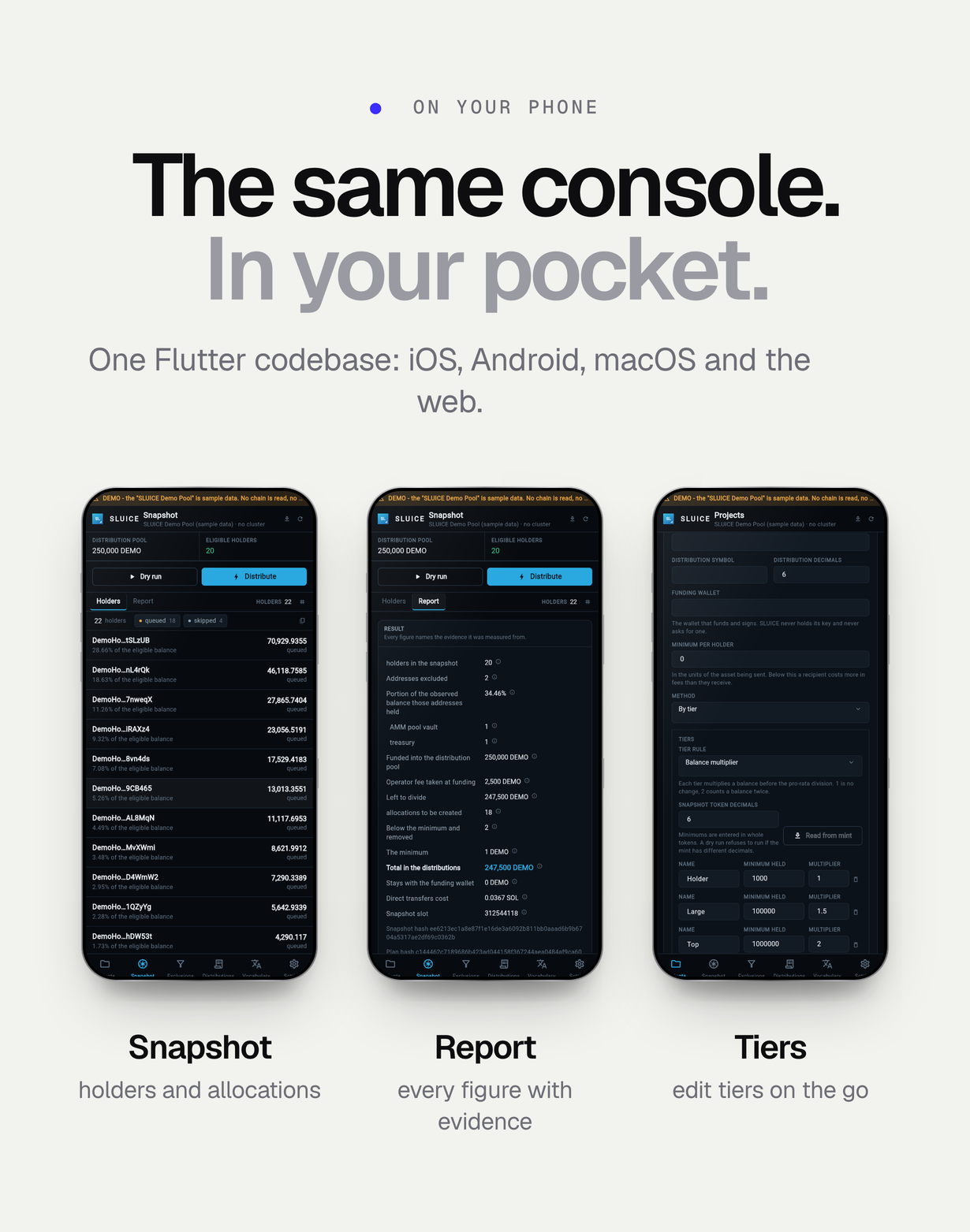
- What you can see there: one sample round, the SLUICE Demo Pool: 22 sample addresses (every one starts with Demo), of which 2 are excluded (the pool vault and the treasury), 20 are eligible holders and 18 are paid after the per-holder minimum. Every figure is computed by the product from that sample set. The demo reads no chain and connects no wallet, so nothing can be signed or sent. Recording a balance sample is disabled in the demo (the sample project already carries 30 daily samples), and only the sample project can be dry-run, because the demo reads no chain.
- Documentation – sign-in: none. sluice-demo.mikodes.com/docs/ is public.
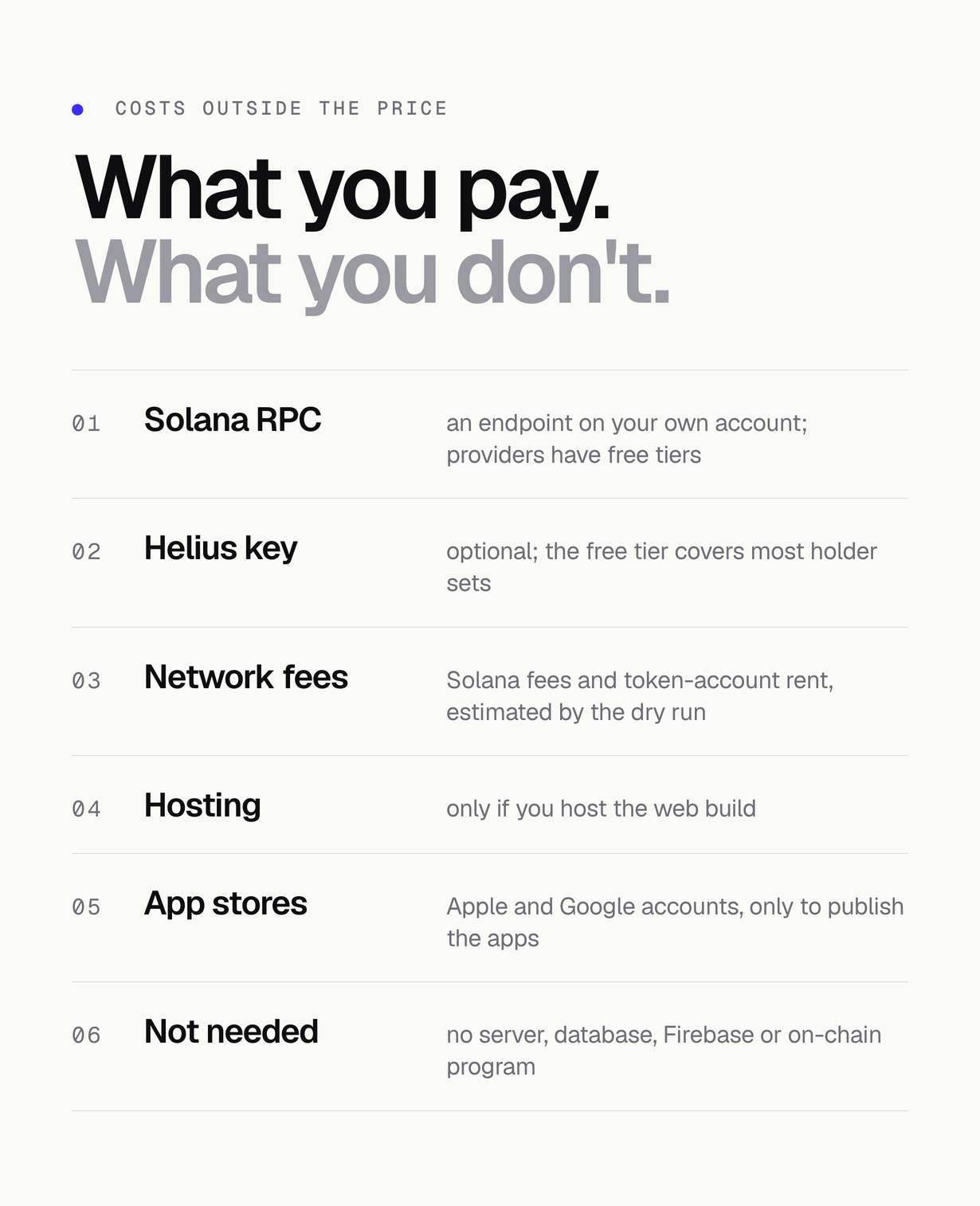
Costs not included in the price
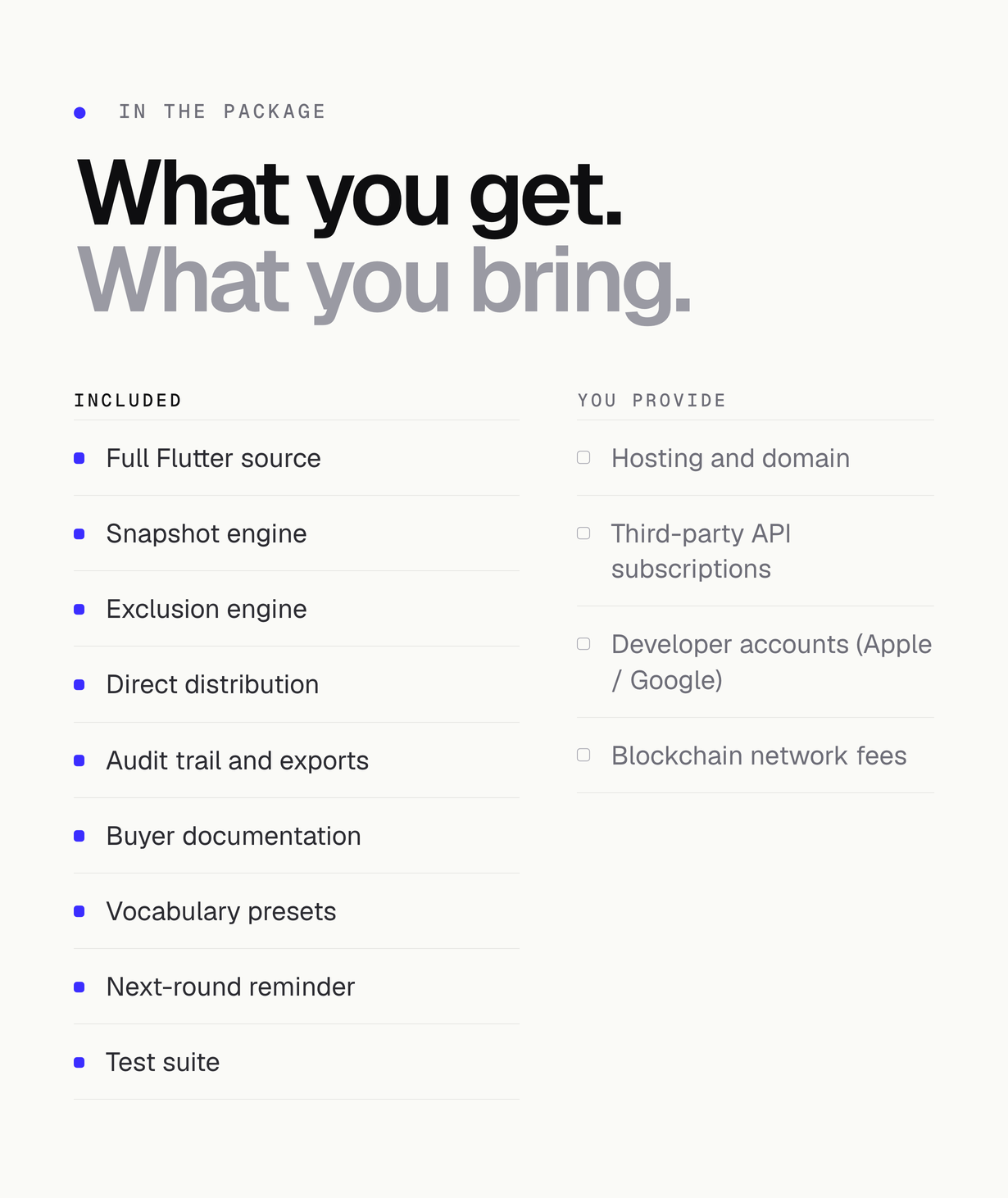
The item price covers the source code and its documentation. Third-party API services such as Solana RPC providers or Helius may involve usage costs, which are the buyer’s responsibility; they are billed separately, by their providers, on your own accounts. Check each provider’s current pricing.
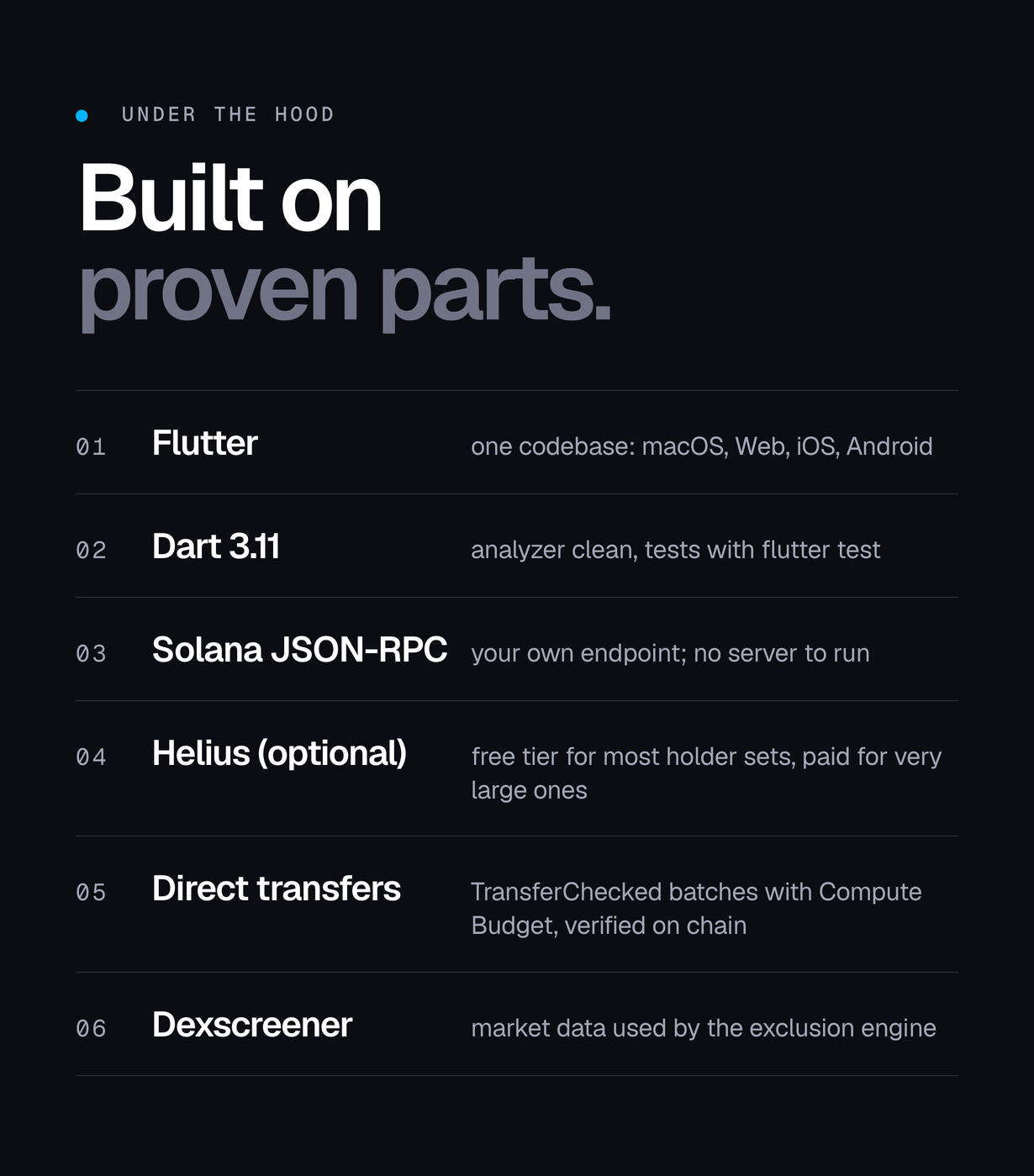
- Solana JSON-RPC provider (Helius, QuickNode, Alchemy or your own node): needed to read holders and confirm signatures; its plan above the free tier is billed by the provider to you.
- Helius API key (optional) for paginated holder enumeration: the free tier covers most holder sets; very large ones need a paid plan.
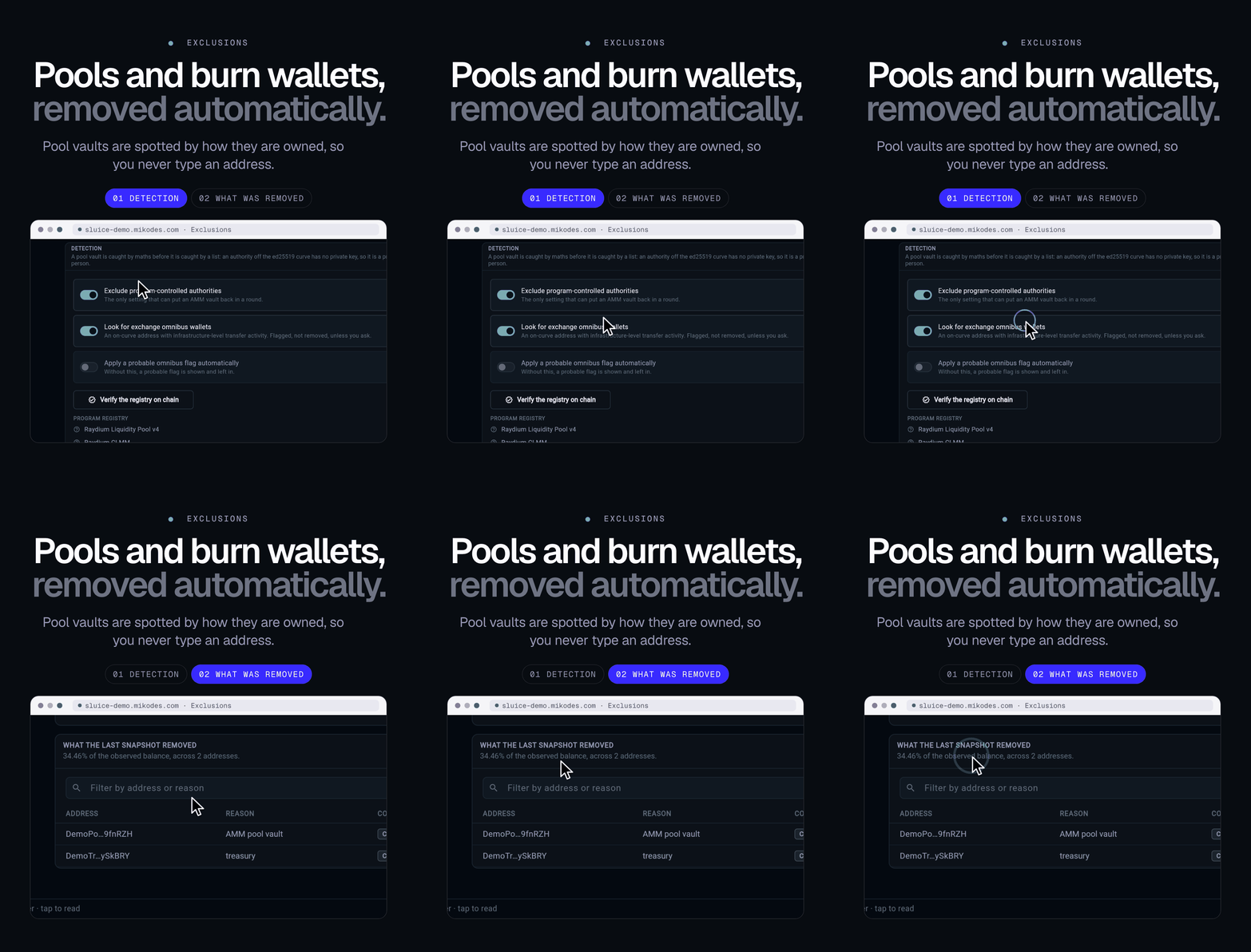
- Dexscreener public API, used to label pool vaults for exclusions: keyless and free to call, no account; its rate limits apply. If it cannot be reached the round still works and says which check did not run.
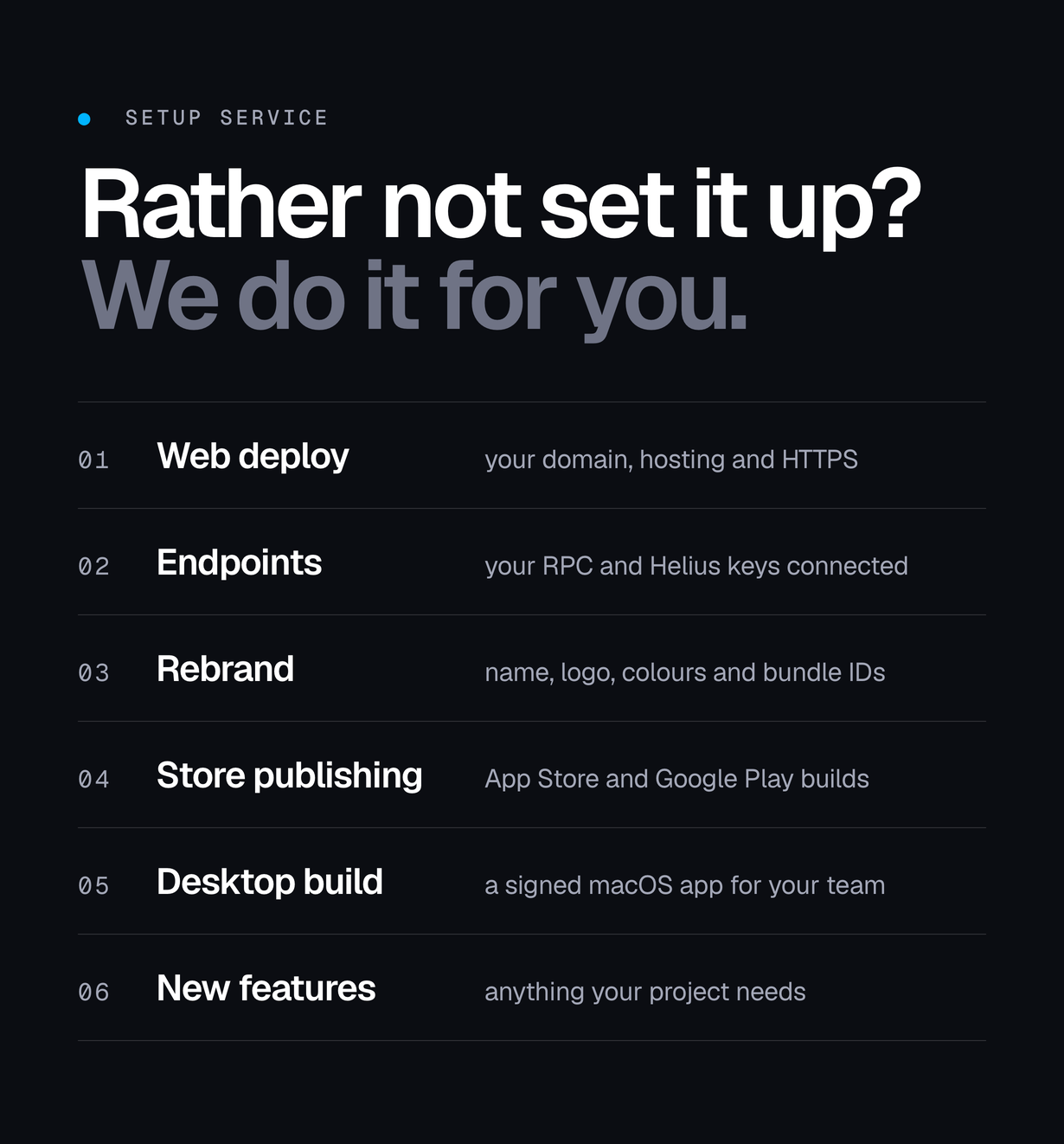
- Static web hosting and a domain, only if you host the web build: paid by you.
- Apple Developer Program (yearly membership) and Google Play Console (one-time registration fee), only to publish the iOS, macOS or Android apps: paid by you.
- Solana network fees and token-account rent for every distribution: paid by your funding wallet, which signs; the dry run estimates them first.
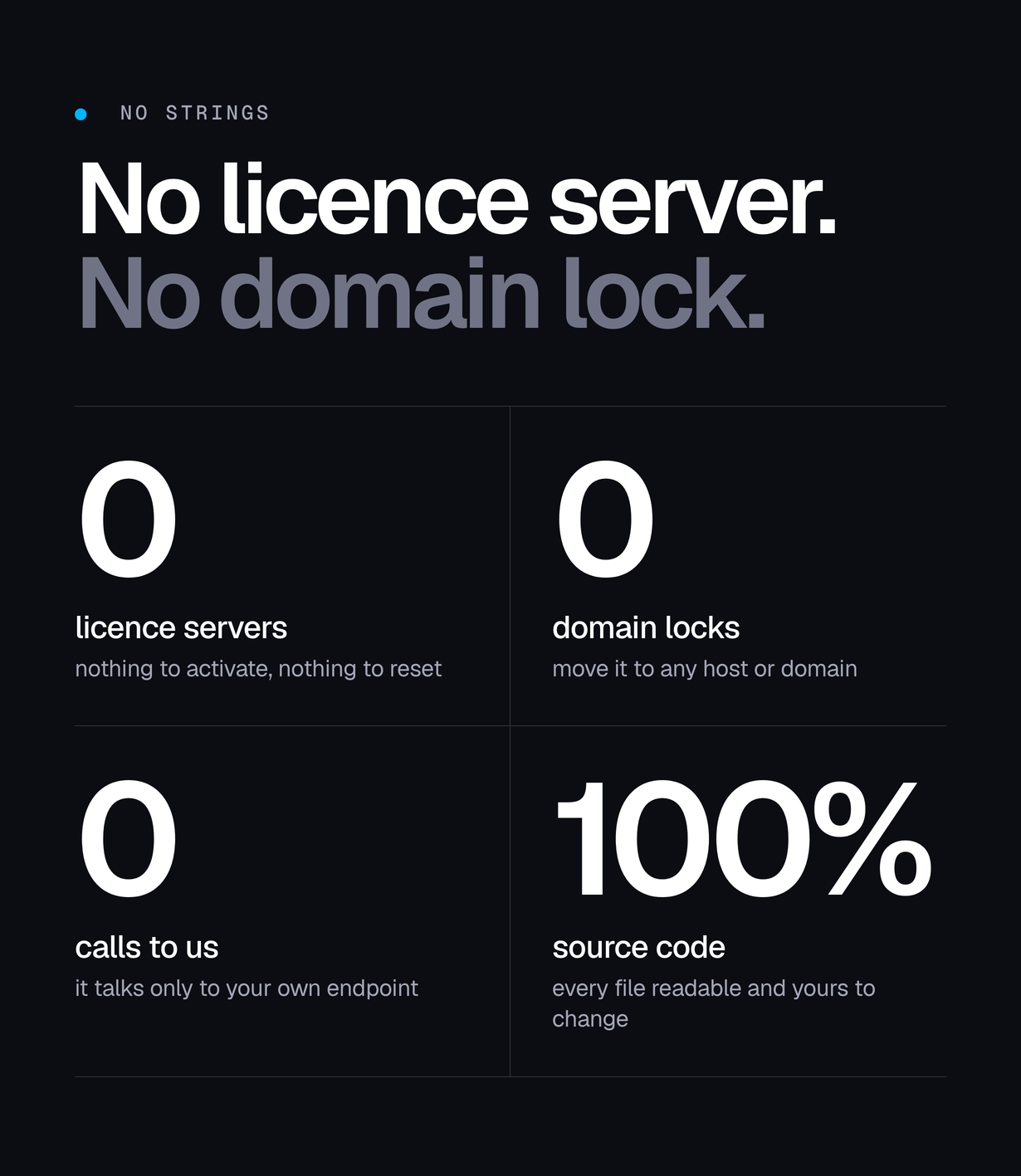
Not needed at all: a WalletConnect / Reown project, Firebase, an on-chain program, a database or a server. SLUICE has no backend.
Features
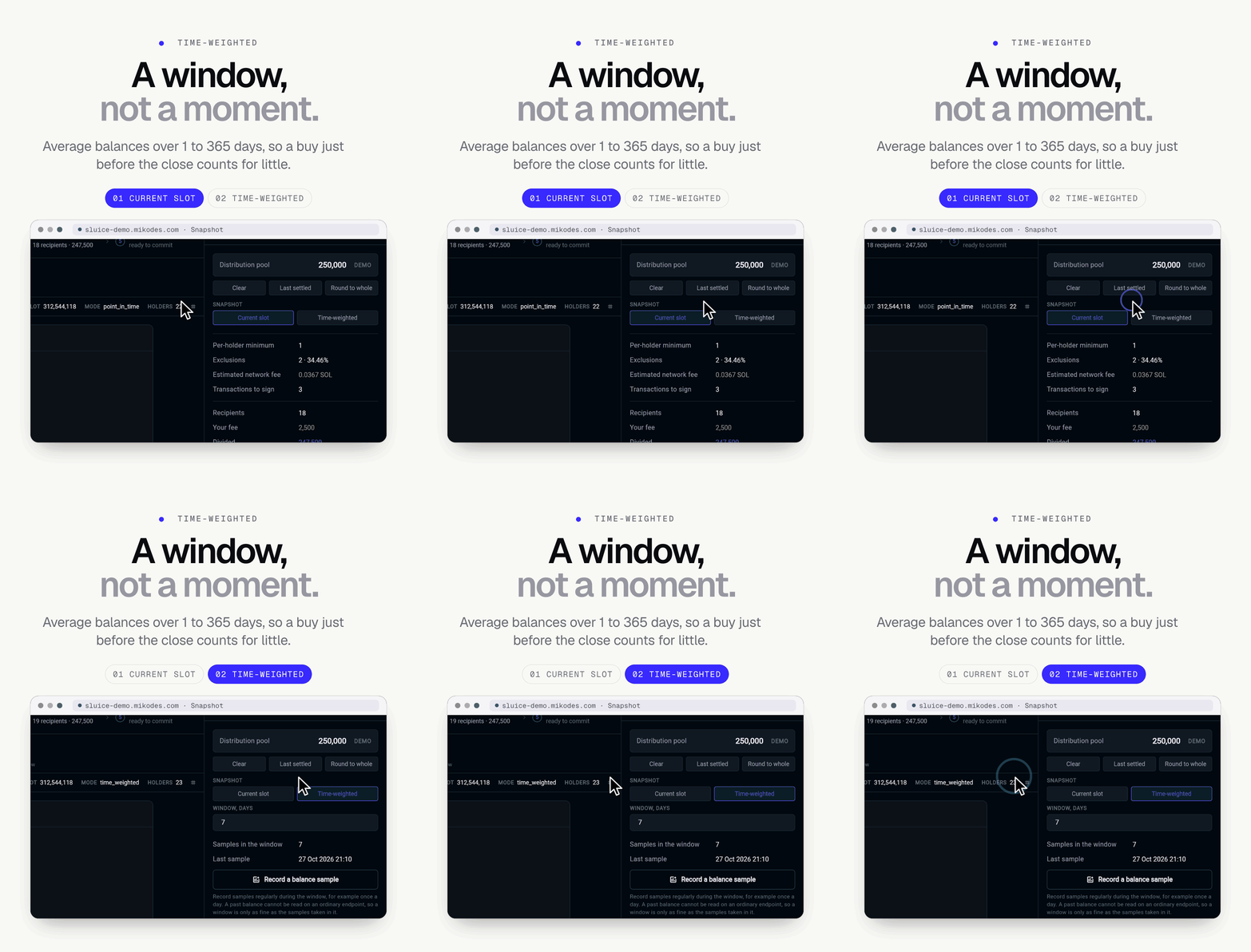
- Snapshot: holders at the current slot, or time-weighted over a window of 1 to 365 days from balance samples you record; one holder per wallet.
- Exclusions: pool vaults found by how they are owned (an off-curve authority has no private key), an AMM program registry you can verify on chain, burn addresses and your own list.
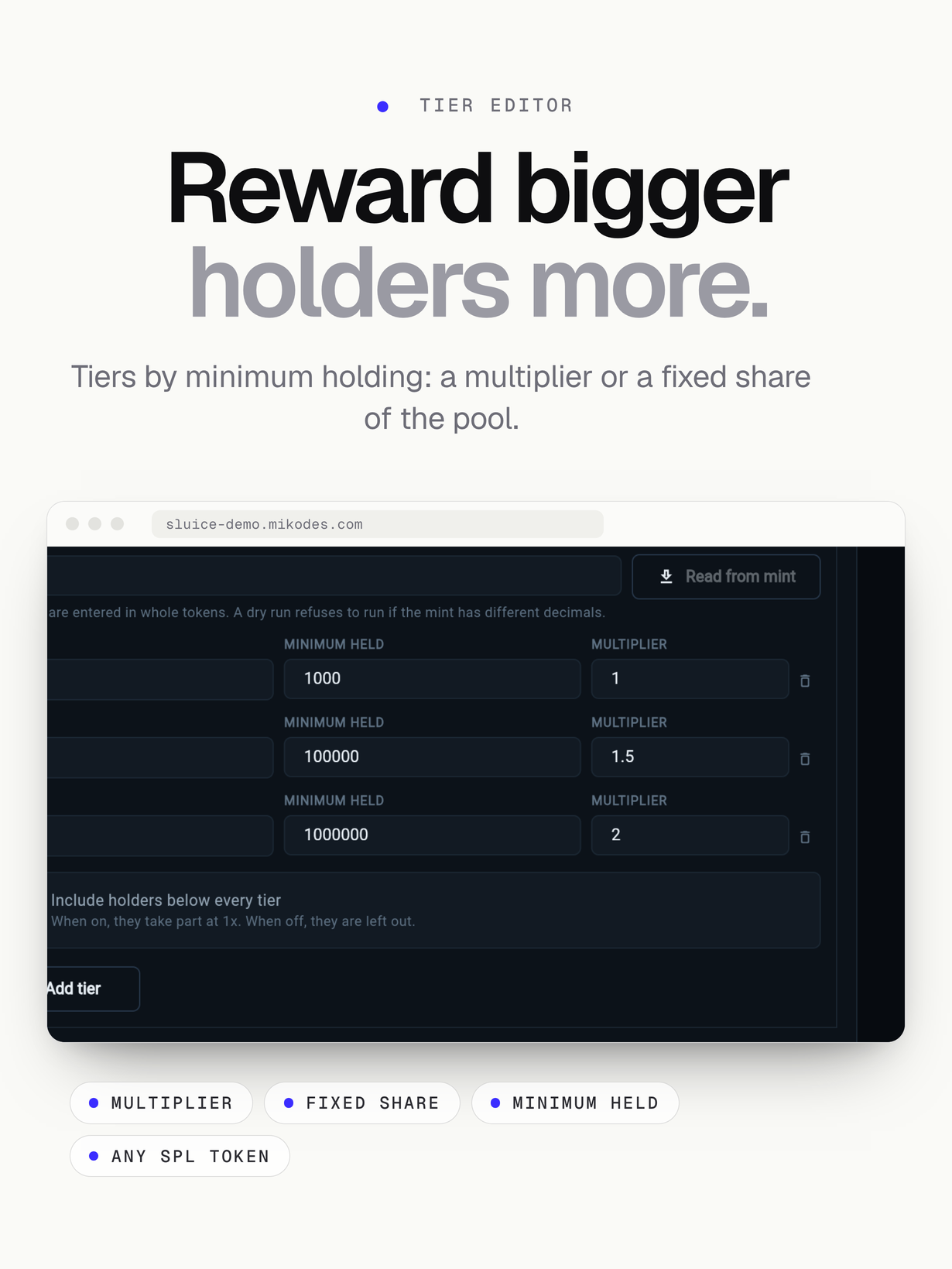
- Allocation: pro-rata or by tier (balance multipliers or fixed shares), in integer base units with a documented rounding rule.
- Payout: unsigned direct-transfer batches (TransferChecked with Compute Budget) for your own signer; a batch counts as paid only when its finalized transaction matches exactly.
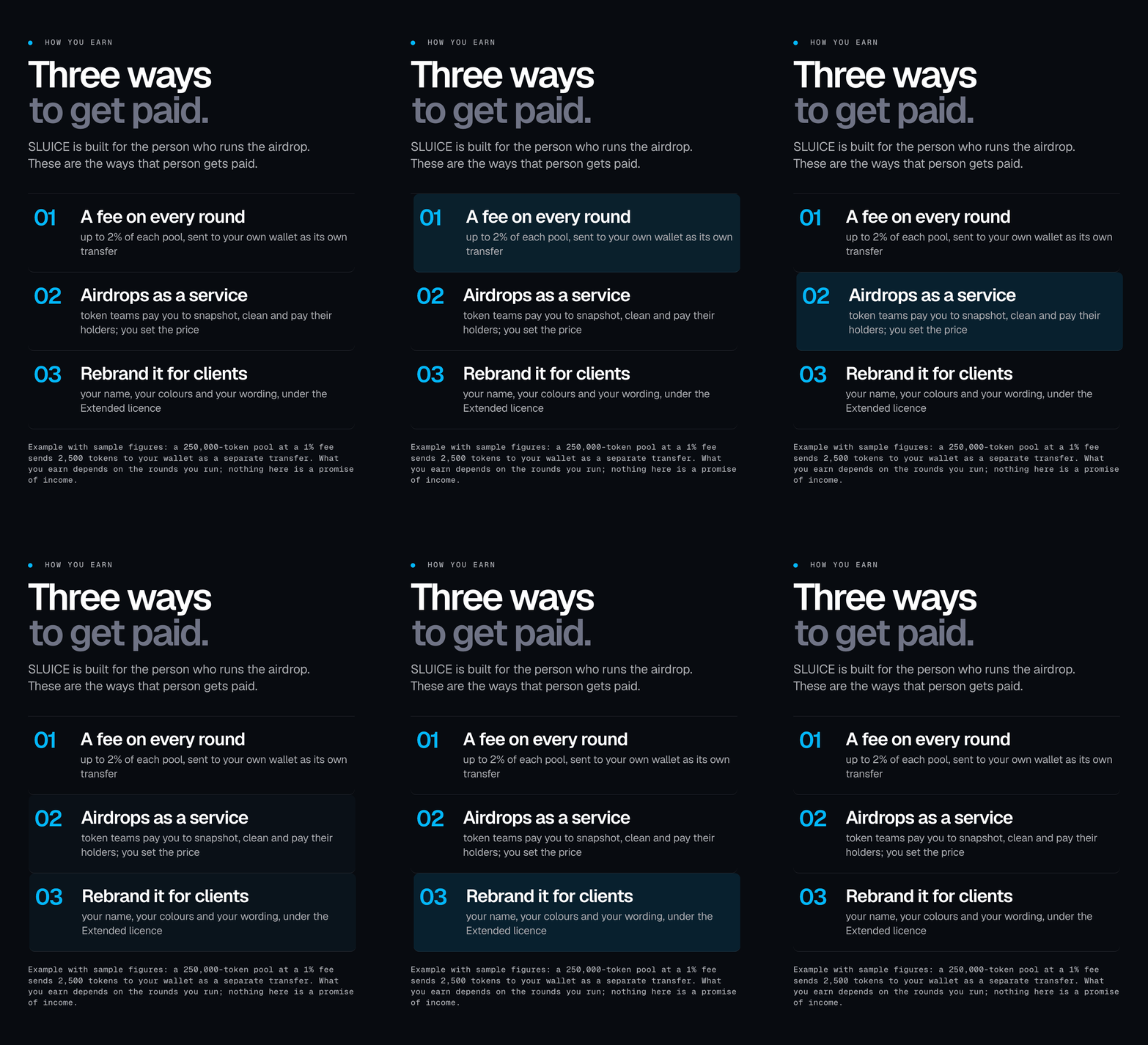
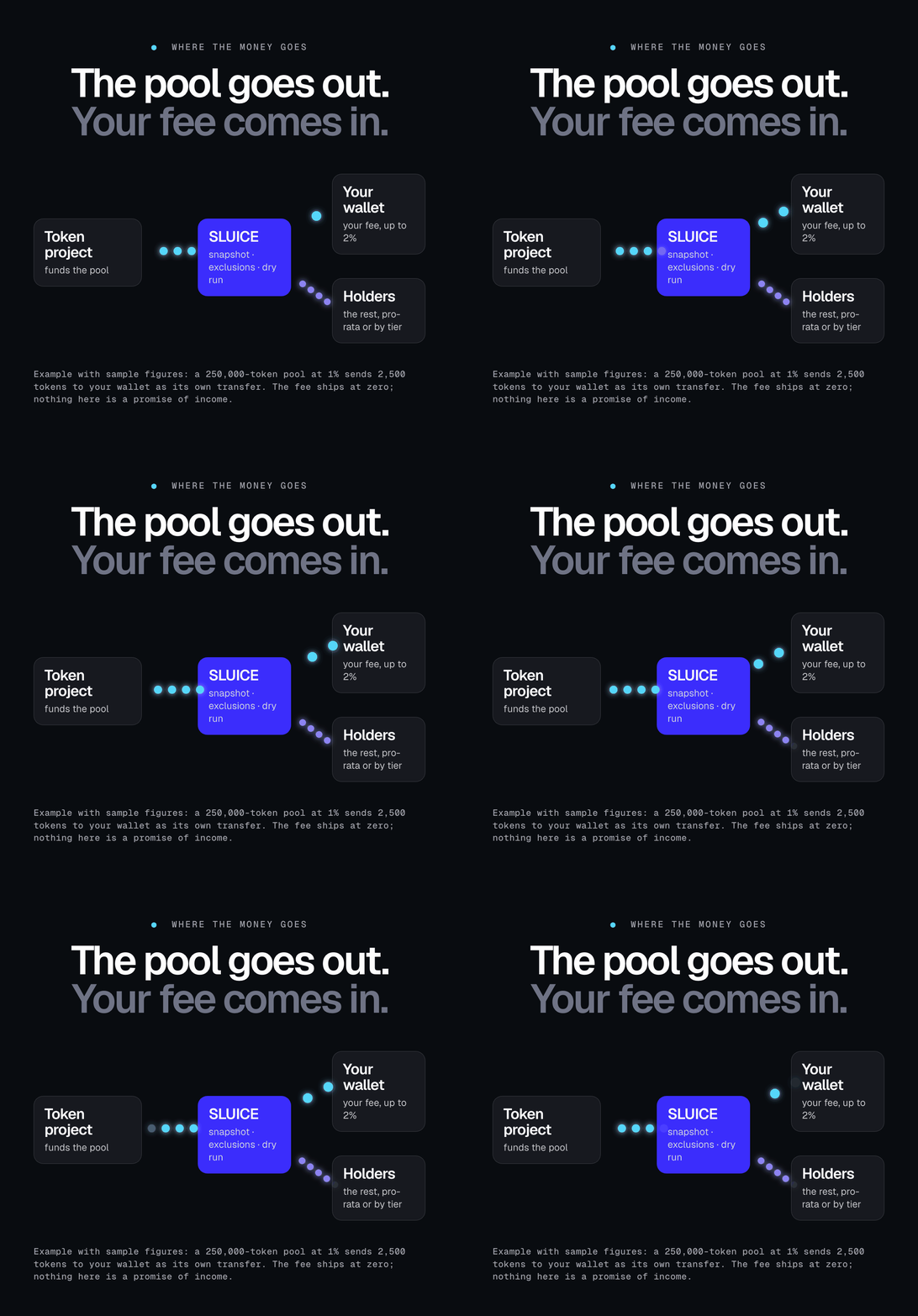
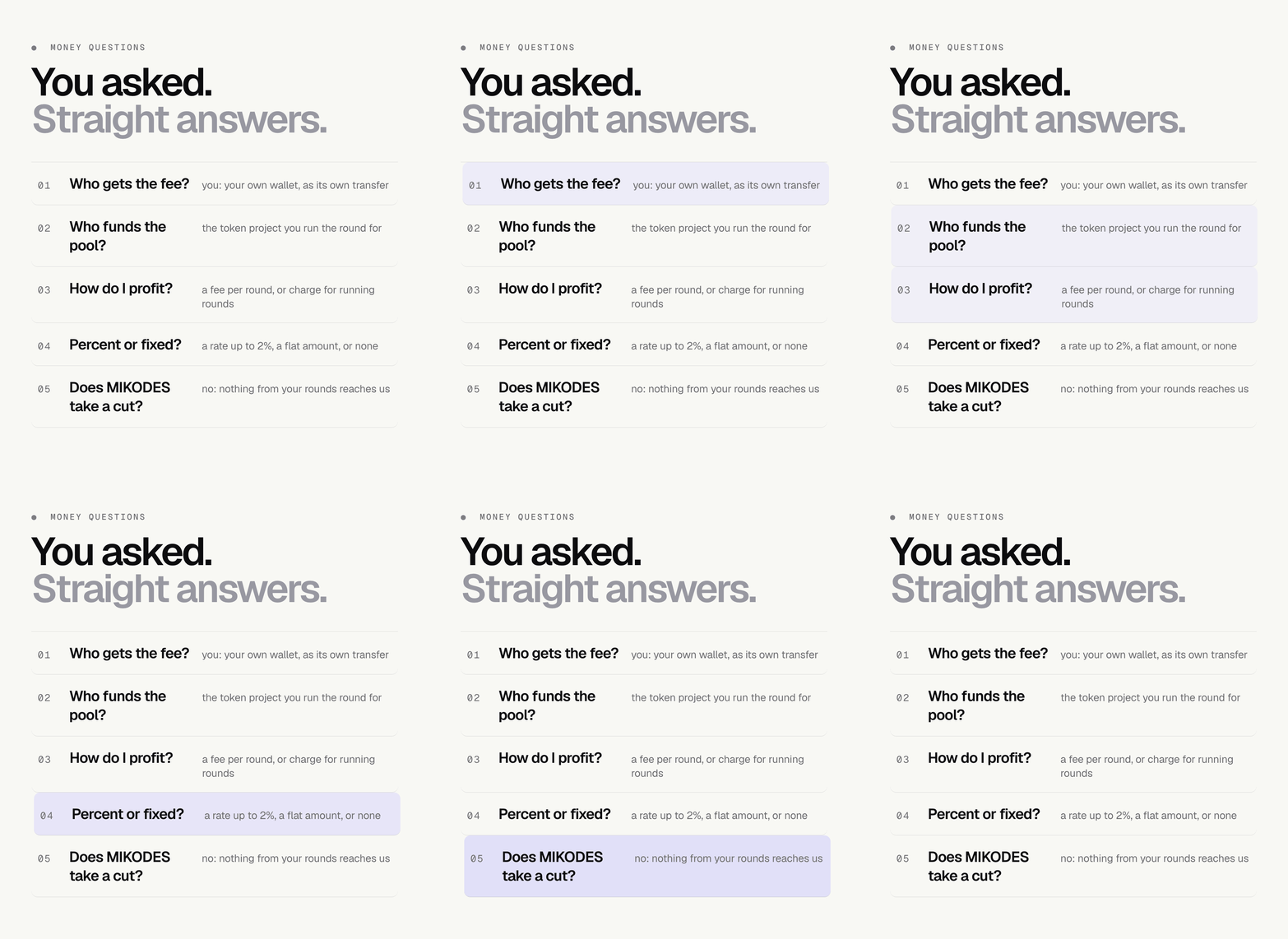
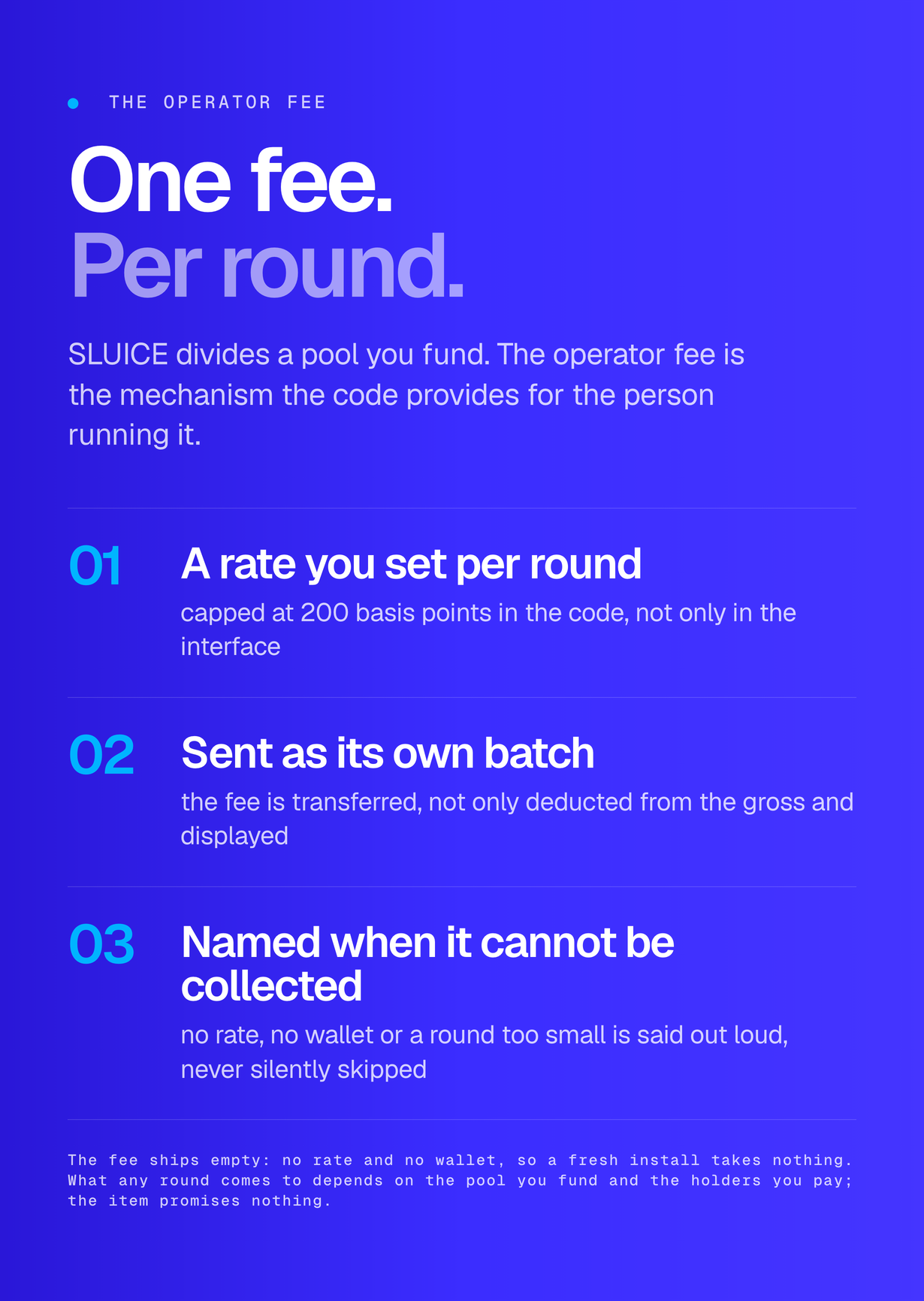
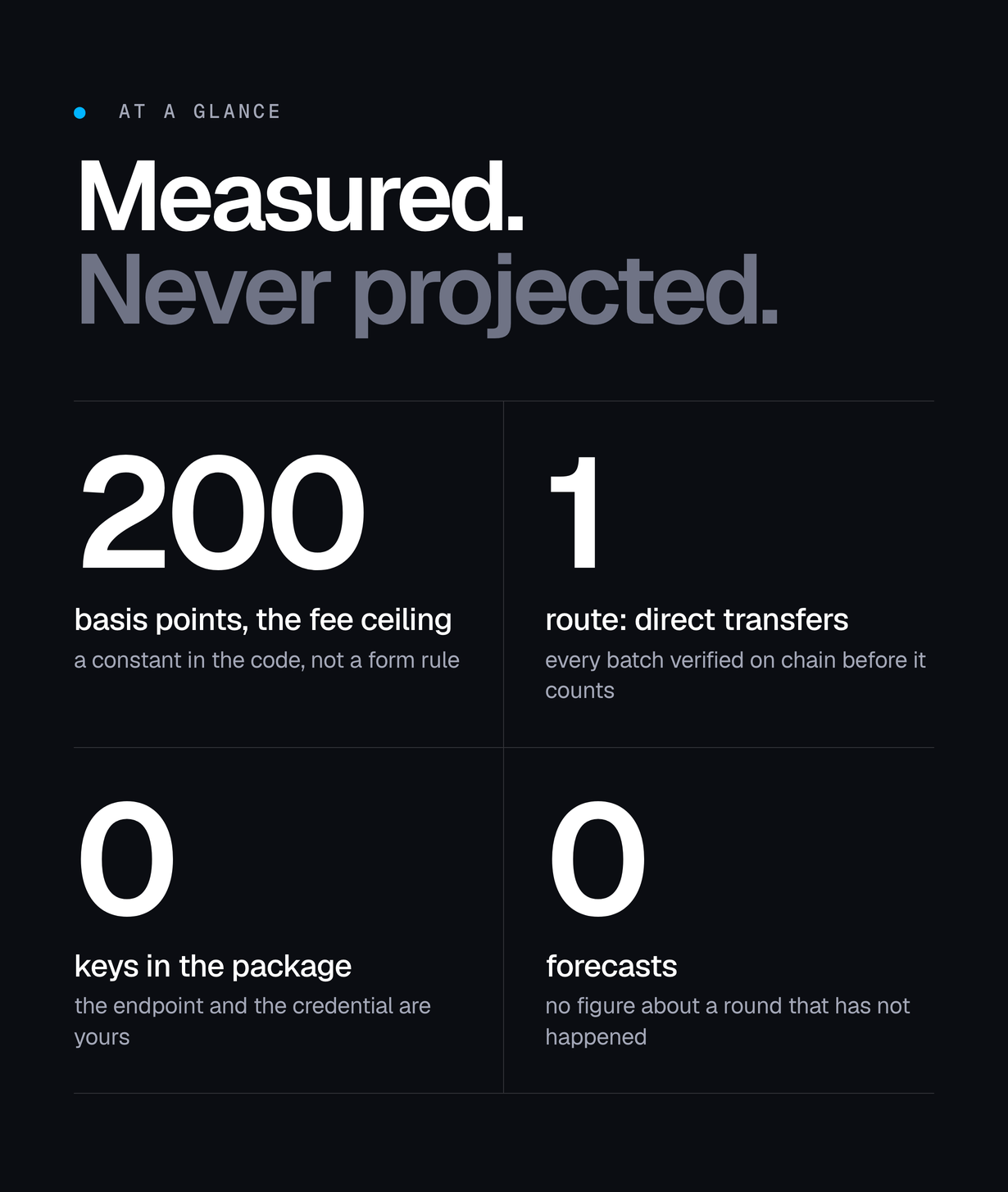
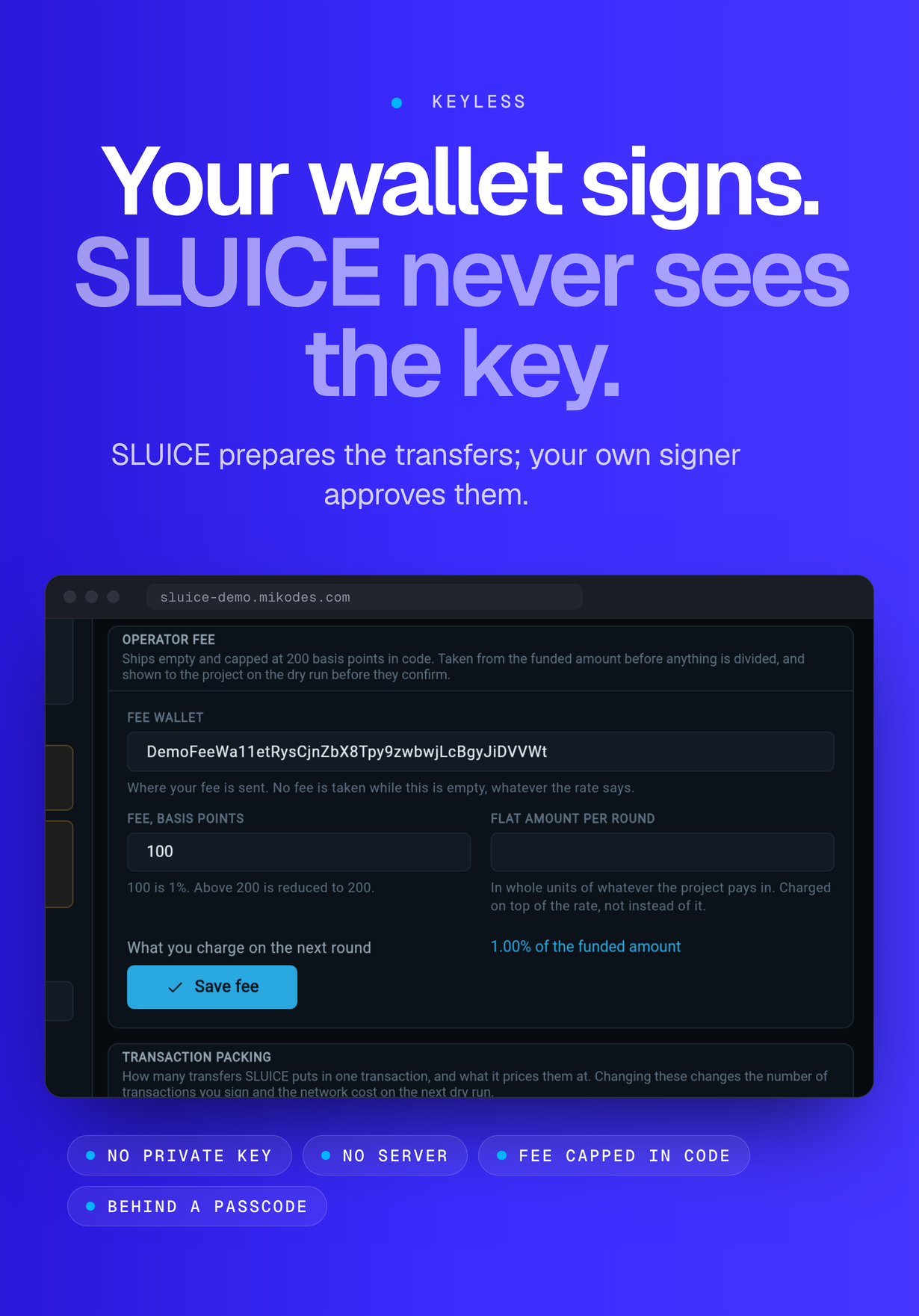
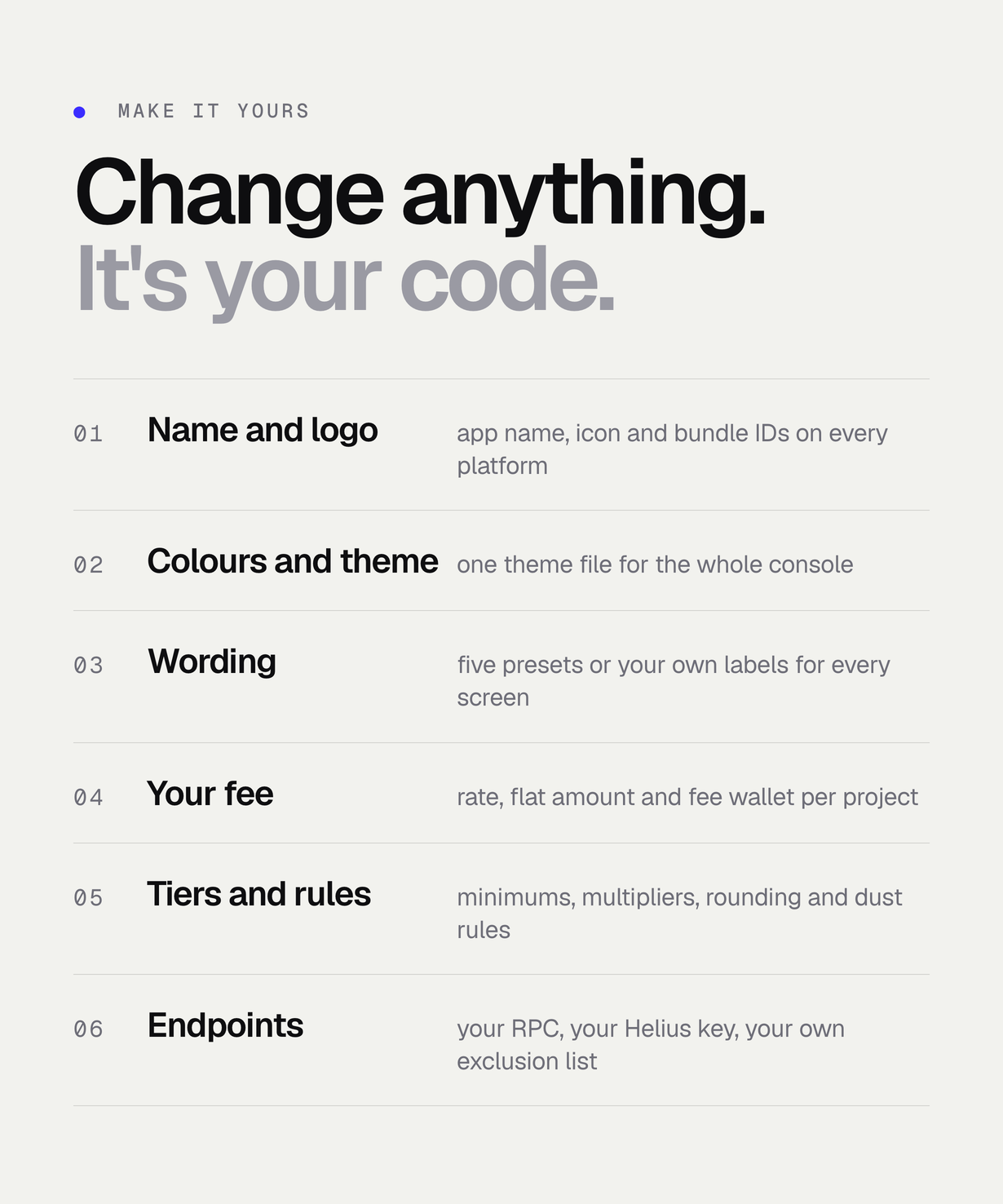
- Operator fee: a percentage, a flat amount or both per round, capped at 2% (200 bps) in code, paid as its own transfer and never skipped silently.
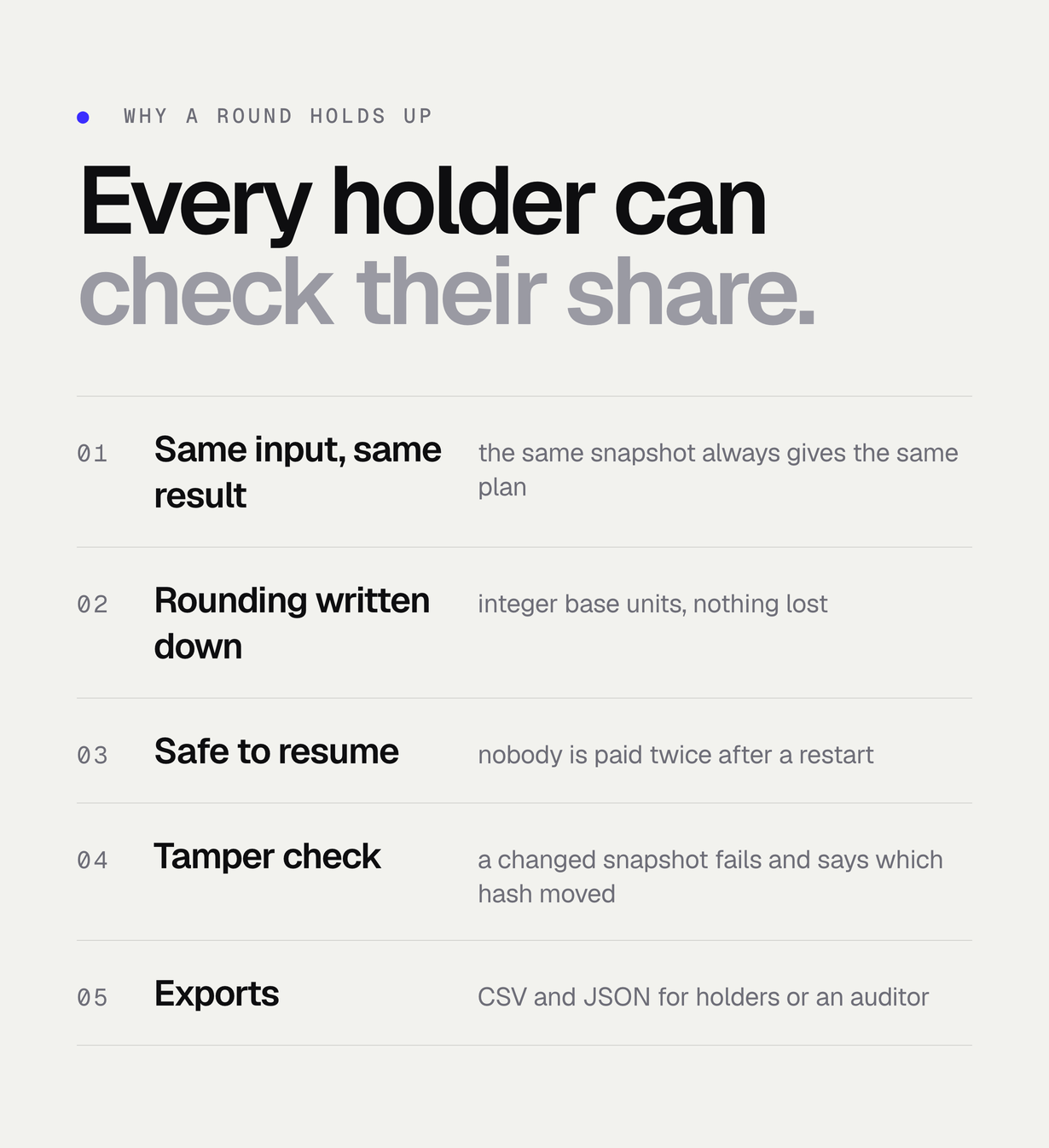
- Audit: dry run with evidence for every figure, round journal and safe resume, tamper check on the stored snapshot, CSV and JSON exports and an audit bundle.
Screenshots and preview images show the demo build: one sample round with sample holder addresses (all starting with Demo), every figure computed by the product, the DEMO strip left in frame. They are presentation material, are not part of the download, and no figure in them is a promise of a result. Device frames are illustrations.
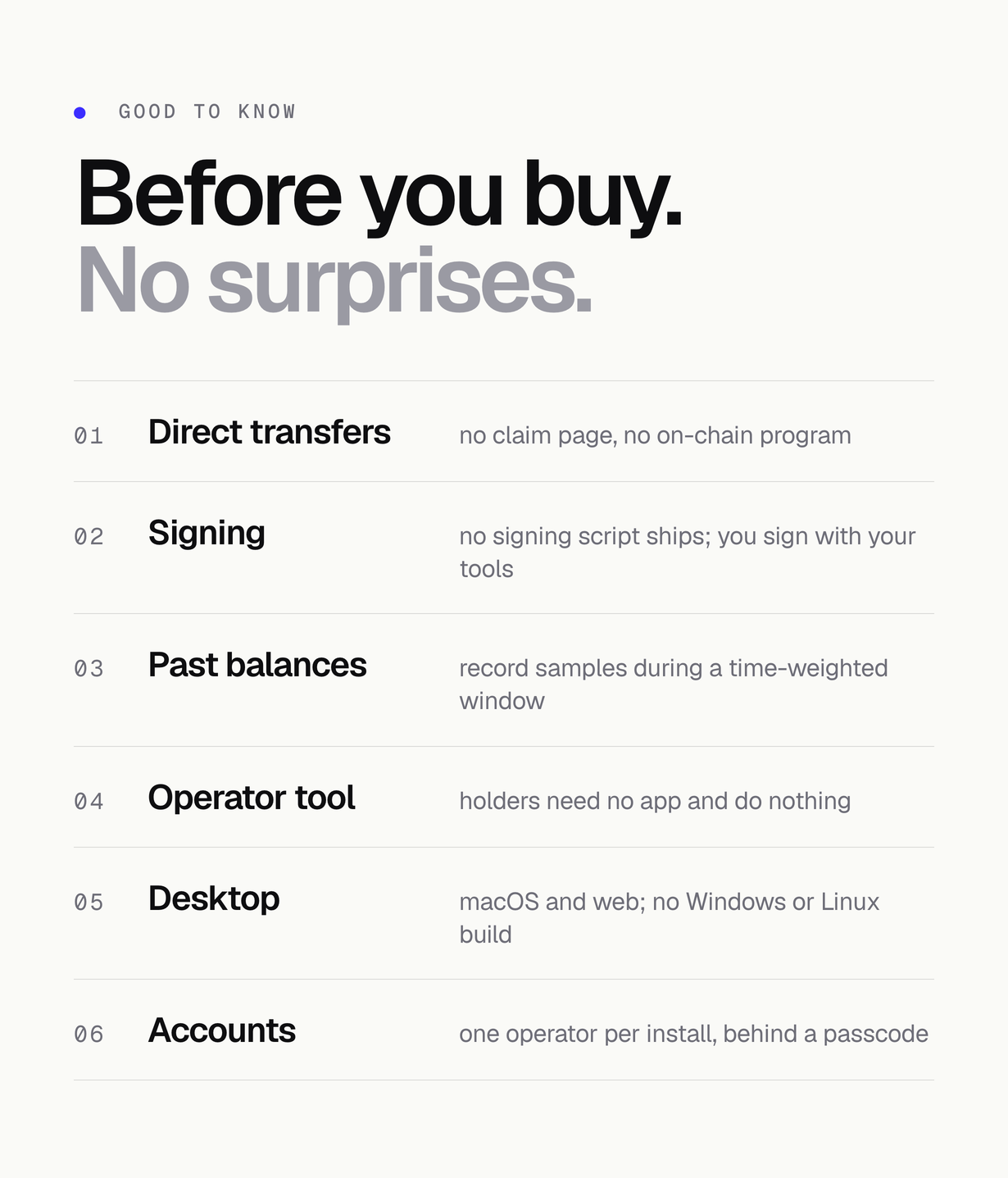
Good to know before you buy
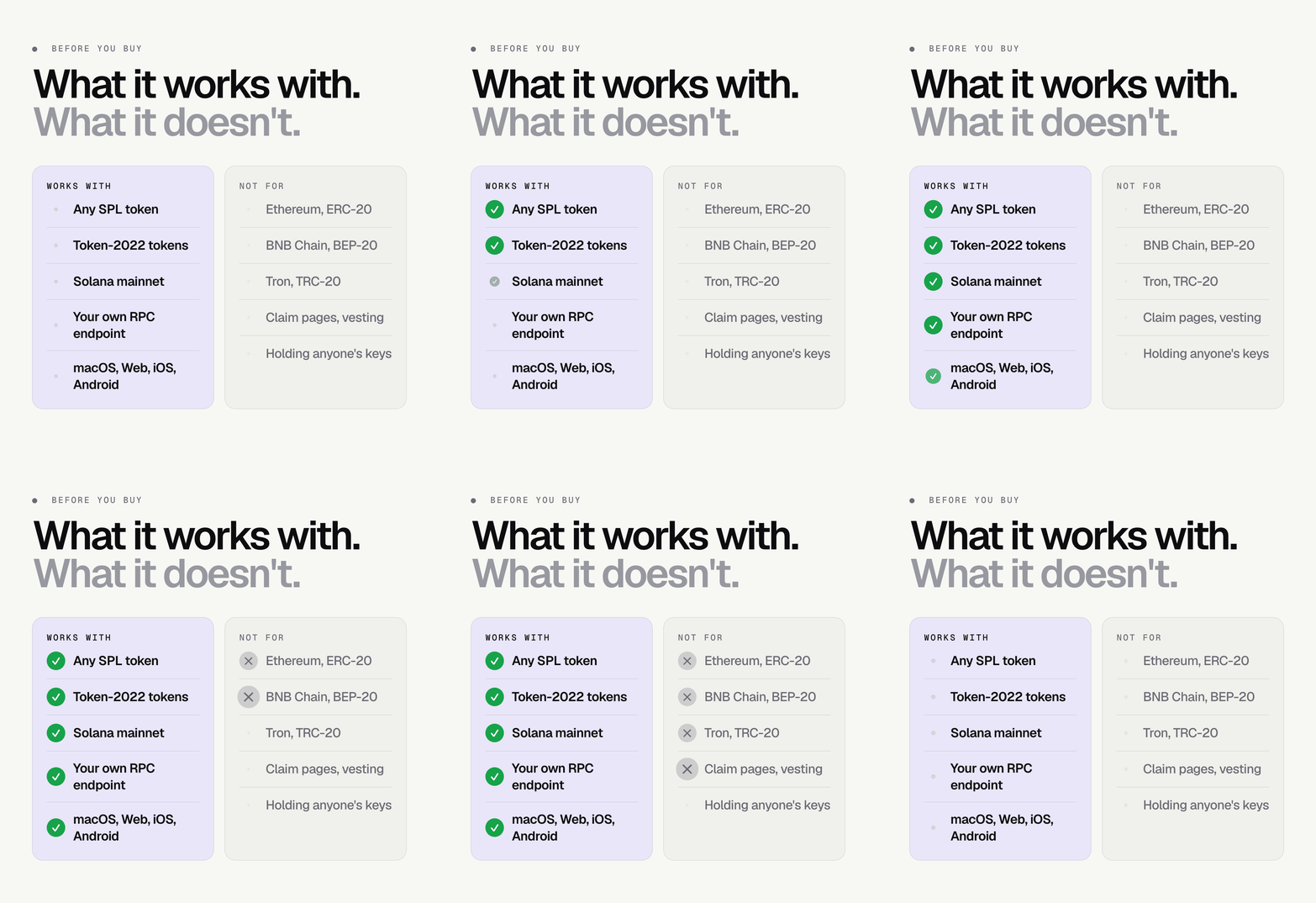
- Payouts are direct SPL transfers from your funding wallet. There is no claim page and no on-chain program.
- SLUICE prepares unsigned transfer batches as JSON; no signing script ships. You sign them with tooling you control (your own script, a hardware-wallet flow or a multisig) and paste the signatures back, and SLUICE verifies each batch on chain.
- Balances cannot be read at a past date from a normal RPC. For a time-weighted round, record balance samples during the window (for example once a day).
- It is an operator tool, not an app for holders: holders do nothing and need no app.
- Desktop targets are macOS and the web; Windows and Linux desktop builds are not configured.
- There are no user accounts: one operator per install, behind a passcode.
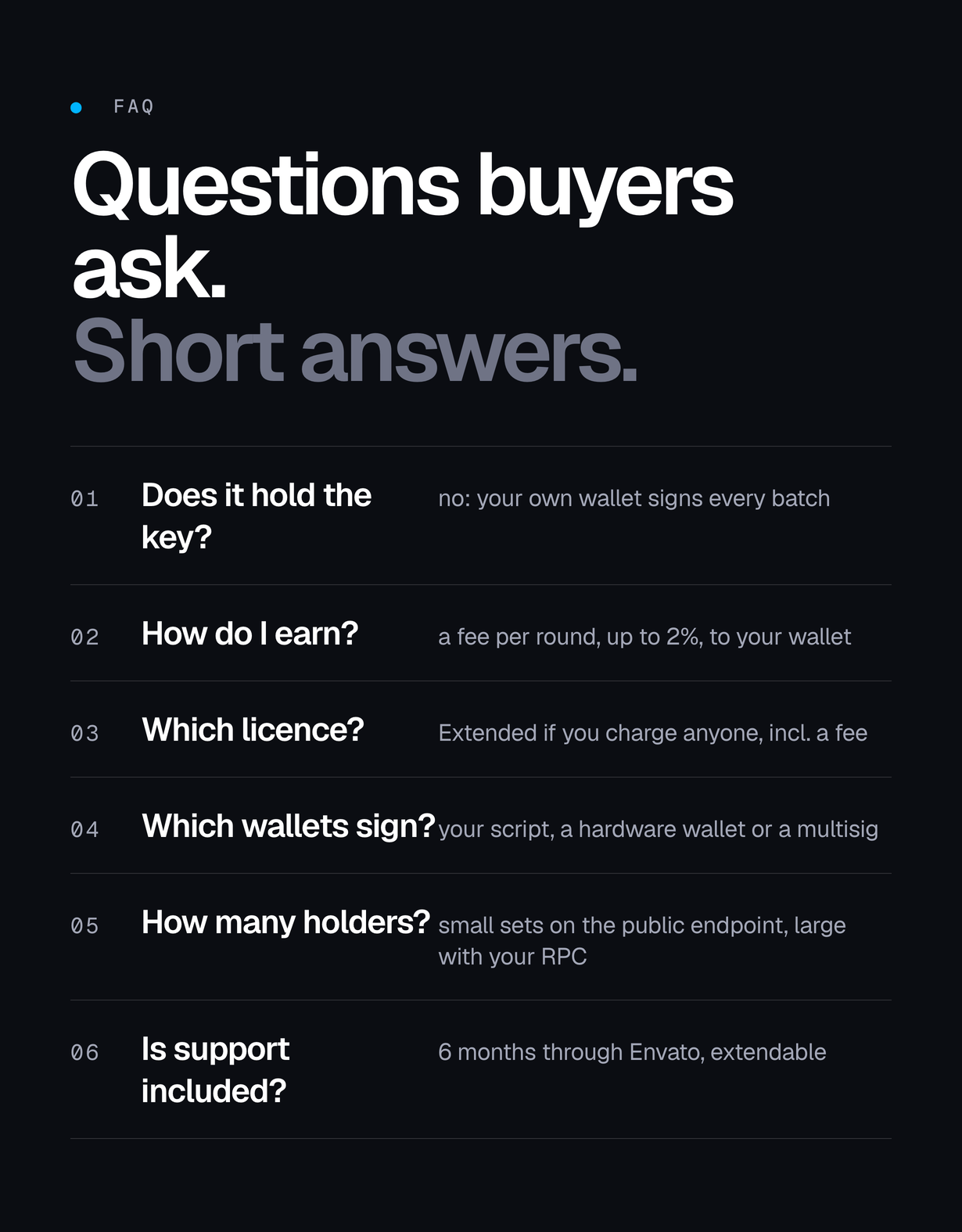
FAQ
Does SLUICE ever hold the pool or a private key?
No. It hands over unsigned instruction batches for your own signing tooling, and a test asserts that no shipped source carries an API key or a fee wallet. The funding wallet that holds the pool stays yours.
How does the operator earn from it?
You set a fee per round: a percentage, a flat amount, or both, up to 2% of the round combined, enforced in code. It is taken from the funded pool before division and sent to your own wallet as its own transfer. It ships at zero with no wallet set, so a fresh install charges nothing. What it comes to depends on the rounds you run.
What stops a holder arguing with the result?
Every figure in the dry run names the evidence it was measured from, the round re-derives from its stored snapshot hash, each paid batch is checked against its on-chain transaction, and the audit bundle lets anyone re-run the division. Where the numbers do not settle a question, the report says so instead of guessing.
How are holders paid?
By direct SPL transfers from the funding wallet, prepared as unsigned batches for your own wallet to sign. Holders do not have to do anything, and no on-chain program is needed. After signing, you attach each signature to its batch and SLUICE checks the transaction on chain before it counts the batch as paid.
Can I weight holders by tier or by time held?
Yes. Tiers are edited in the project form (balance multipliers or fixed portions of the pool). For time weighting, record balance samples in the console during the window – for example once a day – and run the dry run over the last N days. A past balance cannot be read on an ordinary RPC endpoint, so samples have to be taken during the window.
What happens if a distribution is interrupted?
The round journal records what was finalised. On resume a finalised batch is never handed out again, checked by recipient rather than by position, and the operator fee batch is covered by the same rule.
Can I change the wording for my own community?
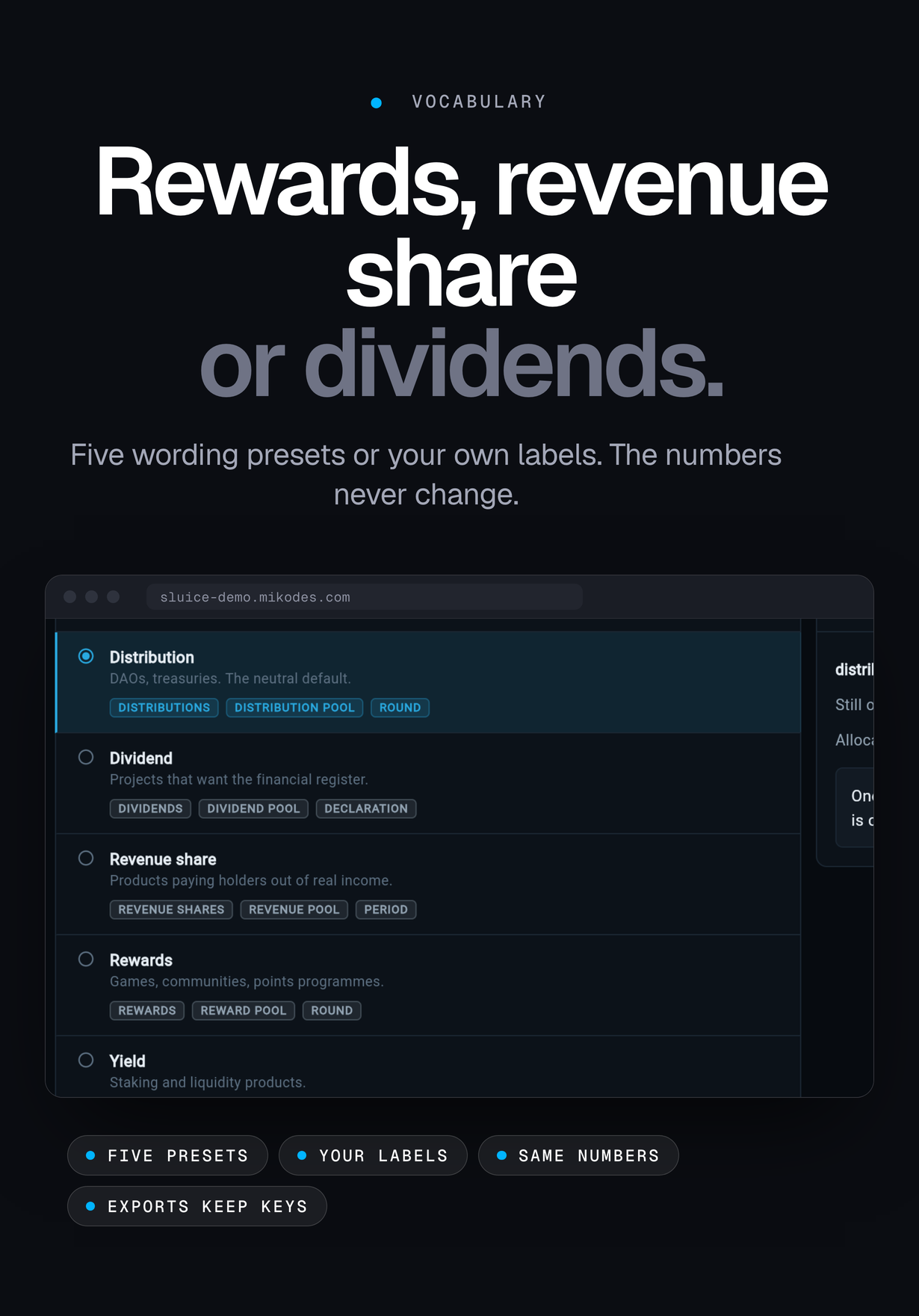
Yes. Five presets (distribution, rewards, revenue share, dividend, yield) or twenty-two labels of your own. They rename the main labels (the action button, the project form, the dry-run report, the holder ledger and the rate figures); engine warnings, batch states and exports keep the default words, and the documentation lists which is which. A test renders the dry run under every preset and requires the same numbers, so the words never move a figure.
What is not included?
Hosting, a domain or any backend – SLUICE has none by design; third-party API plans and developer accounts; blockchain network fees and token-account rent, which the funding wallet pays and the dry run estimates first. SLUICE pays by direct transfer only, and it does not read balances at a past slot.
What support is included?
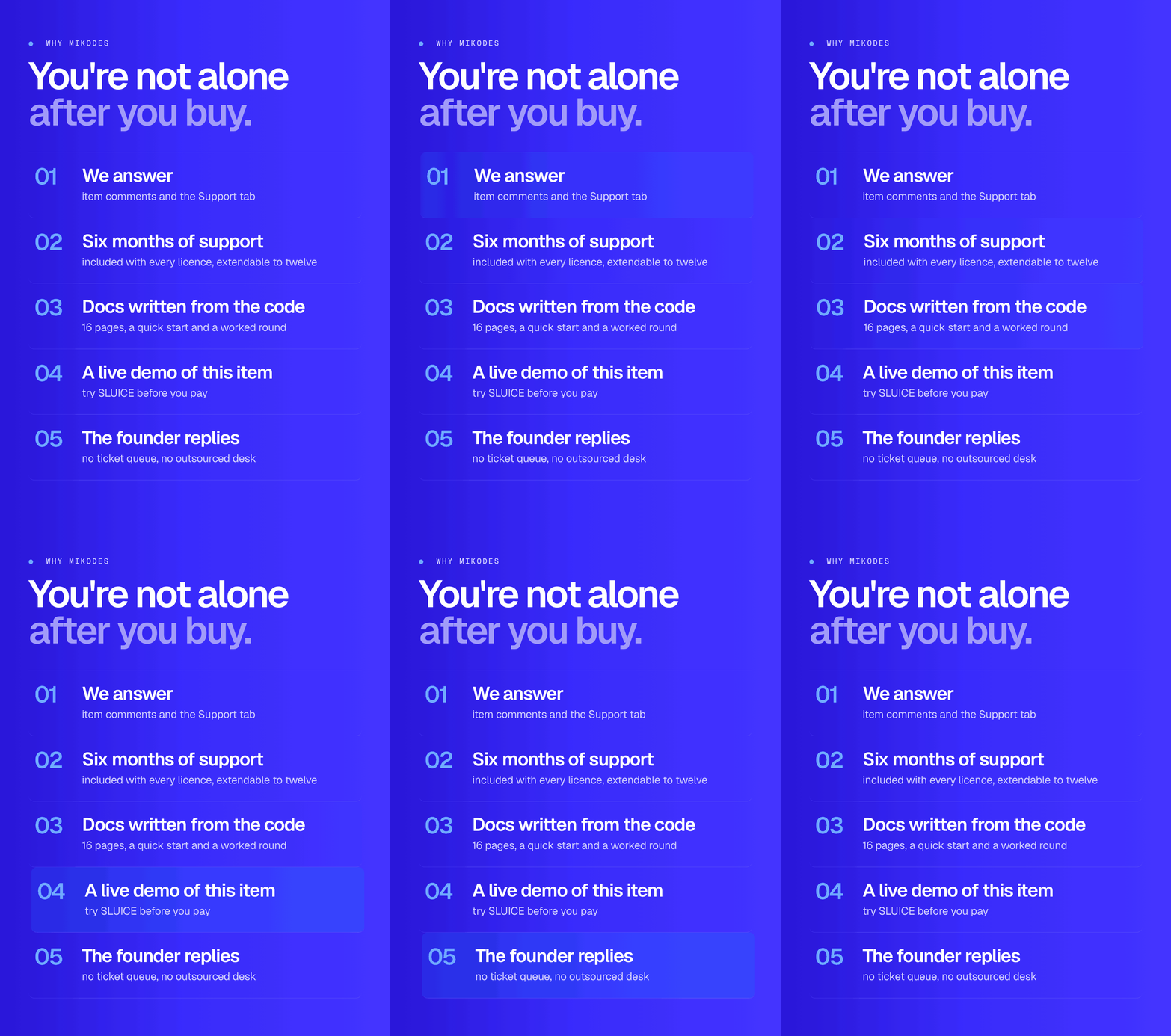
Six months of item support from the purchase date are included with the purchase under Envato’s item support policy, and the support period can be extended through Envato. Support covers questions about how the item works and fixes for bugs in the code as delivered; customisation, third-party services and your own hosting are not. Never send private keys, seed phrases, keystores or API keys in a support message – they are never needed and will never be asked for.
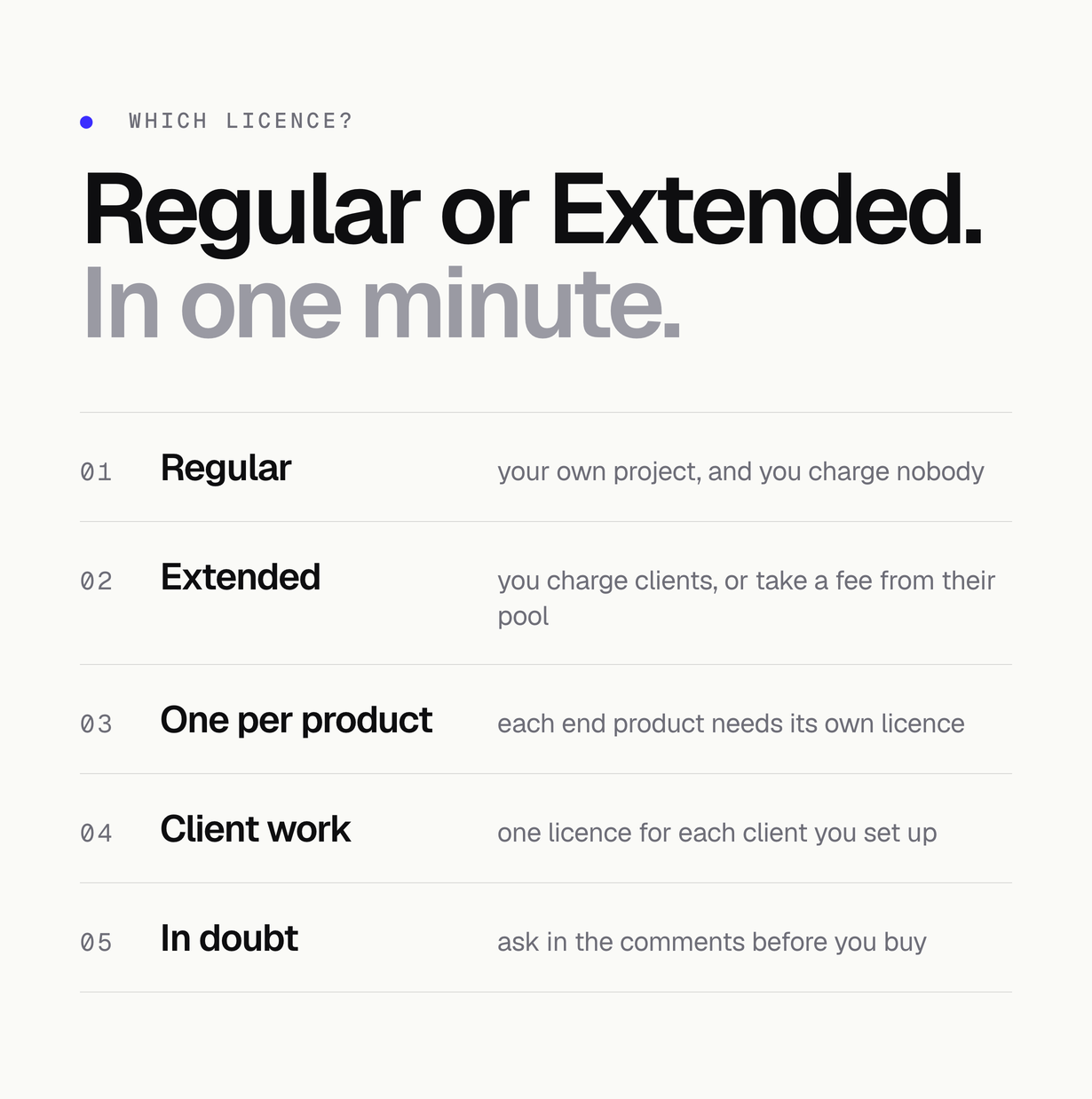
Regular or Extended licence?
Use the Regular licence when nobody is charged for using your deployment, for example airdrops for your own token. If you charge anyone, including an operator fee taken from a client project’s pool, you need the Extended licence under Envato’s licence terms.
Credits
Solana, Token-2022, Helius, Dexscreener and Solscan are named to describe compatibility; the names and marks belong to their owners. No font file is bundled – the app uses the platform UI font – and the icons are Material Icons shipped with the Flutter SDK. Every Dart package used is listed with its licence in the credits page of the documentation and in the third-party licence file in the download.
Which wallets can sign the payouts?
SLUICE never signs. It exports each batch as unsigned instructions in JSON, and you sign with tooling you control: a script of your own, a hardware-wallet flow or a multisig. No signing script ships with the item. You then attach each signature and SLUICE checks the transaction on chain before it counts the batch as paid.
How many holders can it handle?
The public default endpoint works for small holder sets. For large ones use an RPC endpoint on your own account and, optionally, a Helius key for paginated holder enumeration; the free tier covers most sets.
Declarations
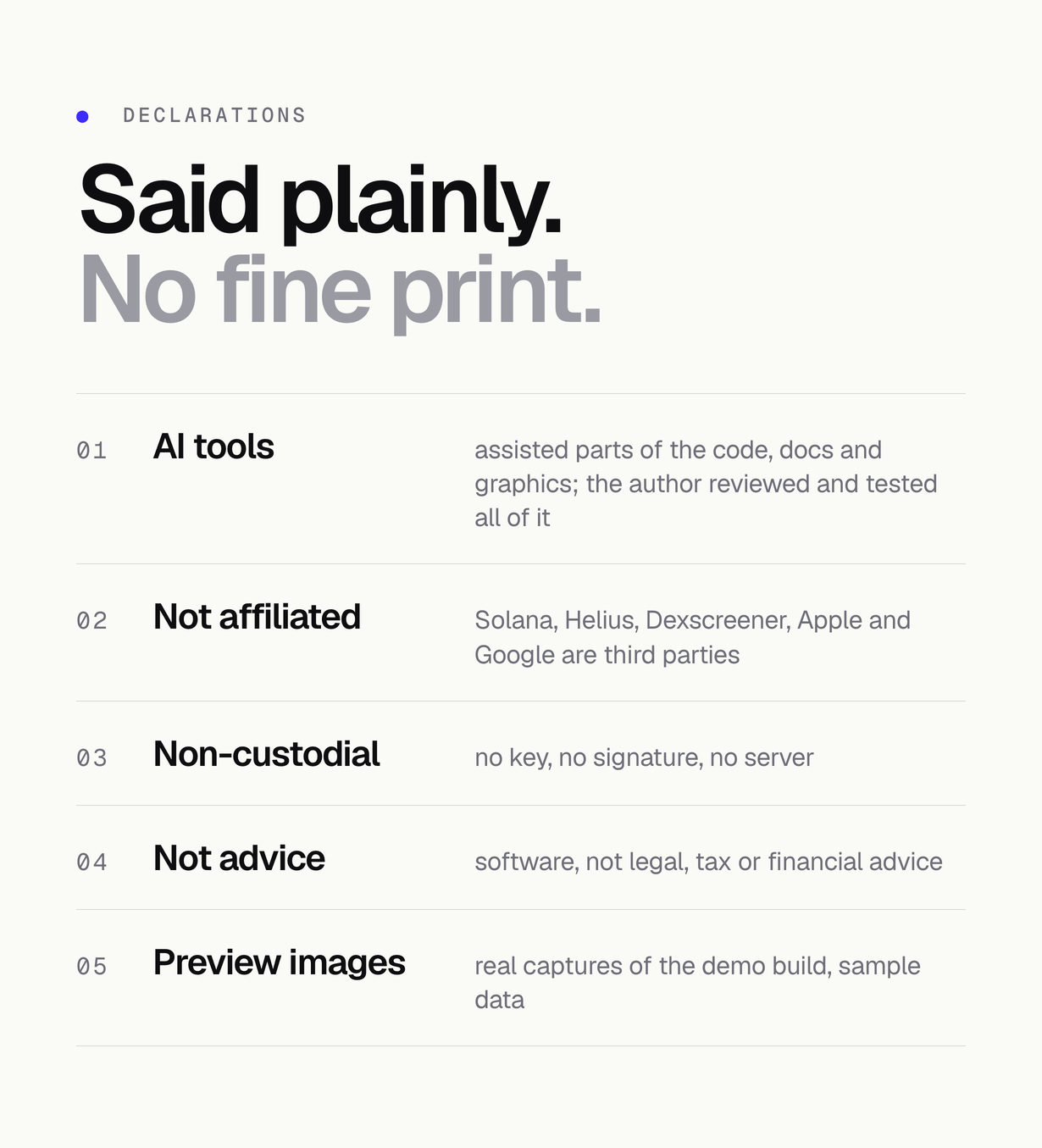
- AI tools: yes. AI tools were used to assist with parts of the code, documentation and graphics of this item. The author directed, reviewed and tested every part before release: flutter analyze reports no issues and flutter test passes, including tests that assert no API key, credential or fee wallet is in the shipped source and that every figure shown is measured rather than projected. The dependencies are the public packages listed in pubspec.yaml and licenses/THIRD-PARTY-LICENSES.md.
- Not affiliated: Solana, the SPL Token programs, Helius, QuickNode, Alchemy, Dexscreener, Solscan, Apple, Google and Flutter are third parties, named or shown only to describe compatibility. This item is not affiliated with, endorsed by or sponsored by any of them; the names, logos and marks belong to their owners.
- Non-custodial and keyless: SLUICE holds no private key, produces no signature and has no server: it emits unsigned instruction batches as JSON for the project’s own wallet to sign. The console that sets the projects, the funding wallet and the operator fee is compiled in only with an operator passcode and opens only after it is entered. The operator fee ships at a zero rate with an empty wallet, and its ceiling is a constant in the code rather than a form rule. No author ID, API key or wallet address ships in the download.
- Distributions and the law: distributing tokens, revenue shares or holder rewards is regulated differently from country to country. This item is software, not legal, tax or financial advice, and every figure it shows is measured from public on-chain data, never a forecast.
- Preview material: the screenshots, the cover and the preview images are real captures of this item’s demo build (SLUICE_DEMO=true), composed by the author’s own build scripts. The holder set in them is sample data whose addresses all start with Demo; every figure is computed by the product from it. They are presentation material, not part of the download, and no figure in them is a result or a forecast.
Requirements
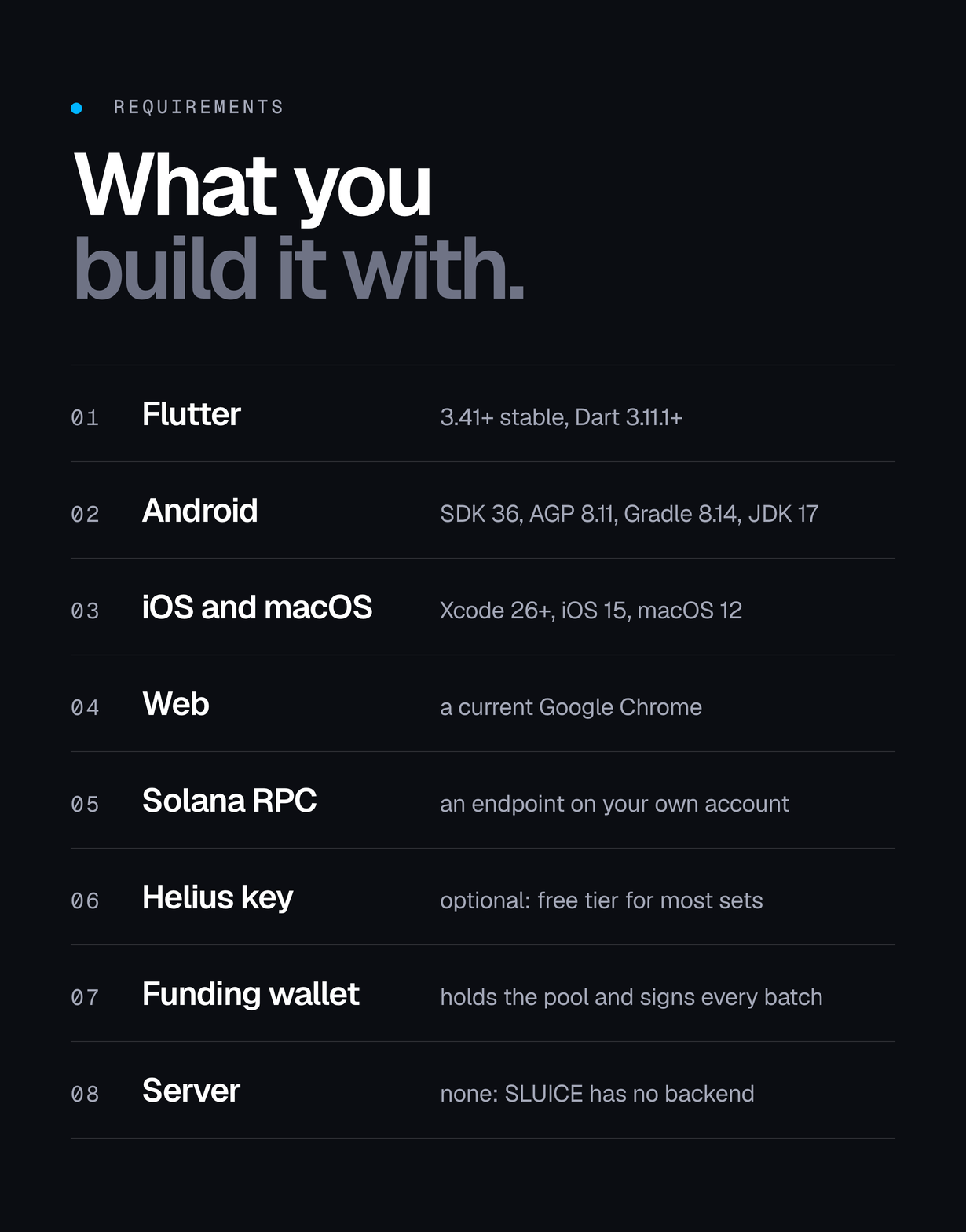
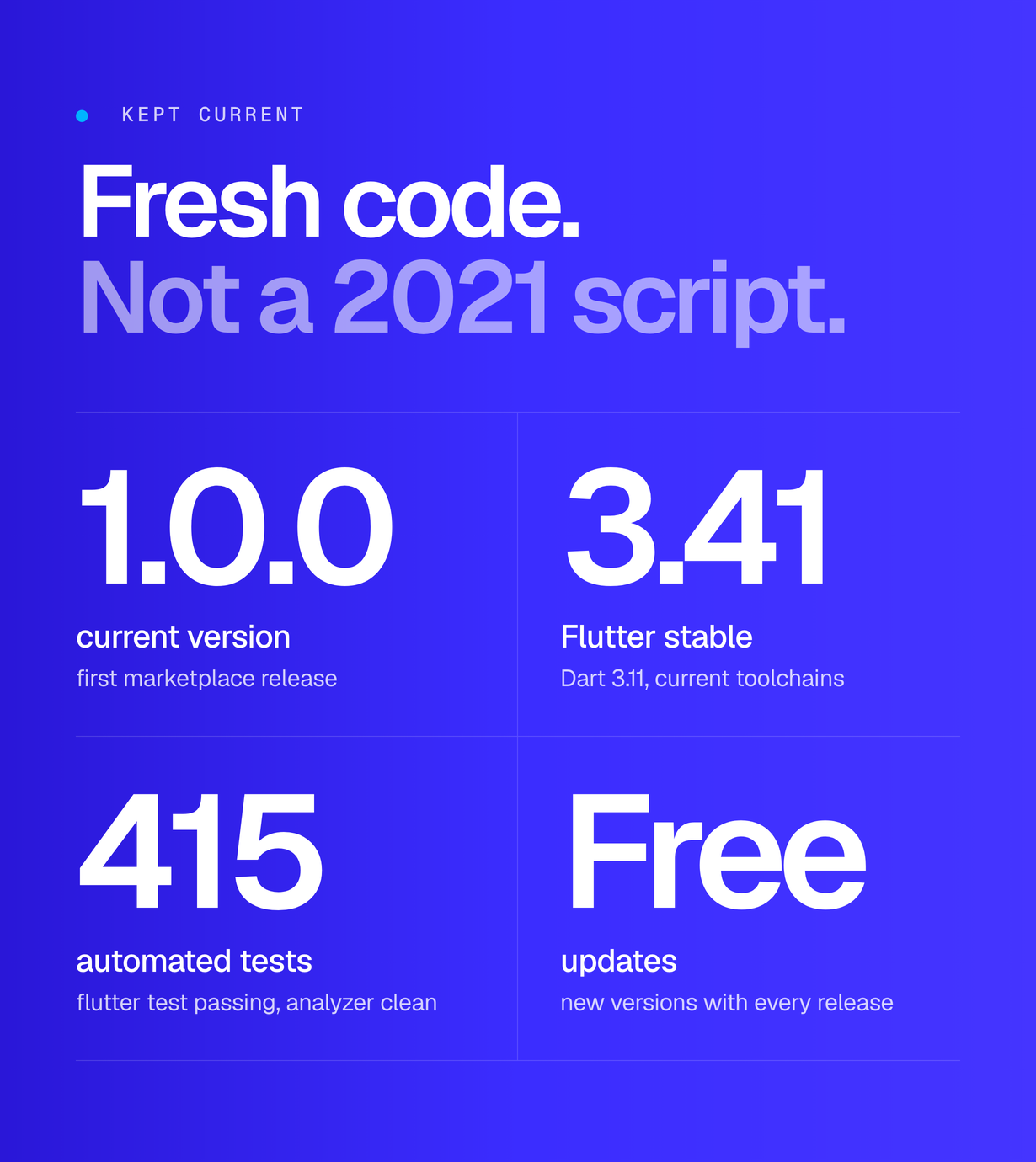
- Flutter 3.41 or newer on the stable channel (Dart 3.11.1 or newer). pubspec.yaml declares Flutter >=3.41.0 as its lower bound; verified with Flutter 3.41.4 and Dart 3.11.1
- Android builds: Android Studio Narwhal 2025.1.1 or newer, Android SDK Platform 36 (compileSdk = 36), Android Gradle Plugin 8.11.1, Gradle 8.14 and JDK 17
- macOS and iOS builds: Xcode 26 or newer on a Mac (checked with Xcode 26.4.1 and Xcode 27.1). macOS 12.0 minimum, iOS 15.0 minimum. Windows and Linux targets are not configured; on a Windows PC run the shell commands from WSL or Git Bash
- Web build: a current Google Chrome. A browser has no keystore, so the endpoints and the Helius key typed into the web build last for the session
- A Solana JSON-RPC endpoint on your own account – the shared public endpoint rate limits hard and often refuses getProgramAccounts
- An optional Helius API key for paginated holder enumeration (the free tier covers most holder sets); without it SLUICE falls back to getProgramAccounts, which is the first call to fail on a large holder set
- A funding wallet that holds the pool and signs every batch – SLUICE never holds its key – and signing tooling you control (a script, a hardware wallet or a multisig)
- No on-chain program is needed: every recipient is paid by a direct SPL transfer from the funding wallet
- No Node.js, database or server is needed: SLUICE has no backend
Changelog
v1.0.0 (first release)
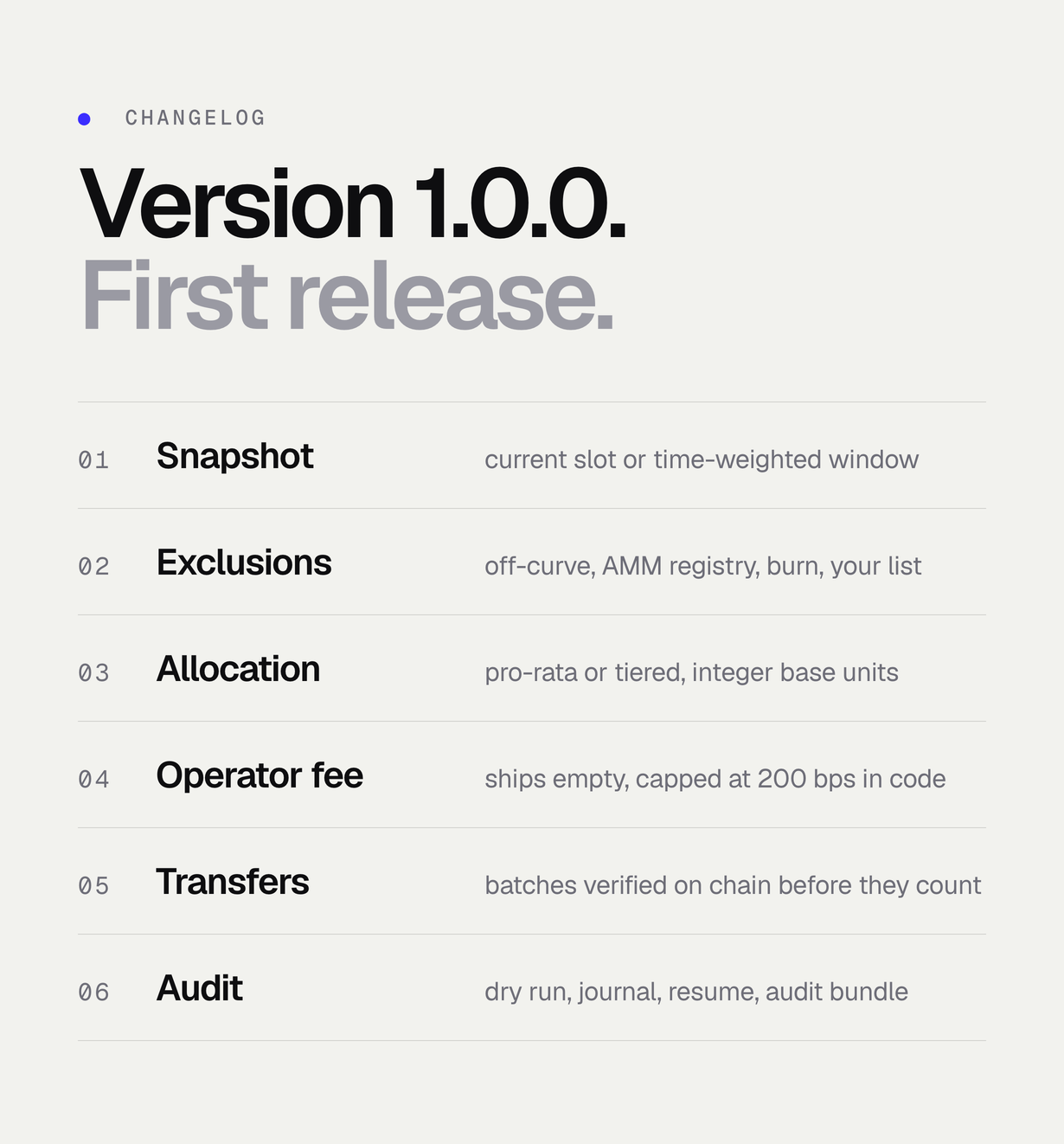
- First marketplace release: the engine and the operator console.
- Snapshot at the current slot, or time-weighted over a window from balance samples recorded in the console.
- Exclusions by off-curve detection, an AMM program registry, burn addresses and operator lists.
- Pro-rata and tiered computation (with a tier editor) in integer base units with documented rounding and dust rules.
- An operator fee that ships empty, is capped at 200 basis points in code and is transferred as its own batch.
- Direct transfer batches with Compute Budget instructions, each verified on chain against its recorded transfers before it counts as paid.
- Dry run, audit trail, audit bundle, reproducibility check, round journal and resume.
- Five vocabulary presets.
- The SLUICE product icon on every platform.
- The console is compiled in only with an operator passcode.
- The web build has a strict Content-Security-Policy and stores no key or endpoint.
- The full release notes are a page in the documentation.
| Author | Mikodes |
|---|---|
| Price | $199 |
| Sales | 0 |
| Rating | 0 (0) |
| Published | Nov 3, 2026 |
| Last Update | Nov 3, 2026 |
| Compatible Software | Flutter 3.x |
| Demo Url | https://sluice-demo.mikodes.com |
| Mobile Files Included | Dart, YAML, JavaScript JSON, .java, .kotlin, .plist, .swift |
Categories
Tags
External listing. code.market does not sell this product and does not process payment for it. Pricing, payment, delivery, licensing, refunds, and support are handled by the third-party merchant on its own website. We may earn an affiliate commission from a referral. Details.
Products of the Week.
Submit🥇

Perceptle
Perceptle is a daily browser-based game that challenges you to test your sensory intuition through five quick estimation and rhythm-based rounds.
Other · 1 views · 0 clicksOther · Week 47 · 1 views · 0 clicks
🥈

Free LinkedIn Likes From Real
Get free LinkedIn likes on your posts from real members who react by hand. No
SaaS · 124 views · 2 clicksSaaS · Week 47 · 124 views · 2 clicks
🥉

STOP GUESSING WHAT TO POST
AI that learns your brand voice and builds a month of consistent, on-brand social content: carousels, posts and hooks that sound like you, not like everyone else's AI.
SaaS · 7,686 views · 71 clicksSaaS · Week 47 · 7,686 views · 71 clicks
#4

aaas.market
407 reliable micro tools for solo founders, marketers and creators. They work in your browser
SaaS · 122 views · 0 clicksSaaS · Week 47 · 122 views · 0 clicks