
Shelfora | Flutter AI Book Tracker App with Laravel Key Proxy
Description
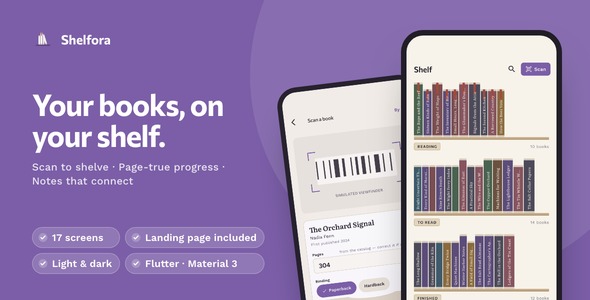
Ship a reading app people actually open: 17 screens and 11 sheets, a barcode scan that puts a book on a shelf of real spines in two taps, and one color file that re-skins every one of them. A Laravel key proxy and a one-page product website are in the same download. Light and dark themes, GetX architecture, offline documentation, 243 passing tests.
Demo Instructions: the sign-in screen is a mock and contacts no server, so any credentials are accepted. Use demo@shelfora.app / demo1234, or tap Sign in with both fields left empty. There is nothing to register, no API key to enter and no network required: Demo mode is on out of the box, so 36 sample books, 104 reading sessions and an 11-day streak are on screen the moment the preview opens. Onboarding has a Skip in the corner.

Why this one
- The figures are arithmetic, not a model: pace, time remaining, the finish date, the year totals, the streak and every distribution come out of a plain-Dart engine with no Flutter import and an injected clock, so two readers with the same log get the same numbers and the bundled tests can assert on them.
- Ready to show on day one: 36 books across three shelves, 104 sessions spread over 120 days and a live streak ship inside the app, and while that sample is loaded the app pins “today” to the sample’s own date. That is why the screenshots, the live preview and the tests all agree with each other.
- Tested, not just screenshotted: 243 tests pass, the driver walks every screen and every sheet on a simulator,
flutter analyzereports zero issues, and the Laravel back end has 36 tests of its own.

The screens people will remember
The shelf. Every book is drawn as a spine, as wide as its page count and as tall as its binding, in a cloth color derived from its title. Three shelves with brass plates, and a ribbon over the head of anything being read. Tap a spine and it rises out of the shelf; drag it to move it. There are no cover images anywhere, and none are needed.

Scan to shelf. Hold a barcode in the frame and a library card comes out of its paper pocket with the title, author, year and page count on it. Correct the page count if the catalog got it wrong, pick a shelf, and the spine slides in. Already on your shelf, or no catalog entry at all, are both first-class outcomes rather than errors.

The fore-edge. The book seen from the side as a block of page edges, read pages inked, with a madder tab standing out of the block at the page every sitting ended on and its date above it. Drag along it to move the bookmark. It shows the shape of how a book was read, which a progress ring cannot.

The year. The books finished this year stacked flat, each slab as thick as its page count, with the goal a dashed line beside the pile. A year of long books stands taller than a year of short ones at the same count.

Plus the screens a real app needs: onboarding, a mock sign-in and register, a reading list with a log-a-sitting sheet, a book’s own page, a notes editor, the full session history grouped by day, a goal screen, settings, an about screen that prints how every figure is worked out, and a mock paywall.

Laravel back end included
The download ships a Laravel key proxy in backend/: it holds the API keys for OpenAI, Anthropic and Google, gives every device a per-day allowance, and logs usage on a Filament dashboard, so your users never see an API key. The app runs perfectly without it — point it at nothing and it works on the device, or let each user bring their own key. Deployment is PHP 8.4 or newer, or the bundled Docker compose file, and the provider usage is billed to your own account on whichever vendor you configure. Reading data never reaches the server: the three tables it owns are devices, usage logs and settings.

Landing page included
The download ships a one-page product website for your app (landing/): hero with two phone mock-ups, three feature tiles, a swipeable screen gallery, FAQ and store buttons, already set in the same colors and typefaces as the app and filled with its real screenshots. It is a single self-contained HTML file with no frameworks and no external requests, so you can put it on any static host in a minute and replace the copy and store links from the marked spots.

Built for developers
- Clean GetX architecture: View, Controller, Service, Model, with lazy bindings per route and no mock import anywhere under
modules/. - Five runtime dependencies, and the AI clients are plain REST — no vendor SDK can break your build when it publishes a major version.
- Swap the store in one class: every screen reaches data through one service, and that service touches storage through three members. A SQL-backed version of them is a drop-in, and chapter 10 walks through it.
- Swap the catalog in one interface: Open Library needs no key and ships as the default; add your own and Google Books joins it as a second source. Two methods to implement if you have a license for something else.
- Theme-aware components: one color file, four fences written down in it, and the same widgets look right in light and dark.

Requirements
Flutter SDK 3.29 or newer, and Dart 3.7 or newer. Builds for Android and iOS from the same source; a web build is included for the live preview and falls back to typing an ISBN, because a browser has no barcode scanner. The Laravel back end needs PHP 8.4 or newer — check what your hosting plan actually runs before you buy it, because a good many still default to 8.2.
What you get: full Flutter source code, the Laravel back end with its own deployment guide and 36 tests, the one-page product website, offline HTML documentation with two GIFs of the interactions in motion, three bundled variable typefaces under the SIL Open Font License, the sample shelf, light and dark themes, and the integration driver that produced every screenshot here.
AI disclosure
This template includes AI features, and this is what they do. At run time a model is asked for one thing only: to read the reader’s own shelf and their own written notes and produce a short note about them — three observations, one suggestion of what to read next from their to-read shelf, and up to three tags for each of the dozen books nearest to hand. It is never asked to score a book, never asked how fast somebody reads, never asked when they will finish, and never asked to look up a review, a summary or a rating; all of those figures are arithmetic in plain Dart over the reader’s own sessions. Who provides it and who pays: you bring your own API key from Google, OpenAI or Anthropic and are billed by that vendor directly, or you deploy the included Laravel key proxy and the usage is billed to your own account on the vendor you configure there. This item includes no key and no credits and makes no charge of its own. Without a key, and without the back end, the app is fully usable: scanning, the shelf, page progress, the reading engine, the year figures, notes, export and import never involve a model under any configuration, and Demo mode writes the shelf note on the device from the reader’s real shelf with no network call at all. The assets in this package are not AI-generated: there are no photographs, no illustrations and no image files of any kind beyond the launcher icon — every spine, pocket card, page block, pile, barcode frame and tab glyph is painted by a CustomPainter at run time — and the sample books, their titles, their authors, the documentation and all source code were written by the author. The sample books are invented; not one is a real book and not one author is a real person.

| Type | Flutter App |
|---|---|
| Author | coderqh |
| Price | $53 |
| Sales | 0 |
| Rating | 0 (0) |
| Published | Sep 9, 2026 |
| Last Update | Sep 9, 2026 |
| Compatible Software | Flutter 3.x |
| Mobile Files Included | Dart, YAML, JavaScript JSON, JavaScript JS, CSS, PHP, HTML |
Categories
Tags
External listing. code.market does not sell this product and does not process payment for it. Pricing, payment, delivery, licensing, refunds, and support are handled by the third-party merchant on its own website. We may earn an affiliate commission from a referral. Details.