
Phasora | Flutter AI Period Tracker App Template
Description
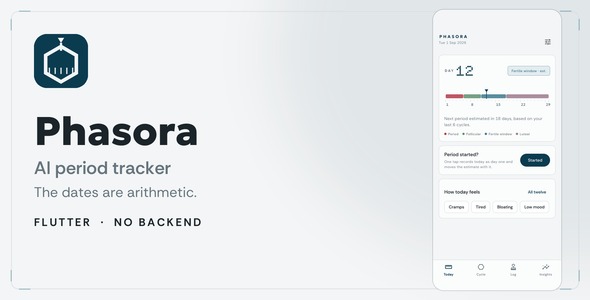
The dates are arithmetic. The model only writes them up.
Phasora predicts the next period, the phase you are in and a fertile-window estimate by averaging the dates the user entered — on the device, in plain Dart, with no model involved. Run it twice and you get the same answer, which is why the bundled tests can assert on a prediction.

Runs out of the box
Demo Instructions — the sign-in screen is a mock and contacts no server, so any credentials are accepted. Use demo@phasora.app / demo1234, or simply tap Sign in with both fields left empty. There is no account to register, no API key to enter and no network required: Demo mode is on out of the box, so every screen — including both AI features — works on the device. Onboarding has a Skip in the corner.
No backend. No Firebase. No real account anywhere. The app ships with ten cycles of sample history, so the first screen you see has something on it, and demo mode pins “today” to that history’s own date — which is why the screenshots, the live preview and the tests all agree with each other.
flutter pub get
flutter run
That is the whole setup. The project sits at the root of the archive; there is no wrapper folder to step into.
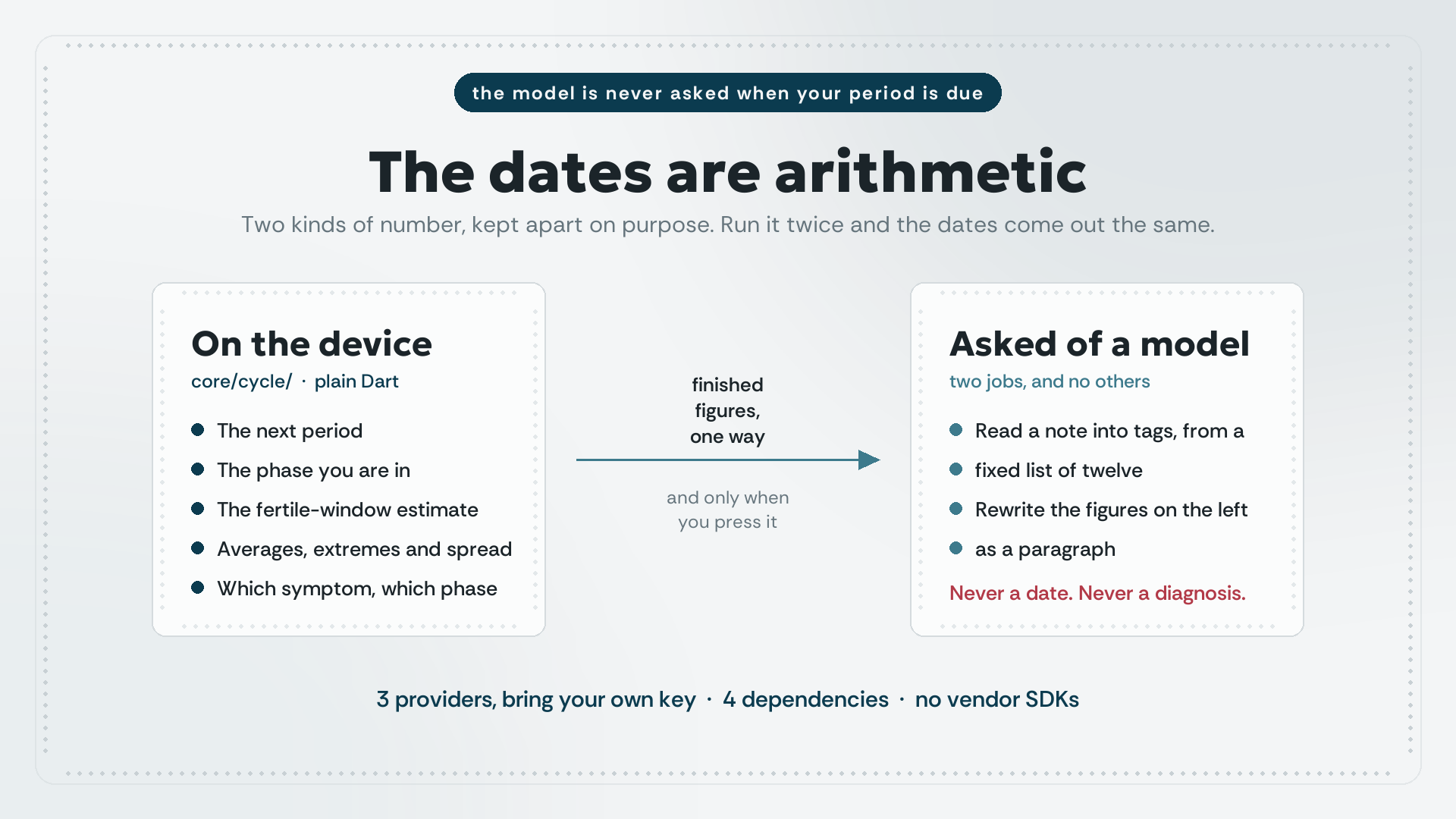
The model is never asked when your period is due
Two kinds of number, kept apart on purpose. The device works out the next period, the phase, the fertile-window estimate and every statistic. A provider is asked two things only: read a note into tags from a fixed list of twelve, or rewrite those figures as a paragraph. Never a date. Never a diagnosis.
Filled is recorded, outlined is a guess
The calendar never draws a guess like a record. A day logged as bleeding is filled; everything else on the month is projected from the user’s own past cycles and drawn differently for exactly that reason. The key sits under the calendar in the app, so a first-time reader never has to guess.

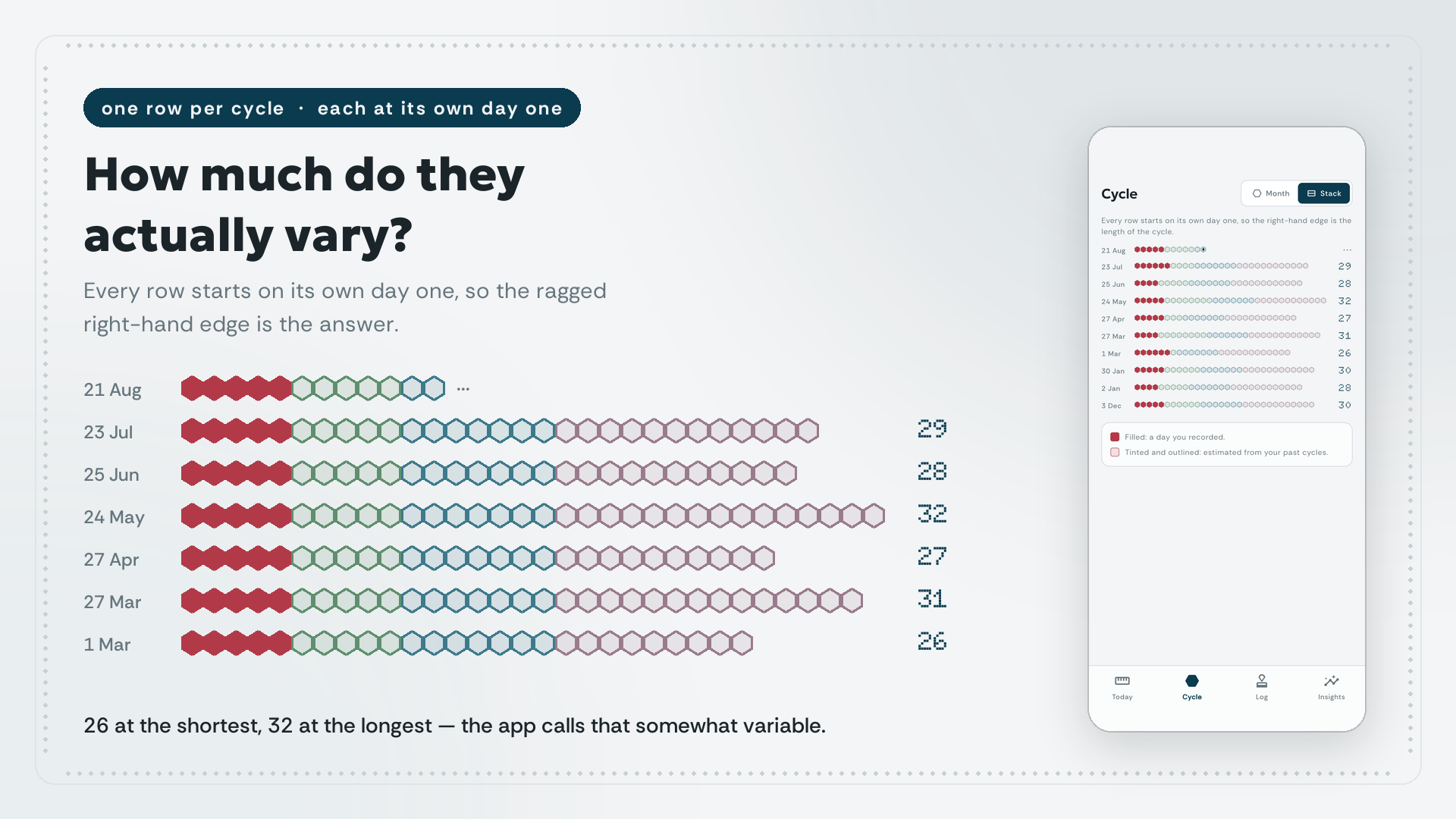
One row per cycle, each at its own day one
How much do they actually vary? Every row starts on its own day one, so the ragged right-hand edge is the answer — 26 days at the shortest, 32 at the longest, which the app calls somewhat variable. It is the one question a month grid cannot answer, because every month is a different shape.
A closed list of twelve
You write it. It gets tagged. A model may only answer with names from the twelve stamps, the schema says so, and the reply is filtered against the list again when it arrives. Tags are added, never substituted; an empty answer is a correct answer; there is no severity scale and no slider; and it works offline in demo mode.

The figures, then the words
You can read exactly what gets sent. The top of the screen is what the device computed; the bottom is the same facts, rewritten. In that order on purpose — a screen that led with the prose would be asking you to trust the generated half. The instruction forbids adding a figure, predicting a date or naming a condition, and the disclosure that shows the outgoing text ships in the app rather than behind a debug flag.

No account, no sync, no server of ours
Where the entries live: in the phone’s encrypted store — Keychain on iOS, EncryptedSharedPreferences on Android — behind one class you can replace. Take it with you (one button copies every entry out as CSV), destroy it (one button deletes all of it, memory and disk), start from your own dates (three questions replace the sample history), or read what is sent before you send it. No account to create, no health-platform sync, no analytics and no ads.

13 screens, all of them buildable today
The rest of it: a day (flow, twelve stamps, a note), set up (three questions, no more), providers (keys, and an editable model name), and Pro (a mock paywall, wired to one flag).

What is in the download
A buildable app, not a mockup — 13 screens in light and dark, 12 symptom stamps on one closed list, 3 AI providers plus a demo mode, 4 dependencies and no vendor SDKs, 105 tests with flutter analyze clean, 18 chapters of offline documentation, and 0 lines of backend to deploy. Figma is not included; every screen is Flutter.

How the estimates are worked out
Printed in the app itself, on Settings → How the estimates are worked out, with the numbers read off the engine rather than typed into the copy:
- Next period — the mean length of the last 6 complete cycles, added to the current cycle’s first day. The cycle in progress has no length and is never averaged.
- Not enough history — with fewer than two complete cycles the app uses the length it was given at setup and says on screen that it is doing so.
- Sanity limits — a predicted cycle is held between 21 and 45 days. A run too short to be a cycle, or a gap too long to be one, is kept out of every average.
- Phases — counted backwards from the next predicted period, because the stretch after ovulation varies less between people than the stretch before it.
- Fertile window — estimated, drawn as an outline rather than a fill, and switchable off entirely, in which case the engine does not compute it at all.
What is not included
- No backend and no admin panel. Sign-in and the paywall are mocks with the seams drawn for you; wiring your own API and your own store products is your work, and the documentation walks through where.
- No pregnancy mode. Tracking a pregnancy is a different app with different duties of care.
- No payment code. Receipt validation needs a server and cannot be pre-built.
SubscriptionService.purchase()is the one seam to replace, and only the request allowance is wired to the Pro flag — the rest of the feature gating is left to you. - No notifications. Nothing is scheduled on the system and there is no notification dependency in
pubspec.yamlto configure. Reminders appear inside the app when it is opened. - No health-platform sync. Apple Health and Health Connect are deliberately not touched; adding them is your call and your declaration.
- No Figma file. Every screen is Flutter.
- Entries do not sync between devices, and are lost if the app is deleted. That is the point of the design, and the app says so in its own About screen. Settings offers a CSV export.
Requirements
- Flutter SDK 3.29 or newer, Dart 3.7+
- Android Studio or VS Code
- Android and iOS. A web build works and is what the live preview is made from.
- An API key from Google Gemini, OpenAI or Anthropic — optional, and free to skip: demo mode needs none.
Important
Phasora is for informational purposes only and is not a medical device or a substitute for professional medical advice. Predictions are estimates based on the dates the user enters; they are not a contraceptive method and must not be presented as one. The app scores nothing, assesses nobody and never names a medical condition.
The AI features are produced by a third-party provider the user supplies their own key for. Connecting this template to a live service such as Google Gemini, OpenAI or Anthropic will involve those third-party services, which will incur their own separate costs, not included in the price of this item. Free tiers and prices are set by each vendor and can change without notice. Demo mode makes no network calls.
Support
Questions about setting the template up, connecting a provider or re-skinning it are answered through this item’s comments page. Item support covers this template; it does not cover a provider’s own account, quota or billing, and it is not medical or clinical advice.
Changelog
v1.0 — first release.
| Type | Flutter App |
|---|---|
| Author | coderqh |
| Price | $28 |
| Sales | 0 |
| Rating | 0 (0) |
| Published | Sep 2, 2026 |
| Last Update | Sep 2, 2026 |
| Compatible Software | Flutter 3.x |
| Mobile Files Included | Dart, YAML, JavaScript JSON, .kotlin, .swift |
Categories
Tags
External listing. code.market does not sell this product and does not process payment for it. Pricing, payment, delivery, licensing, refunds, and support are handled by the third-party merchant on its own website. We may earn an affiliate commission from a referral. Details.