
Nappora | Flutter Daycare Parent App With Laravel Admin
Description
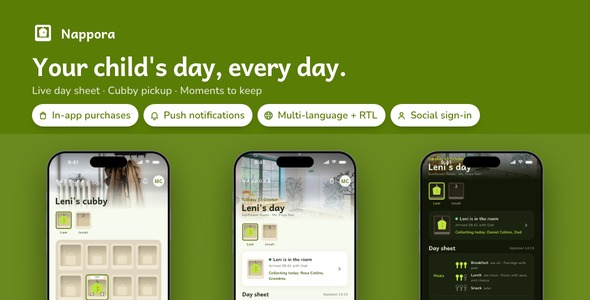
Nappora is the app a daycare or preschool hands its families: the child’s day as the room writes it, with meals, nap, changes and mood; a cubby that answers who is in, who is collecting today and what goes in the bag; the room’s photos and artwork kept in an album; and notices with permission slips answered in one tap, all filled in by the teachers through a Laravel admin panel. The download carries 25 finished screens, and Google and Apple sign-in, store purchases, notifications, Spanish and Arabic beside English, and a product website come wired in. Light and dark themes throughout.
Demo Instructions
The Live Preview starts on a small menu of four demos (the app, the documentation, a snapshot of the admin panel and the landing page); the section See every part before you buy says what each one shows. The app’s sign-in form comes prefilled with the demo parent below, and because the preview runs on the bundled sample room, any email and password get through, empty fields included. The sample clock sits at 14:20 on a school day, so the day sheet, the cubby, the moments and the slips are all filled in; a switch in Settings moves the clock to 08:15, before anyone is in, to try choosing today’s pickup. Once the center runs the included back end, parents sign in with accounts the center creates, or sign themselves up once the center switches that on in Settings, and a new account sees nothing until the center links a child to it. A parent who signs up or taps Forgot password gets a six-digit code by email; with Docker those emails wait in the bundled Mailpit inbox at http://127.0.0.1:8025.
- Parent sign-in in the app: Email demo@nappora.app · Password demo1234
- Teacher sign-in to the admin panel, after you install the back end: Email admin@nappora.test · Password password
Costs not included in the price
Google Sign-In, Sign in with Apple, push notifications, analytics and in-app purchases each run on a developer account or service the center holds itself (the Apple Developer Program, a Google Play Console account, a Firebase project), as does publishing the app to the stores. Sign-up and password-reset codes go out through the center’s own SMTP email provider. A server to host the back end is paid to its provider as well. These charges are not included in the purchase price; each provider bills the center on its own terms.
What a center gets from the first morning
- The day, written once by the room: a teacher fills in a child’s day sheet in the admin panel meal by meal; the parent’s Today tab follows from it, drawn as spoons, a cot that fills and a mood sticker rather than a form.
- The morning questions, answered before the door: the cubby shows whether the child is in, who is collecting today and what to bring, and the server keeps the rules: one adult collecting per child, cleared at midnight, and away days from today on, one per day.
- Tested on both sides: 25 screens, each with its empty state and a dark version, read in three languages; the Flutter suite runs 95 tests and the Laravel suite 115, all green.
Nine things you will not have to build
- Google and Apple sign-in: a parent taps Continue with Google or Apple and the back end turns the token into a session. Pointed at your server, a provider you have not configured never shows its button; the sample room shows both.
- In-app purchases with a paywall: Nappora Pro opens every earlier day sheet beyond the last seven through App Store and Play products, priced by the store, restored with one tap and remembered offline.
- Push notifications: the center sends a message to every phone now or at a set time, optionally pointing it at a screen of the app; the parent is asked for permission from Settings.
- Analytics and crash reports: screen views and the errors a parent actually hits, collected only after the consent switch is turned on.
- Face ID or fingerprint lock: a parent can ask Nappora to lock itself on launch; a phone with nothing enrolled says so beside the switch.
- Three languages, right to left included: Spanish and Arabic sit beside English, and Arabic turns every screen right to left; adding a language means one file plus one line in
app_languages.dart, and the back end answers in the language the phone asked for. - Update prompts: announce a release from the App updates page of the admin panel and parents see a gentle nudge, or a required update when you say so.
- Share sheet: a day sheet, a notice or a classroom photo goes out through the system share sheet, ready for a grandparent.
- Remote images: room and moment pictures load from your server’s uploads, with a placeholder while they arrive and a fallback when they do not.
Open the whole box before you buy
The Live Preview shows the four parts of the download, each in its own tab-sized demo. It opens on a menu, and every demo carries a small link home to it:
- The app: Nappora compiled for the browser inside a phone frame, with the sample room loaded and the sample clock on a school afternoon.
- The documentation: all 41 chapters of the HTML manual, the same file a buyer opens offline.
- The admin panel: read-only pages captured from a running install, from the dashboard through every sidebar entry to a day sheet open for editing.
- The landing page: the center’s one-page website as it ships, lime and crayon orange with Andika headings.
The full source code is included with every license type, Regular and Extended alike.
What parents will open every day
- Today: arrival and who dropped off, every meal as spoons, the nap as a little cot that fills, changes as safety pins and the mood sticker the teacher picked, with the room’s note underneath and what is running low.
- The cubby: the child’s cubby on the room’s wall, the coat on its hook while they are in, a shelf listing what the teacher asked you to bring, ticked off as it goes in the bag.
- Pickup and away days: choose who is collecting today from the adults you added, and mark a day away with a reason and a note for the teacher.
- Moments: classroom photos and artwork in album corners, for the whole room or just your child, saved to the phone or shared.
- Notices and permission slips: news from the center and slips for outings in one place; a sticker on the slip is the answer, and it can change until the slip’s due date.
- Every earlier day: the day sheets behind today, a page for each child with allergies and care notes, and the center’s hours and contacts.
Around them sit the screens a parent expects: onboarding, sign-in, sign-up and its code, a switcher for two children on one account, notifications, settings, about and Nappora Pro.
Landing page included
landing/ holds a website for new families: the day sheet and the cubby on two phones up top, three features, six screens from a sample day, three questions parents ask first, and buttons for both stores. Edit its words and links in one HTML file and upload it to whatever static hosting the center already uses.
Laravel back end included
backend/ is the teachers’ side of Nappora: a Laravel REST API and a Filament admin panel holding parent accounts, rooms, children with their cubbies, day sheets written meal by meal, pickup adults, away days, things to bring, moments, notices, permission slips and their answers, plus the center’s address, phone and hours under Settings. The server decides what each family may see: another family’s child, day sheet or slip answer is never handed over, a photo only says whether your child is in it, and the cubby wall shows numbers, never names. It also exchanges social sign-in tokens, announces releases on an App updates page, sends notifications now or later and keeps a Push history, stores the room’s photos and pictures, and starts from one Docker compose file. Build the app with --dart-define=API_BASE_URL and sign-in, the day sheets, pickup, away days and slips all go through it; it needs PHP 8.4 or Docker.
For the developer who extends it
- Four small engines in plain Dart: the day sheet, the cubby, the slips and the photo filter, each a file with its own tests and the same rules the server enforces.
- One repository between the screens and the data: RoomService reads either the bundled sample room or the Laravel API through the same interface, so pointing Nappora at another server means writing one more class.
- Integrations configured in one file: store product ids, sign-in client ids and each on/off flag sit side by side in
feature_config.dart, with the Firebase switch infirebase_config.dart. - Colors in one place:
app_colors.dartholds the lime fill, the bright and text grades and the crayon orange, and the icon and website were drawn from those same values.
In the download: the Flutter source with the nine integrations above wired in, the Laravel back end and its admin panel, the landing page, a README, offline HTML documentation (41 chapters, 15 figures), the sample room, light and dark themes, and 15 licensed photographs.
AI disclosure
AI-assisted tools were used to help write and review the source code and the documentation of this item. The author reviewed, tested and finalized every part before release. The 15 photographs are licensed Pexels stock, each listed with its photographer in assets/images/room/LICENSES.txt; no image-generation model was used. The app itself makes no AI calls at run time.
Notes
Nappora serves one center; its rooms, children and families all live in one install, and a group of centers would run one install each. Teachers write the day in the admin panel, which works in a tablet’s browser; a dedicated teacher app would add write routes to the same API, and the manual names the form whose fields to follow. The app takes no fees, so a center that bills keeps its own billing system and links to it from the center page.
Out of the box the app runs on its bundled sample room and switches to the included back end once you deploy it. The photographs are stock images under the Pexels license with no children’s faces, listed in LICENSES.txt, and meant to be replaced with your own. Design files for Figma or Sketch are outside this download.
| Author | coderqh |
|---|---|
| Price | $79 |
| Sales | 0 |
| Rating | 0 (0) |
| Published | Oct 16, 2026 |
| Last Update | Oct 16, 2026 |
| Compatible Software | Flutter 3.x |
| Mobile Files Included | Dart, YAML, JavaScript JSON, .kotlin, .swift, JavaScript JS, CSS, PHP, HTML |
Categories
Tags
External listing. code.market does not sell this product and does not process payment for it. Pricing, payment, delivery, licensing, refunds, and support are handled by the third-party merchant on its own website. We may earn an affiliate commission from a referral. Details.
Products of the Week.
Submit🥇
Perceptle
Perceptle is a daily browser-based game that challenges you to test your sensory intuition through five quick estimation and rhythm-based rounds.
Other · 1 views · 0 clicksOther · Week 47 · 1 views · 0 clicks
🥈

Free LinkedIn Likes From Real
Get free LinkedIn likes on your posts from real members who react by hand. No
SaaS · 124 views · 2 clicksSaaS · Week 47 · 124 views · 2 clicks
🥉

STOP GUESSING WHAT TO POST
AI that learns your brand voice and builds a month of consistent, on-brand social content: carousels, posts and hooks that sound like you, not like everyone else's AI.
SaaS · 7,686 views · 71 clicksSaaS · Week 47 · 7,686 views · 71 clicks
#4

aaas.market
407 reliable micro tools for solo founders, marketers and creators. They work in your browser
SaaS · 122 views · 0 clicksSaaS · Week 47 · 122 views · 0 clicks