
Listaro | Flutter Classified Ads Marketplace App With Website and Laravel Admin Panel
Description

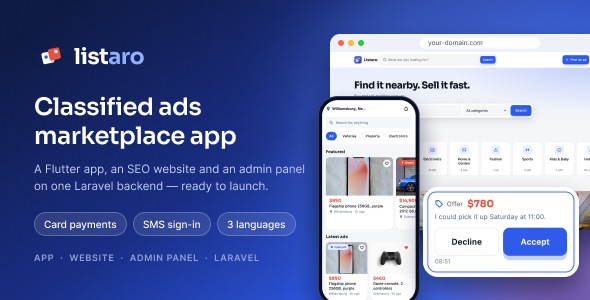
A marketplace, not a set of screens
Most classifieds templates are screens with nothing behind them. You buy 40 beautiful pages, and then you write the server yourself.
Listaro ships all three parts: the Flutter app buyers and sellers use, the Laravel API behind it, and the web admin panel you run the marketplace from. They were built together, against each other, and the API the app talks to is the same one in the download.
It also runs the moment you unzip it. The app opens on bundled sample data — real photos, real categories, real conversations — so every screen works before any server exists. When you are ready, one flag on the build command points it at the API instead:
flutter run --dart-define=LISTARO_API=https://your-server.test/api/v1No screen changes. The repositories the sample data implements are the same interfaces the API layer implements, which is also what makes swapping in your backend a matter of writing one class.
Live admin panel: listaro.webkodingtheme.com/admin/login — the demo account is printed on the login page and fills itself with one click.
Live API: /api/v1/listings answers in your browser right now.

What is in the box
| Flutter app | 36 screens, a five-step posting flow, 10,326 lines of Dart, 118 tests |
| Laravel API | 29 endpoints, Sanctum authentication, 27 tables with migrations, 73 tests |
| Admin panel | 11 screens: moderation, categories and fields, users, reports, payments, promotions, settings |
The app covers the whole life of an ad: browse and search, filter, favourite, post in five steps, chat, negotiate, boost, mark sold, review the other side, and every account screen around it — verification, blocked users, wallet, notifications, help, account deletion.

The thing that makes it classifieds
A marketplace is not a shop. A car needs a year, a mileage and a gearbox; a flat needs rooms, floor area and a floor number; a phone needs storage and condition. A product catalogue cannot express that, and hardcoding it means an app release every time you add a category.
Fields belong to categories, and you define them in the panel. Five types ship — text, number, select, multi-select and boolean. Mark a field filterable and it appears in three places at once: the posting form, the ad detail sheet, and the search filters. No app release, no migration, no deploy.
That single decision is why the admin panel exists at all, and it is the difference between an item you can launch a real marketplace on and one you have to fork.

Offers, not just chat
Every classifieds app has a chat. What sellers actually do in that chat is haggle, and a plain message thread makes that unreadable — nobody can tell what was agreed.
In Listaro an offer is a message. It sits in the thread where it was made, it carries its own amount, it has an accept and a decline that both sides can see, and it expires on its own. The conversation stays a conversation, and the negotiation stays legible.
Around it: per-side unread counters, marking a thread read, blocking, and reporting that lands in the admin panel’s queue.

The revenue model is already built
A marketplace with no way to charge is a hobby. Listaro ships the standard classifieds model, working end to end:
- Four boost packages — Bump up, Featured, Urgent and a Bundle — each with its own price, duration and benefit list.
- A wallet with a real ledger. Every credit and debit is a row; balances are derived, never edited.
- Money in integer minor units everywhere, from the database to the API to the app. No float arithmetic anywhere near a price.
- An admin screen to price the packages, turn them on and off, and mark one as popular.
Prices, durations and benefits are data, not code. Repricing your marketplace is a form, not a release.

The panel runs on ordinary hosting
The admin panel is plain Blade and one hand-written stylesheet. There is no Vite, no Tailwind build, no npm manifest and no compiled bundle anywhere in the download — because the person deploying this is on shared hosting, where there is no Node and often no shell.
Upload, point the document root at public/, run the migrations, and it is live. What you read in the source is what runs.
Two more things that are done rather than promised: a listaro:maintenance command expires promotions and offers on a schedule that is actually registered, and listaro:admin creates your first administrator without touching the database by hand.
Under the hood
- Repository interfaces, not providers. Screens never know whether they are talking to sample data or to your server.
- Search that works on both engines. MySQL FULLTEXT where it is available, with a token-wise fallback — because InnoDB ignores words under three letters, and “tv” is a search people make.
- 191 tests, 118 in Flutter and 73 in PHP, green on both SQLite and MySQL 8.
- Fonts and photos are bundled, not fetched. Sora and Inter ship with their OFL licences, and the nine sample photos are assets — open the app on a plane and it still looks like the screenshots.
- Auth tokens in platform secure storage. Signing in against your server puts the Sanctum token in the iOS Keychain and the Android Keystore through
flutter_secure_storage— never SharedPreferences, never a file. It is checked at launch, so a token revoked from the panel signs that device out, and a sign-out clears the device whether or not the server answered. - Full unlocked source. Nothing minified, nothing obfuscated, nothing phoning home.
What is not included
Stated plainly, because finding this out after buying is how items earn one-star reviews.
| No live payment gateway | The wallet, the ledger and buying a boost with wallet credit all work end to end. What is missing is the gateway that puts money into the wallet — WalletService::credit() is where your Stripe or PayPal call goes, and the app’s Top up button says so rather than doing nothing. |
| No map tiles | Location, radius search and the location picker all work. The map screen plots real ads on a drawn street grid rather than fetched tiles, so the app needs no key and no billing account to run. |
| No push delivery | Notifications are stored, listed and counted. Wiring FCM is your key and your certificate. |
| No SMS | The phone-verification screens are built — code entry, resend timer, the fraud warning — but nothing sends an SMS. There is no OTP endpoint in the API; adding your provider is one route and one screen callback. |
Each one has a single documented place to change, named in the documentation. And in the app itself the affected control tells you what is missing rather than doing nothing when you tap it — there is a test that fails the build if a control is ever wired to an empty handler again.
Please read this before buying: the external services above are not included in the purchase price and will cost you extra. Firebase Cloud Messaging, SMS gateways such as Twilio or Vonage, payment providers such as Stripe or PayPal, map tile providers, and the Apple Developer account iOS push requires are all separate third-party products. You open those accounts yourself, they bill you directly, and their pricing is theirs to set and change. Nothing on that list is resold or bundled here — what you are buying is the app, the API and the panel, plus the documented integration points that connect to them. Listaro runs completely without every one of them: on bundled sample data with no server at all, and on your own server with no external account.
Requirements
- Flutter 3.x — built and tested on 3.44.7 / Dart 3.12.2, floor declared at Dart 3.3
- PHP 8.3+ with Laravel 13.x (the version in
composer.json), MySQL 8 or SQLite - Android SDK platform 36 —
compileSdkandtargetSdkare both pinned to 36 - Android and iOS
Questions people ask first
Does it work without a server? Yes, completely. That is the default. The sample data is bundled, so the app runs end to end on a fresh clone.
Can I use my own backend? Yes. Implement four repository interfaces — listings, categories, chat and auth — and change nothing else.
Is the source unlocked? Entirely. Both projects, no exceptions.
Can I change the branding? Colours, spacing, radii, shadows and type are design tokens in two files. Change them once.
Will the panel run on my shared host? If it runs PHP 8.3, yes. There is nothing to compile.

Support
Six months of support included, extendable at checkout. Bug reports are answered; so are questions about wiring your own backend in.
Changelog
1.0.0 — Initial release.
| Type | Flutter App |
|---|---|
| Author | WebKoding |
| Price | $29 |
| Sales | 1 |
| Rating | 0 (0) |
| Published | Aug 24, 2026 |
| Last Update | Oct 4, 2026 |
| Compatible Software | Flutter 3.x |
| Demo Url | https://listaro.webkodingtheme.com/ |
| Mobile Files Included | Dart, YAML, JavaScript JSON, .java, .kotlin, .h, .storyboard, .plist, .swift, CSS, PHP, HTML |
| Video Preview Resolution | 1280x720 |
Categories
Tags
External listing. code.market does not sell this product and does not process payment for it. Pricing, payment, delivery, licensing, refunds, and support are handled by the third-party merchant on its own website. We may earn an affiliate commission from a referral. Details.