
Jauntora | Group Trip Planner App With Firebase and Laravel Admin
Description
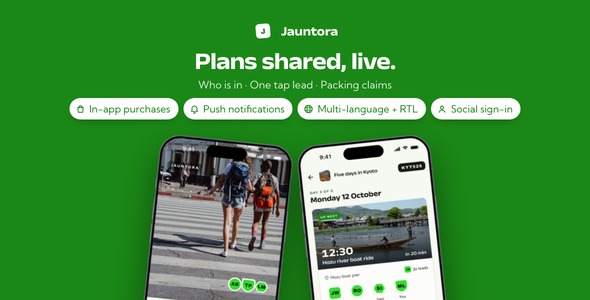
Jauntora puts one trip on every phone in the group: a day by day plan where each friend counts themselves in with a tap, one person leads each plan and nobody can take it twice, a packing list that keeps what everyone packs apart from what one person brings for all, and a six-character code that gets a friend onto the trip before they have an account. Under it sit 15 finished screens, Google and Apple sign-in, in-app purchases, push, three languages, a Laravel panel over your Firebase project and a landing page, each switched on from one file. Light and dark on every screen, with 185 tests behind them.
Demo Instructions
The Live Preview starts on a hub page with four doors, described below under Open every door before you buy. For the app, tap Plan a trip and then Sign in: on the sample trip the sign-in form checks nothing, so demo@jauntora.app with demo1234 gets you in and so does leaving both fields blank. Join with a code and the code KYT526 shows what a traveler sees before joining. Nothing has to be registered: the sample Kyoto trip opens on its third day with its plans, its people, its packing list and who is where already there. Once you connect your own Firebase project, organizers sign in with an account they register on the Sign up screen, and friends keep joining with the code alone. Forgot password? on the sign-in screen sends Firebase’s own reset email once your project is connected.
- In the app, on the sample trip — Email: demo@jauntora.app · Password: demo1234 (any other pair, or none at all, works as well)
- Laravel panel, after you install the back end — Email: admin@jauntora.test · Password: password
Costs not included in the price
Firebase (Authentication, Cloud Firestore, Cloud Messaging, Analytics) runs in your own Firebase project and charges you once a group’s traffic leaves its free tier. Google Sign-In, Sign in with Apple and push notifications each need a paid developer account or service of your own, namely an Apple Developer Program membership, a Google Play Console account and that Firebase project; so do in-app purchases and the store listings themselves. The host that runs the Laravel panel charges you too. Every one of those providers bills you directly, and their charges are not included in the purchase price.
Why this trip planner
- Nine integrations finished before you open the project: Google and Apple sign-in, a paywall on in-app purchases, push, analytics with crash reports, Face ID or fingerprint lock, update prompts, English, Spanish and Arabic with RTL, the share sheet and bundled pictures, every one behind an interface with a working default and a switch in one config file. The paywall lifts the free plan’s cap of two trips organized at once; joining a friend’s trip never costs anything.
- The server side is in the same download:
backend/is a Filament panel over the Firebase project your phones use, where you open trips, plans and packing lists as documents, keep a nightly copy of Firestore on your own machine and remind everyone on a trip the day before it starts;landing/is a one-page site already dressed in Jauntora’s green. - Ready to demo the day you download it: 15 screens and 8 sheets with their empty states, the lead settled by a Firestore transaction and held by the security rules on the server, 185 app tests pass, 97 rules assertions pass on the emulator, and the back end has 98 tests of its own.
Nine things you will not have to build
- Google and Apple sign-in: the organizer’s two buttons on the Start screen go straight to Firebase Authentication, and each one shows only once its client id is in place.
- In-app purchases with a paywall: the Pro screen lists the App Store and Play products at the store’s own price, unlocks a third trip and beyond, keeps the unlock offline and restores it with one tap.
- Push notifications: every phone on a trip registers itself, the friend who joined with a code too, so the panel can push a trip’s day-before reminder or a note to one person; the permission request lives in Settings and messages show while the app is open.
- Analytics and crash reports: each screen view and every error a traveler hits, collected only after the consent switch in Settings is on.
- Face ID, Touch ID or fingerprint lock: a switch in Settings locks Jauntora on launch, disabled on a phone with nothing enrolled.
- Three languages with RTL: English, Spanish and Arabic on every screen, a new language in one copied file, and the invitation that carries a trip code goes out in the sender’s language.
- Update prompts: publish a release on the panel’s App updates page and the phones show a gentle or a required update on their next launch.
- Share sheet: the trip code and the backup file leave through the system sheet, anchored correctly on iPad.
- Pictures on trips and plans: covers and plan pictures from 14 licensed photographs, through an image component with placeholders and fallbacks that takes your server’s URLs just as readily.
Open every door before you buy
The Live Preview is not only the app. Its first page is a hub with four doors, and the All demos button on each of them returns you to it:
- The app: Jauntora itself inside a phone frame in your browser, the Kyoto and lake trips already on it.
- The manual: the same 45-chapter HTML file that sits in the download, with all 28 figures.
- The panel: a read-only capture of the Laravel panel from a real install: the dashboard, every sidebar page, the Firestore browser, the snapshot and reminder pages and Settings.
- The product site: the landing page from the download, in Jauntora’s green.
The full source code is included with every license type, Regular and Extended alike.
The screens a trip lives on
- Who is in: every plan carries a rail of stickers, two letters on a shape each traveler picked, the lead first and tagged; when a friend taps Count me in on their phone, their sticker lands on yours.
- Take the lead: one press, settled by a transaction so two people reaching for the same plan get exactly one lead, and the lead can hand it on to anyone on the trip.
- The Now tab: the next plan with its photograph and how long until it starts, everyone in it marked here, on the way or skipping, and a countdown of days before the trip.
- Packing: what each traveler packs and ticks for themselves, apart from what one of you brings for everybody, with every claim showing up for the whole group.
- Join by code: six characters with no O, 0, I or 1 to misread, the trip named before anything is committed, then a name and a sticker.
And the rest of a finished app: onboarding, the start screen, sign-in and sign-up, the list of your trips, a new trip, the plan editor, the trip sheet and a traveler’s sticker sheet, settings with backup and restore, about and the Pro screen.
Landing page included
Inside landing/ is a one-page site for Jauntora: a hero with two phones, three feature tiles, a gallery of screens, a FAQ and the two store buttons, already in the app’s green and type, light and dark. Change the copy and the store links and host it on anything that serves static HTML.
Laravel back end included
backend/ is a Laravel application with a Filament admin panel that sits over the Firebase project Jauntora already uses, so nothing in the app changes when you install it. Its Firestore page opens any trip, plan, member or packing document as JSON and saves it back with timestamps and references intact. Firestore snapshots copy the trips, the codes and each person’s trip list to this server every night at a time you set, or on a tap, and open as tables or download as JSON. Reminders push Trip starting tomorrow, with the time of the first plan, to everybody on a trip whose first day is tomorrow, with a preview of who gets what before you switch them on. The Firebase users page disables, deletes, resets and signs out accounts, marks staff and pushes to one person; Send notification, Push history and App updates sit beside it, and a small REST API serves the version check and the server’s half of Delete account, which removes a person’s phones and their copies in the snapshots. A Docker compose file and an install script are in the folder; the panel needs one service-account key from the Firebase console, and the phones never route through it.
What the developer inherits
- GetX, kept tidy: View, Controller, Service, Repository, and every number a screen shows comes from one pure Dart trip engine that the screens only call.
- Two repositories behind one interface: the phone’s encrypted store and Cloud Firestore, both stream-first, so a screen written against the phone works unchanged when a friend’s Count me in arrives over the network.
- Security rules with a harness:
firestore.rulescomes with 97 emulator assertions, so each traveler changing only their own place in a plan, and one lead per plan, are enforced by the server and not only by the app. - One file of switches:
feature_config.dartholds the product ids, the client ids and every on and off for the nine integrations. - One palette file: change the three greens in
app_colors.dartand the app follows; the icon, the panel and the landing page are rendered from the same values.
What you get: the full Flutter source with the nine integrations, the Firestore rules and their emulator harness, the Laravel panel, the landing page, a README, offline HTML documentation (45 chapters, 28 figures), two sample trips, light and dark themes, and 14 licensed photographs.
AI disclosure
AI-assisted tools were used to help write and review the source code and the documentation of this item. The author reviewed, tested and finalized every part before release. The 14 photographs are Pexels stock, each listed with its photographer in assets/images/trips/LICENSES.txt; no image-generation model was used on anything in the package. Jauntora has no AI feature of its own.
Notes
Jauntora plans what a group does together: plans on days, who is in, who leads and who brings what. A plan has a clock time on one day of the trip, and up next is judged by the phone’s own clock. Maps and live location are left to you; the day-before reminders are sent by the included panel once its scheduler line is in place and reminders are switched on, with tomorrow counted in the server’s time zone.
With Firebase not yet connected the app runs on its two bundled sample trips, on one phone; once your project is connected every phone on a trip shares it. Photo uploads and phone-number sign-in are left to you, as both need the paid Firebase plan. Design files for Figma or Sketch do not exist for this item; the interface lives in the Dart source.
| Author | coderqh |
|---|---|
| Price | $69 |
| Sales | 0 |
| Rating | 0 (0) |
| Published | Oct 15, 2026 |
| Last Update | Oct 15, 2026 |
| Compatible Software | Flutter 3.x |
| Mobile Files Included | Dart, YAML, JavaScript JSON, .kotlin, .swift, JavaScript JS, CSS, PHP, HTML |
Categories
Tags
External listing. code.market does not sell this product and does not process payment for it. Pricing, payment, delivery, licensing, refunds, and support are handled by the third-party merchant on its own website. We may earn an affiliate commission from a referral. Details.
Products of the Week.
Submit🥇
Perceptle
Perceptle is a daily browser-based game that challenges you to test your sensory intuition through five quick estimation and rhythm-based rounds.
Other · 1 views · 0 clicksOther · Week 47 · 1 views · 0 clicks
🥈

Free LinkedIn Likes From Real
Get free LinkedIn likes on your posts from real members who react by hand. No
SaaS · 124 views · 2 clicksSaaS · Week 47 · 124 views · 2 clicks
🥉

STOP GUESSING WHAT TO POST
AI that learns your brand voice and builds a month of consistent, on-brand social content: carousels, posts and hooks that sound like you, not like everyone else's AI.
SaaS · 7,686 views · 71 clicksSaaS · Week 47 · 7,686 views · 71 clicks
#4
aaas.market
407 reliable micro tools for solo founders, marketers and creators. They work in your browser
SaaS · 122 views · 0 clicksSaaS · Week 47 · 122 views · 0 clicks