
Foodgoo | Flutter App Multi Service Delivery With Admin Panel
Description
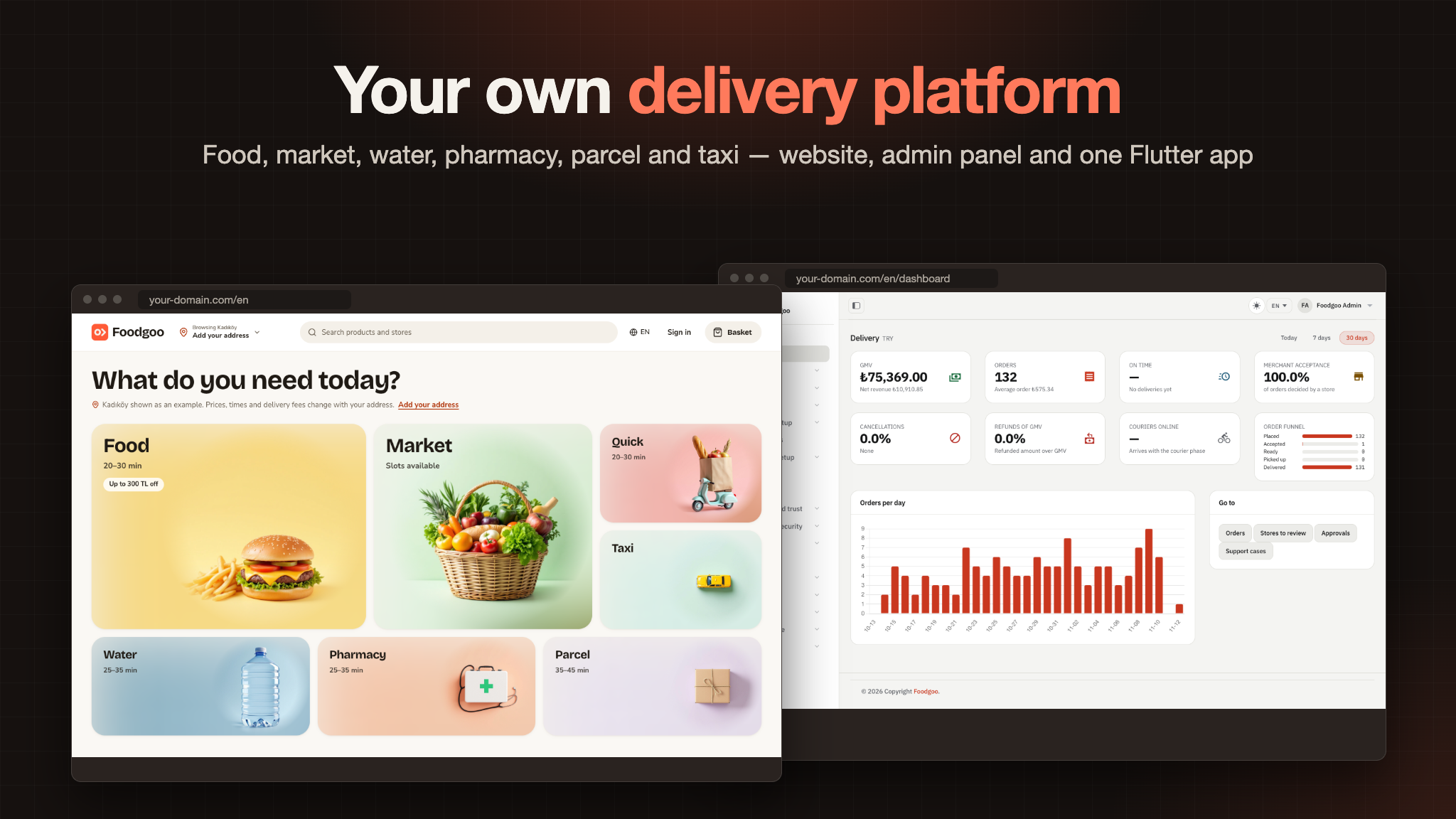
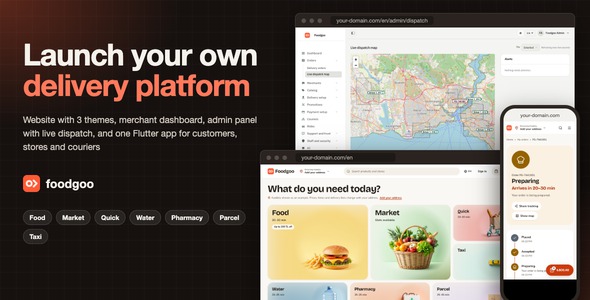
Foodgoo is a full-stack multi-service delivery platform: one cross-platform Flutter mobile app (iOS & Android) and a
companion web platform built with the Laravel PHP framework (customer website, merchant dashboard,
admin panel with live dispatch, and the mobile API). It combines a calm, photo-first app with a production-ready
backend: the included PHP / MySQL API (built with Laravel), Firebase for sign-in and push notifications, live order
tracking over Laravel Reverb (or 10-second polling when no socket server runs), online order payments through Stripe
Connect, iyzico and further regional gateways, and an AI provider of your choice (paid, your own key) for the optional
AI features.
One platform runs seven services from one backend, switched on or off per city: food delivery from
restaurants with option groups, market orders in delivery slots with weighed items and substitution
choices, quick commerce in minutes, water refill with deposits and repeat orders,
pharmacy orders with a prescription photo checked by a pharmacist, parcel delivery
and taxi rides. Customers pick an address and see only the stores that deliver there, pay with cash,
card at the door or an online card, and follow the courier on a live map. A store’s team opens merchant
mode in the same app to take orders that ring until accepted; couriers open courier mode to
go online, swipe to accept a job, navigate with Google Maps or Waze and hand over with the customer’s four-digit PIN.
Operators run dispatch, couriers, zones, fees, payments and approvals from the admin panel. A commission and a service
fee per order, and delivery fees per zone, pay for it.
Payments without any account: cash at the door, card at the door and meal card at the door work out of the box, so the whole platform can run before you sign up with a payment provider.
Note: All online payment services the code integrates (Stripe and Stripe Connect, iyzico, Midtrans, Duitku, Xendit, Adyen, PayTR, Paystack, Flutterwave, Mercado Pago and Paymob) are third-party services and may charge transaction fees or other service fees depending on their pricing plans. Most require merchant account approval and verification before accepting live payments, and marketplace payouts require you to onboard and verify each store you pay out. These services are not included in the purchase price, and buyers are responsible for creating their own accounts, completing any required approval processes, configuring API keys, and covering all applicable fees. These adapters were written from each provider’s documentation and tested against simulated responses only; none has taken a real payment yet. Run each one in its sandbox before you switch it on.
Before you buy: paid third-party services (not included)
This item uses services run by other companies. You must register your own account with each one, accept its terms and pay its fees yourself. No author accounts or API keys are included. This is the complete list of external services the code integrates with.
- Firebase (required): your own Firebase project (sign-in, push, Remote Config, Crashlytics, Analytics). Usage above the free plan is billed by Google.
- Email delivery (required): an SMTP provider, Mailgun or Postmark for sign-in codes, receipts and store and courier applications.
- Map tiles and address search (required in production): a tile provider such as MapTiler and Geoapify for address search. The public OpenStreetMap tiles are for testing only and have a usage policy.
- Payment providers (paid services, optional): the code integrates all of the following, each
with its own account approval, transaction fees and terms:
- Stripe and Stripe Connect: card payments and payouts to stores
- iyzico (Türkiye)
- Midtrans and Duitku (Indonesia), Xendit (Southeast Asia)
- Adyen, PayTR, Paystack, Flutterwave, Mercado Pago and Paymob
- AI provider (paid service, required for every AI feature): all AI features in this
description (menu import from text, links or photos, dish copy and translation, AI search, ask the menu,
recipe to basket, store insights, substitute suggestions, review digests, prescription draft reads and support
replies) do not work without an active, paid account and API key with Google Gemini, OpenAI, Anthropic,
Mistral, Groq, DeepSeek, OpenRouter or xAI. Every AI request is billed per use by that provider to you. No AI
credits are included. The AI code is the free, MIT-licensed
laravel/aipackage (installed by Composer). Ollama on your own server is the only alternative, and that server is yours to run and pay for. - Upstash QStash (paid service, optional): used as the queue connection
(
QUEUE_CONNECTION=qstash) on shared hosting where a queue worker cannot stay running. Needs your own Upstash account; Upstash bills per message above its free tier. Not needed if you run the database queue with a worker on a VPS. - Laravel Reverb or Pusher (optional): instant order status and courier position. Reverb is free and runs on your own VPS; Pusher is a paid service above its free tier. Without either, the app and the website refresh every 10 seconds.
- OSRM (optional): your own routing server for road distances and arrival times. Without it, distances use a straight line.
- Other optional services, each with its own account and pricing: OneSignal or Firebase push, Mailchimp (newsletter sync, off by default, double opt-in), Cloudflare Turnstile or Google reCAPTCHA, Google and Facebook sign-in, media storage / CDN (Amazon S3, Cloudflare R2, DigitalOcean Spaces, Backblaze B2, Wasabi, Google Cloud Storage, MinIO, Bunny) and Google Analytics 4.
Credentials and licences (no author keys included)
Every credential in the download is an empty value or a placeholder that you replace with your own.
- Firebase: no
google-services.json, noGoogleService-Info.plistand no service-account JSON are included. The only Firebase file isstorage/firebase/service-account.example.json, a template with placeholder values (your-firebase-project-id,REPLACE_WITH_YOUR_OWN_KEY). You create your own Firebase project and add your own files, so sign-in, push and Remote Config run on your Firebase account only. - AI (laravel/ai):
laravel/aiis Laravel’s official package, released under the MIT licence (Copyright Taylor Otwell), which permits use in commercial products. It is not bundled: the download contains novendor/folder, and Composer installs the package from Packagist on your server. You need your own paid API key from the AI provider you choose; every AI key in the example.envfiles is empty. - Maps: no map or geocoding key is included. The app and the website read the tile address and the address-search key from your own settings.
- Other services: payment, Reverb, Pusher, QStash, mail, push and storage keys are empty in every
example file and are entered by you in
.envor the admin panel. No Facebook App ID or client token is included either, not even as a fallback; you add your own in the build settings.
AI Disclosure
The AI features use the open-source (MIT) laravel/ai package, which calls an
external AI provider over the internet at runtime: Google Gemini by default, or OpenAI, Anthropic,
Mistral, Groq, DeepSeek, OpenRouter or xAI if you choose one (Ollama runs on your own server instead). These are
paid services: you need your own account and API key with that provider, and every AI request is billed to you by
the provider. No AI credits are included. A monthly spending cap (US$20 by default, adjustable in Admin → AI) stops
new AI calls once reached.
Data sent to the provider is only the content of the feature in use: menu text, links or photos for menu import, dish descriptions for copy and translation, search queries, questions about a store’s menu with that store’s public menu, aggregated sales figures for a store’s insights, review text without names, product text for catalog moderation, a prescription image when a pharmacist asks for a draft read, and support-ticket text for reply drafts. Passwords, payment details, access tokens, a courier’s location and a customer’s address are never sent. End users are told in the app and on the website when an answer comes from AI, and the seeded privacy policy has an AI section. The AI features do not work without an active, paid account with one of these providers; without one, nothing is sent and every AI feature is unavailable, while ordering, dispatch and tracking keep working.
Use of AI tools in making this item: yes, AI tools were used to make this item. The source code (the Flutter app, the Laravel admin panel and web API, and the React website), the documentation and the graphics were created with AI assistance: Claude Code with Anthropic’s Claude Opus 5.5 model for the code and the documentation, and an AI image model for the description banners and the preview images, composed from real screenshots. The author directed, reviewed and tested the result, and maintains and supports the item. The screenshots in the item gallery and the documentation are captures of the running app and website.
Demo Instructions
Try everything before you buy, no install needed. The live demo is a sandboxed installation with fictional data; demo mode blocks changes to settings, keys and staff. These logins are public on purpose.
1. Admin panel
URL: https://foodgoo.laravelbeginner.net/en/admin
Email: admin@foodgoo.test
Password: password123456
2. Merchant dashboard
URL: https://foodgoo.laravelbeginner.net/en/merchant/dashboard
Email: magaza@foodgoo.test
Password: password
Store PIN: 2580
3. Website (customer)
URL: https://foodgoo.laravelbeginner.net/en → Sign in
Email: musteri@foodgoo.test
Password: password
4. Courier (mobile app)
Email: kurye1@foodgoo.test
Password: password
Then Account → Work with us → Courier.
5. Mobile app (Android)
Download the demo APK below and sign in with any login above. For merchant mode, sign in as
magaza@foodgoo.test, then Account → Work with us.
Pay with cash at the door to place a demo order without any card.

Documentation
The package includes a full guide in HTML and PDF (foodgoo-docs/) with screenshots throughout: the
installation (a one-command local setup and a browser installer, every step pictured), running the Flutter app and
connecting it to your backend, a walkthrough of the app, website, merchant and admin screens, setting up each
third-party service (Firebase, maps, payments, AI providers, push, Reverb, QStash), a step-by-step branding guide for
the app name, icon, splash screen and colours, and the Play Store and App Store release checklists.
Third-party services: important notice
This item connects to services run by independent companies. Each one operates under its own terms of service, its own account approval process and its own fee structure, and using them may involve costs entirely outside this item’s purchase price. You create every account yourself and pay every fee yourself. No author accounts, API keys, merchant ids, Firebase projects or measurement ids are included.
- Firebase (Google), required for the app: Authentication, Cloud Messaging (push), Remote Config, Crashlytics and Analytics. Requires your own Firebase project. Usage beyond the free Spark plan is billed by Google (Blaze plan) and is the buyer’s responsibility.
- Stripe and Stripe Connect: separate service with its own terms. Requires your own Stripe account, Stripe’s business verification before live payments, and Connect onboarding of every store you pay out. Stripe charges its own transaction, Connect and payout fees.
- iyzico, Midtrans, Duitku, Xendit, Adyen, PayTR, Paystack, Flutterwave, Mercado Pago, Paymob (paid, switch on the ones you use): regional payment gateways, each requiring your own approved merchant account and charging its own fees.
- Map tiles and geocoding: MapTiler (or another tile provider) and Geoapify, each with its own account and pricing above its free tier.
- AI providers, required for the AI features (paid, per use): Google Gemini (default), OpenAI,
Anthropic, Mistral, Groq, DeepSeek, OpenRouter, xAI or a self-hosted Ollama, called through the open-source
laravel/aipackage. Requires your own separate API account; usage costs apply and are billed by the provider you choose. - Upstash QStash, optional (paid): queue connection for shared hosting
(
QUEUE_CONNECTION=qstash), so background jobs run without a queue worker. Your own Upstash account, billed per message above its free tier. - Pusher, optional (paid): instant updates when you do not run Reverb on your own server.
- Google Analytics 4, optional: the measurement id is not hardcoded. It is a buyer setting
(
GOOGLE_ANALYTICS_ID) that ships blank; when blank, analytics never loads. - Facebook / Meta, optional: Facebook sign-in with your own Facebook app; no app id ships, and without one the SDK never starts.
Backend (included)
The mobile app runs on the backend included in the package:
- Admin panel / Web API (built with Laravel) — the included
foodgoo-admin-panelplatform: a PHP web app built with the Laravel framework, with an admin dashboard, a live dispatch map, zones and fees, store and courier approvals, payments and webhook logs, a merchant dashboard, database migrations + seeders, and the mobile REST API the app talks to. It also ships a customer website in 12 languages (including Arabic, right to left) with three complete website themes (Avenue, Aisle and Plaza), each in light and dark, a media library with CDN support, editable email templates and Google and Facebook sign-in. Ideal if you already run on classic PHP/MySQL hosting or prefer the Laravel ecosystem.
Deploy the web project once and the app talks to that same origin. The queue runs on a VPS worker, or on Upstash QStash on shared hosting where no process can stay running; the scheduler needs one cron entry.
Key Value Propositions
- For Customers: only the stores that deliver to their address, real fees before checkout, food, groceries, water, pharmacy, parcels and taxi in one app, cash or card at the door, live courier tracking and a delivery PIN at the door.
- For Stores: a merchant dashboard and a merchant mode in the app — orders that ring until accepted, prep times, picking with substitutions, a menu with option groups, stock, prices and price books, promotions, ratings, insights and payouts.
- For Couriers and drivers: a courier mode with pre-flight checks, job offers with pay and distance, Google Maps and Waze navigation, pickup and hand-over codes, steps that sync after a lost signal, and earnings and cash balance.
- For Operators: a complete delivery marketplace — commission and service fees, delivery fees and surge per zone, dispatch with reassignment, store KYC, courier documents, refunds with a second-person check, push campaigns and AI caps — managed from one admin panel.
- For Developers: Laravel 13 + MySQL, a documented API, one set of domain services for the site, the app and the panel, a headless theme layer for the website, and a Flutter app with Riverpod and go_router.
Content Disclosure
Foodgoo ships as a complete delivery platform with demo content so you can run it end-to-end out of the box:
- The demo stores, brands, products, street addresses and people (an Istanbul demo with 40 restaurants, supermarkets, quick markets, pharmacies, water dealers, couriers and drivers) are fictional and meant for local and staging installs only; they are never seeded in production. District names and map coordinates are real so the delivery zones work.
- The demo dish, aisle and shop photos are downloaded at seed time from Wikimedia Commons under CC0, public domain,
CC BY or CC BY-SA; every file, author and licence is listed in
database/seeders/data/LICENSES.md. Some images were generated with AI for the demo. - The services, cities, interests, email templates, blog posts, FAQs and the legal pages are original and editable in the admin panel; the interface is translated into all twelve languages.
- The legal pages (privacy policy, terms) are starting templates, not legal advice; have them reviewed for the countries you operate in.
Running a delivery marketplace makes you responsible for the stores you allow, the couriers you work with, prescription rules for pharmacy orders, food safety, refunds, and the consumer-protection, tax, labour, privacy and data-protection rules of the countries and app stores you publish in. Pharmacy and taxi stay switched off per city until you have the legal sign-off. Foodgoo provides the app, the web platform, the backend and the moderation tools; the marketplace and its operation are yours. You are also responsible for following each AI provider’s terms of use; AI provider accounts and their usage are up to you.
AI Usage Disclosure
Code and documentation. AI tools were used to create this item: the source code (Flutter app, Laravel admin panel and API, React website) and the documentation were developed with Claude Code using Anthropic’s Claude Opus 5.5 model, directed, reviewed and tested by the author.
Graphics. The feature banners in this description and the item preview images were made with an AI image model, composed from real screenshots of the product. The screenshots in the item gallery and the documentation are captures of the running app and website.
AI as a feature. Some features rely on a third-party generative AI service at runtime. The provider is not hard-coded — Gemini (default), OpenAI, Anthropic, Mistral, Groq, DeepSeek, OpenRouter, xAI and Ollama are supported, and you choose which one answers each feature. Every AI feature can be switched off:
- Menu import: a menu from pasted text, a link or photos, with the uncertain items marked for the store to check.
- Copy and translation: dish and store descriptions in a chosen tone, and translations into twelve languages.
- AI search, Ask the menu and Recipe to basket: a sentence turned into search filters; answers drawn only from the store’s own menu; a recipe turned into a market basket the customer confirms.
- Store insights and substitutes: findings from the store’s own numbers, and suggested replacements for an out-of-stock item, which the picker confirms.
- Catalog moderation and review digests: a risk note for a product a person reviews, and a short summary of a store’s reviews.
- Prescription draft read and support drafts: a draft for the pharmacist and reply drafts for support staff, never applied or sent without a person.
Everything the AI writes or judges is machine output and may be wrong: moderation is a first opinion for a person, and drafts are edited before they are used. To use the AI features you must create your own account with the provider you choose and supply your own API key. Keys are read only on the server and never reach the app or the browser. Store features spend monthly AI credits, and the operator sets monthly caps.
laravel/ai. The AI features run on laravel/ai, Laravel’s official open-source (MIT)
package installed with Composer. It needs no Laravel Cloud, Forge or other Laravel subscription: requests go directly
from your server to the provider you choose, and nothing passes through the author.
Required Third-Party Services and Costs (please read before buying)
Foodgoo depends on external services that are not included in the purchase. You create every account yourself,
under your own name, and all fees, usage charges and approval processes are your responsibility. The package ships
no author-owned accounts, API keys, merchant ids, analytics ids or other credentials: every key in
.env.example is blank, the mobile app ships only example Firebase files, and no revenue or data is
routed to the author.
- Firebase (required): a separate Firebase project is required for the app to function. You
create your own project and add its
google-services.jsonandGoogleService-Info.plist. The app uses it for sign-in, push (FCM), Remote Config, Crashlytics and Analytics, and the server uses it (via the kreait/laravel-firebase SDK) to verify sign-ins and send push. The free Spark plan covers testing; production use can require the pay-as-you-go Blaze plan. - Maps (required in production): a tile provider and an address-search provider under your own accounts.
- Payment providers (optional, paid): Stripe with Connect, iyzico and the other gateways above, each with its own approval rules, transaction fees and payout terms. Cash and card at the door need none.
- Apple Developer Program and Google Play Console (required to publish the app): your own accounts; Apple and Google charge their membership / registration fees. Courier tracking uses a foreground location service, which Google Play asks you to declare with a short video.
- AI providers (paid, required for the AI features): your own API key with Gemini, OpenAI,
Anthropic, Mistral, Groq, DeepSeek, OpenRouter or xAI, billed per use by that provider, or a self-hosted Ollama.
laravel/aiis Laravel’s free open-source (MIT) package and needs no Laravel Cloud or other Laravel subscription. Without an active, paid provider account the AI features do not work at all; only the non-AI parts of the product keep working. - Upstash QStash (paid, optional): the queue connection for shared hosting
(
QUEUE_CONNECTION=qstash); your own Upstash account, billed per message above its free tier. - Google Analytics 4 (optional): reports to your own GA4 property. No measurement id is included;
leave
GOOGLE_ANALYTICS_IDblank and no analytics loads. - Other optional services: Reverb on your own VPS or Pusher (live updates), OSRM (routing), OneSignal, Mailchimp, Cloudflare Turnstile or Google reCAPTCHA, Google and Facebook sign-in, storage / CDN providers (Amazon S3 and S3-compatible storage). Each has its own terms and pricing.
- Hosting: PHP/MySQL hosting, a cron entry for the scheduler, a queue worker or QStash, email delivery (SMTP), bandwidth and storage costs are yours.
Privacy & Data
No telemetry. The package sends no data to the author and has no license phone-home. Every third-party identifier — Google Analytics, Firebase, Facebook / Meta, the payment keys, the map keys and the AI keys — is blank and supplied by you, so the data each service collects goes to your own accounts. No advertising SDKs or ad-network IDs are included. The package contains source code only, no ready-built APK or IPA; the demo APK above is only for trying the app.
Location. The app asks for location to place the customer’s pin and, in courier mode, to share the courier’s position during a job. A customer sees the courier only while their own order is out for delivery. You are solely responsible for your own privacy policy, privacy labels, location disclosures and App Store / Google Play review outcomes.
Disclaimer
This product is built to work with the included web API / admin panel (built with Laravel, MySQL) — plus third-party
services: Firebase (Auth, Cloud Messaging push, Remote Config, Analytics, Crashlytics), optional online payment
providers (Stripe and Stripe Connect, iyzico and further regional gateways), an AI provider such as Google Gemini
(your own API key), a map tile and address-search provider, a queue service for shared hosting (Upstash QStash) and
optionally Laravel Reverb or Pusher for live updates. Hosting, payment processing fees, AI usage, queue usage, maps
and storage/CDN are not included in the purchase — you will need to create your own accounts, configure API keys, and
manage usage yourself. Every AI request is billed by the AI provider that answers it, to your account. A separate
Firebase project is required for the app to function; the package contains no Firebase configuration files
(google-services.json, GoogleService-Info.plist) and no service-account key, so you must
create and configure your own Firebase project and provide your own credentials. Additional charges may apply
depending on usage and the Firebase services you use. Basic familiarity with Flutter, Xcode, Android Studio,
Firebase, PHP/MySQL hosting, App Store Connect and Play Console setup is recommended before launching.
Laravel, Flutter, Stripe and all other product names, logos and trademarks mentioned here belong to their respective owners. Foodgoo is an independent product built with these frameworks and is not affiliated with or endorsed by any of them.
What’s Included
- Full Flutter application source code (
foodgoo-mobile): one app with customer, merchant and courier modes - Customer website + merchant dashboard + admin dashboard + mobile Web API, built with Laravel
(
foodgoo-admin-panel) — the backend for the app, with migrations and seeders - Seeded countries, currencies, about 50 cities, the seven services, delivery interests, email templates, blog posts, FAQs and legal pages; plus a fictional Istanbul demo with 55 stores, couriers and drivers for local and staging installs
- Ordering: option groups, weighed items, delivery slots, substitutions, promotions, member prices, tips, a delivery PIN, cash and card at the door, and online card payments
- Dispatch: offers to the nearest free courier, batching, reassignment, a live map, scheduled orders and a five-second dispatch tick
- Pharmacy: prescription photos stored privately, a pharmacist approval queue and retention rules
- A notification system on Firebase Cloud Messaging with order updates, quiet hours and admin campaigns, plus email
- Optional Foodgoo AI features through your own AI provider keys
- 12-language app and website (ar, de, en, es, fr, it, ja, ko, pt, ru, tr, zh), with a right-to-left layout for Arabic
- 3 complete website themes (Avenue, Aisle, Plaza), each in light and dark, chosen from the admin panel, and the same three looks in the app
- A browser installer (
/setup), a one-command local setup script, an interactive installer and a production doctor command - Complete documentation in HTML and PDF with screenshots — installation, a feature walkthrough, connecting the backend, Firebase, maps, payments, AI, queues, live tracking, branding (app name, icon, splash) and store release
Key Features
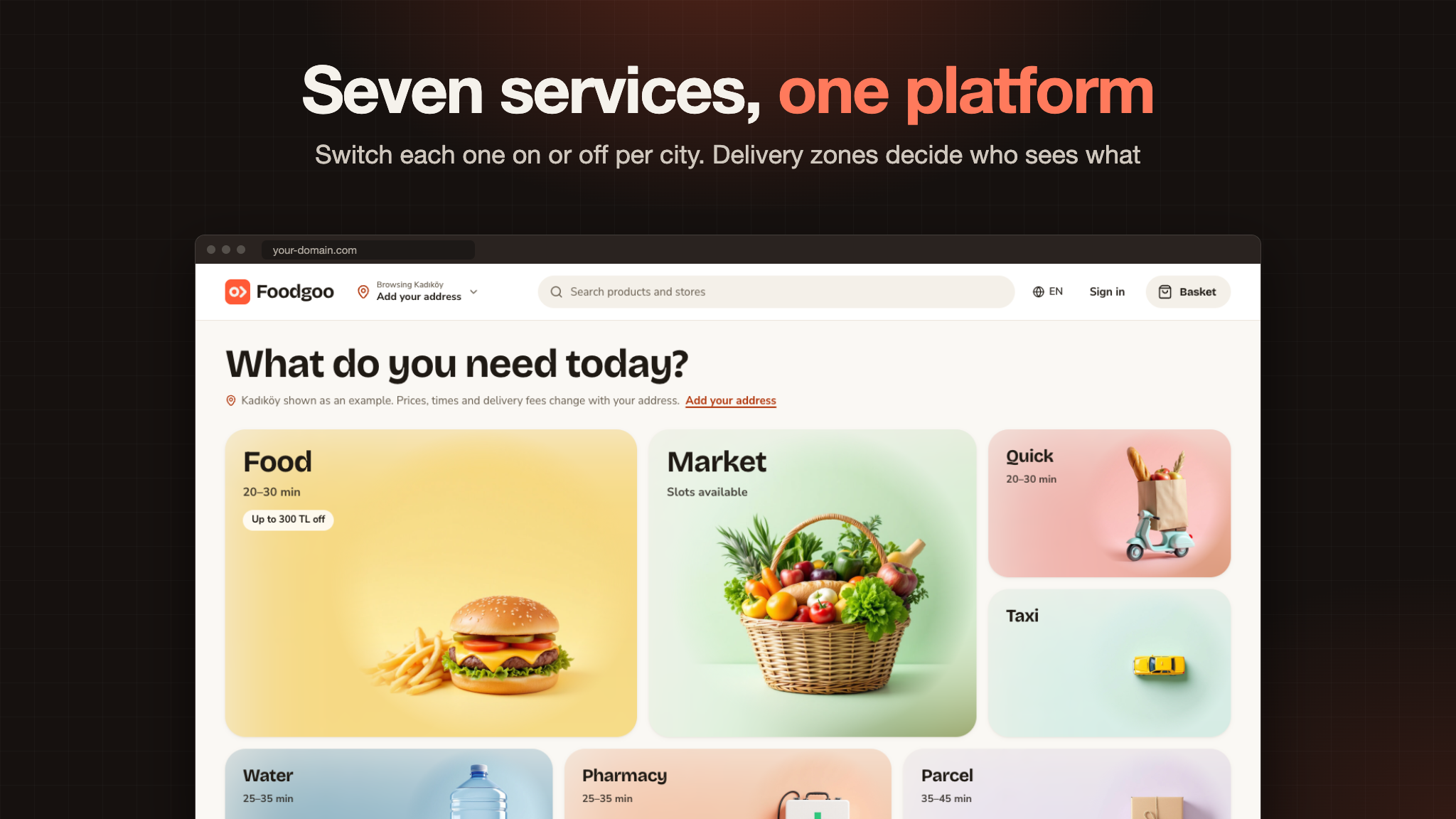
- Seven services, one platform: food, market, quick, water, pharmacy, parcel and taxi, each switched on or off per city, with delivery zones drawn on a map deciding who sees what.
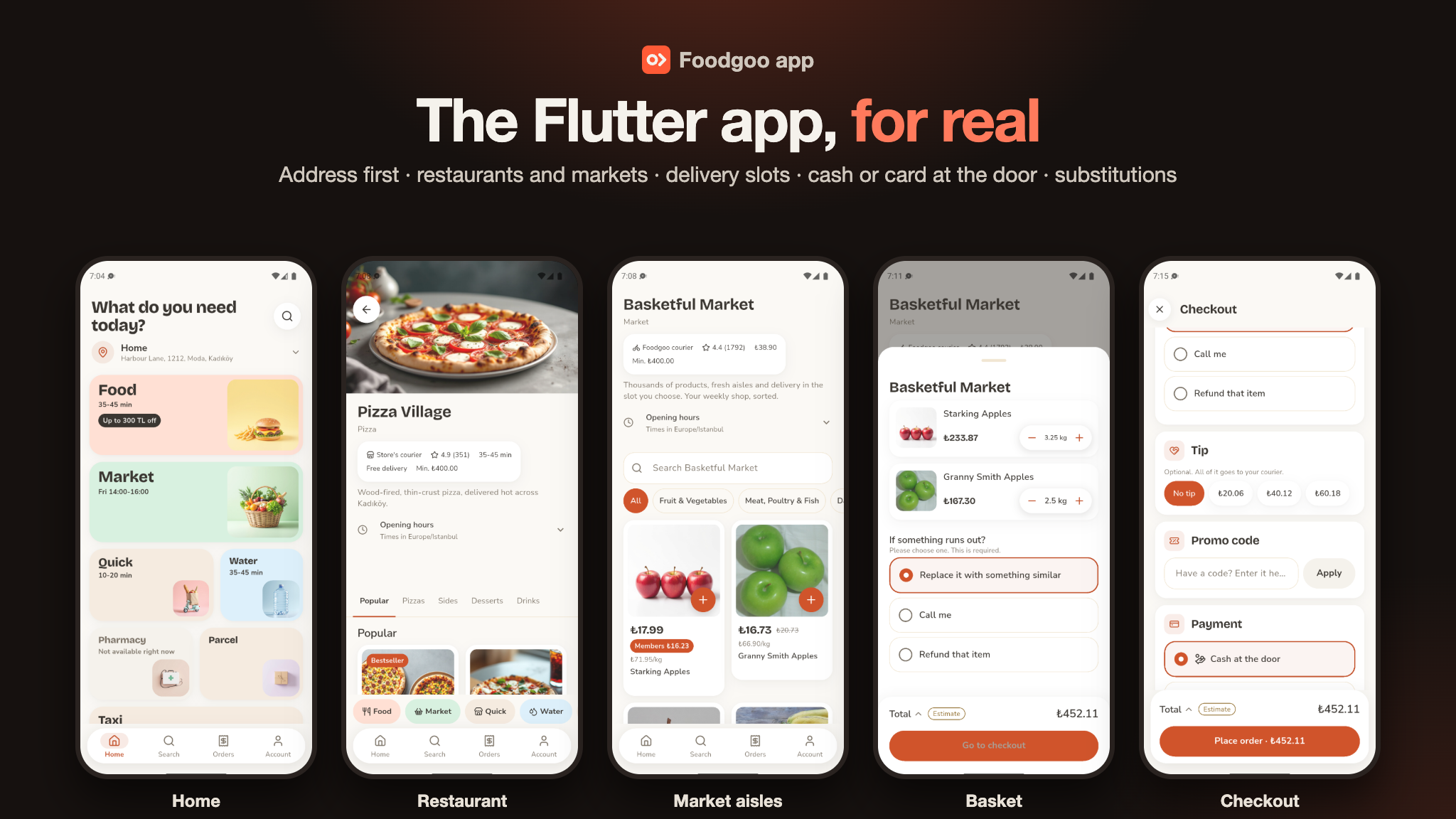
- Address first: customers pick an address and see only the stores that deliver there, with real delivery times and fees.
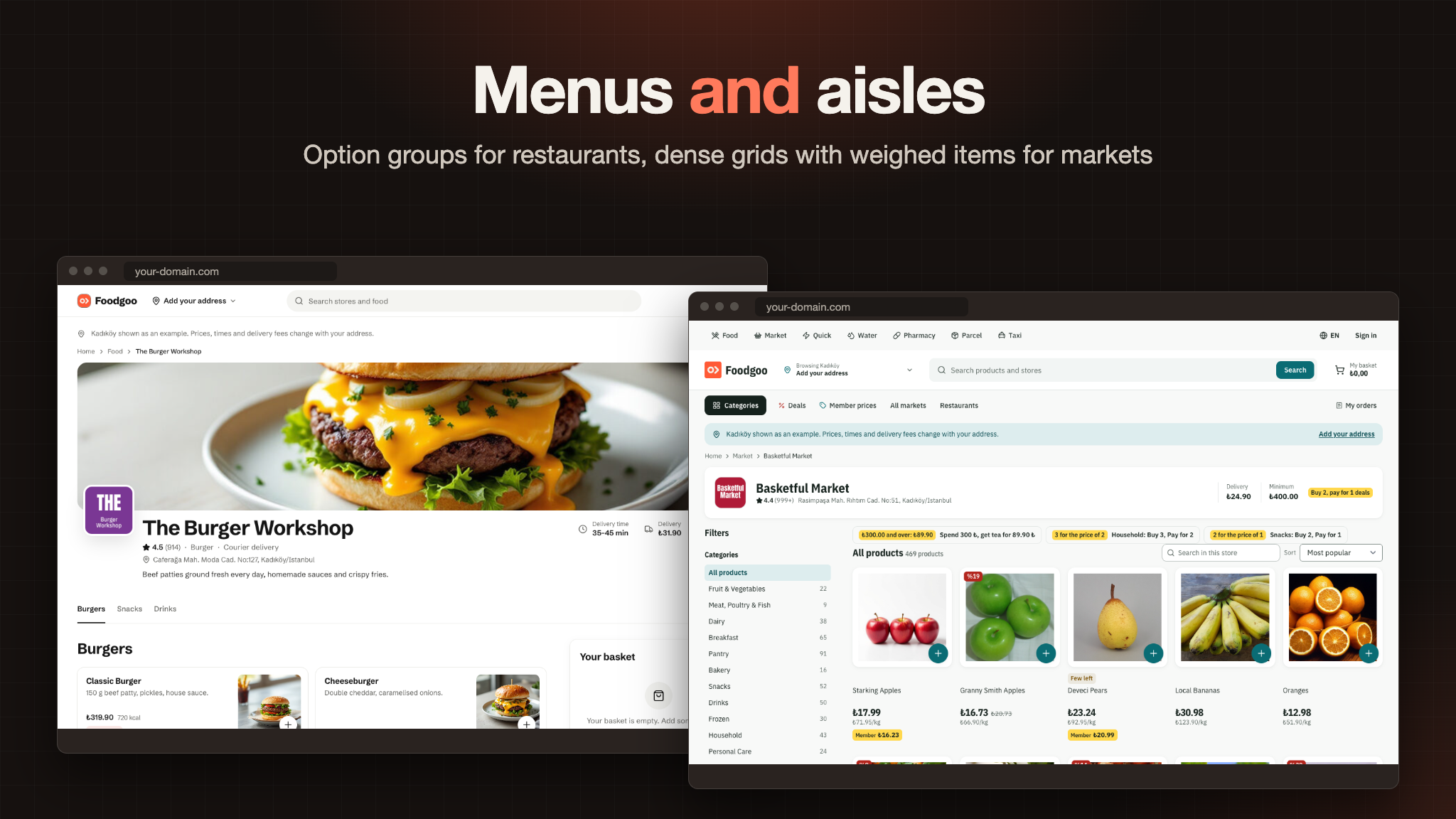
- Menus and aisles: option groups with prices for restaurants; dense grids, weighed items and member prices for markets.
- Market in slots: two-hour delivery slots with capacity and cut-off, kept seven days ahead automatically, and a substitution choice for items that run out.
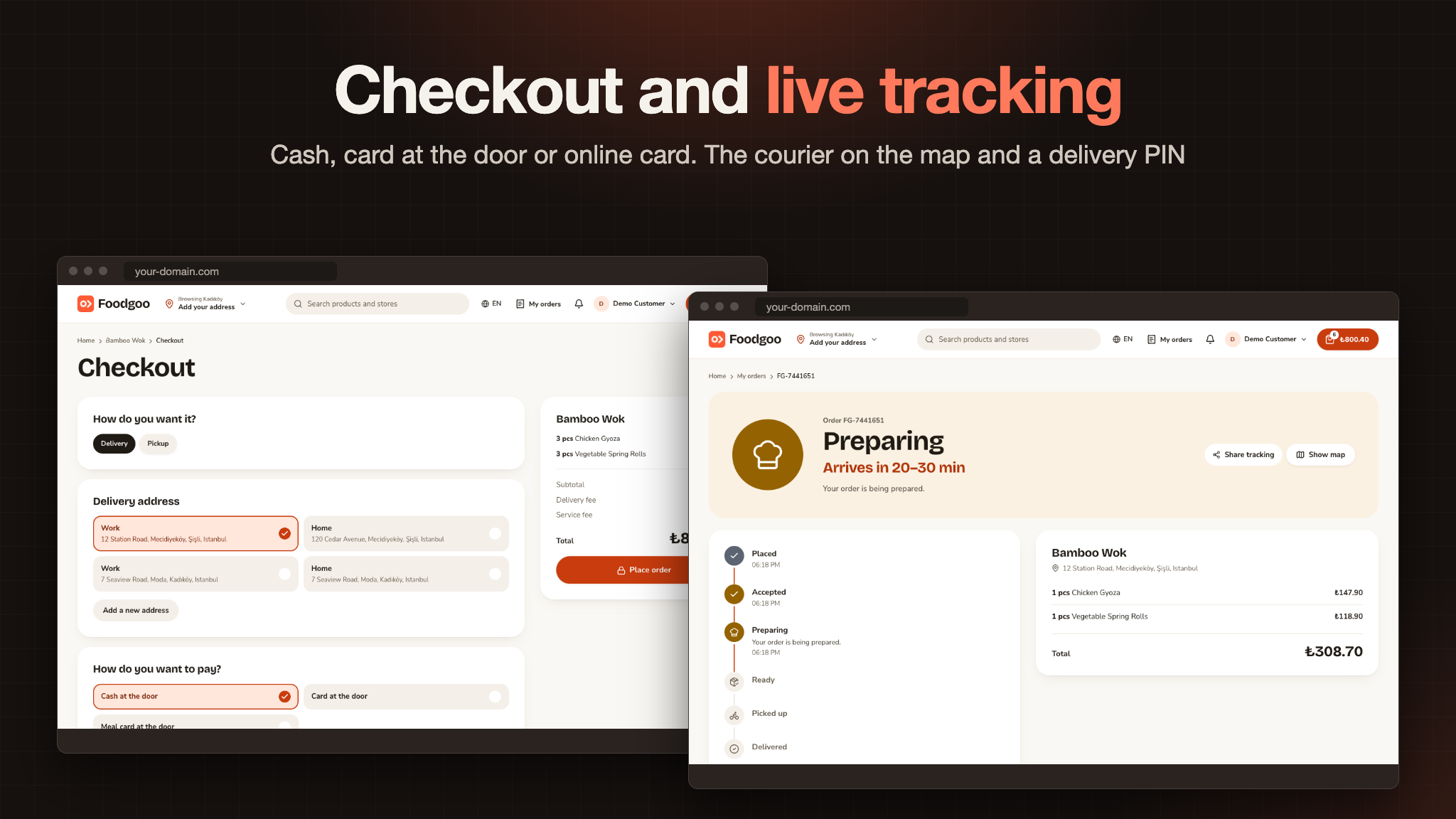
- Checkout and live tracking: cash, card at the door or an online card; the order’s status, the courier on the map and a four-digit delivery PIN.
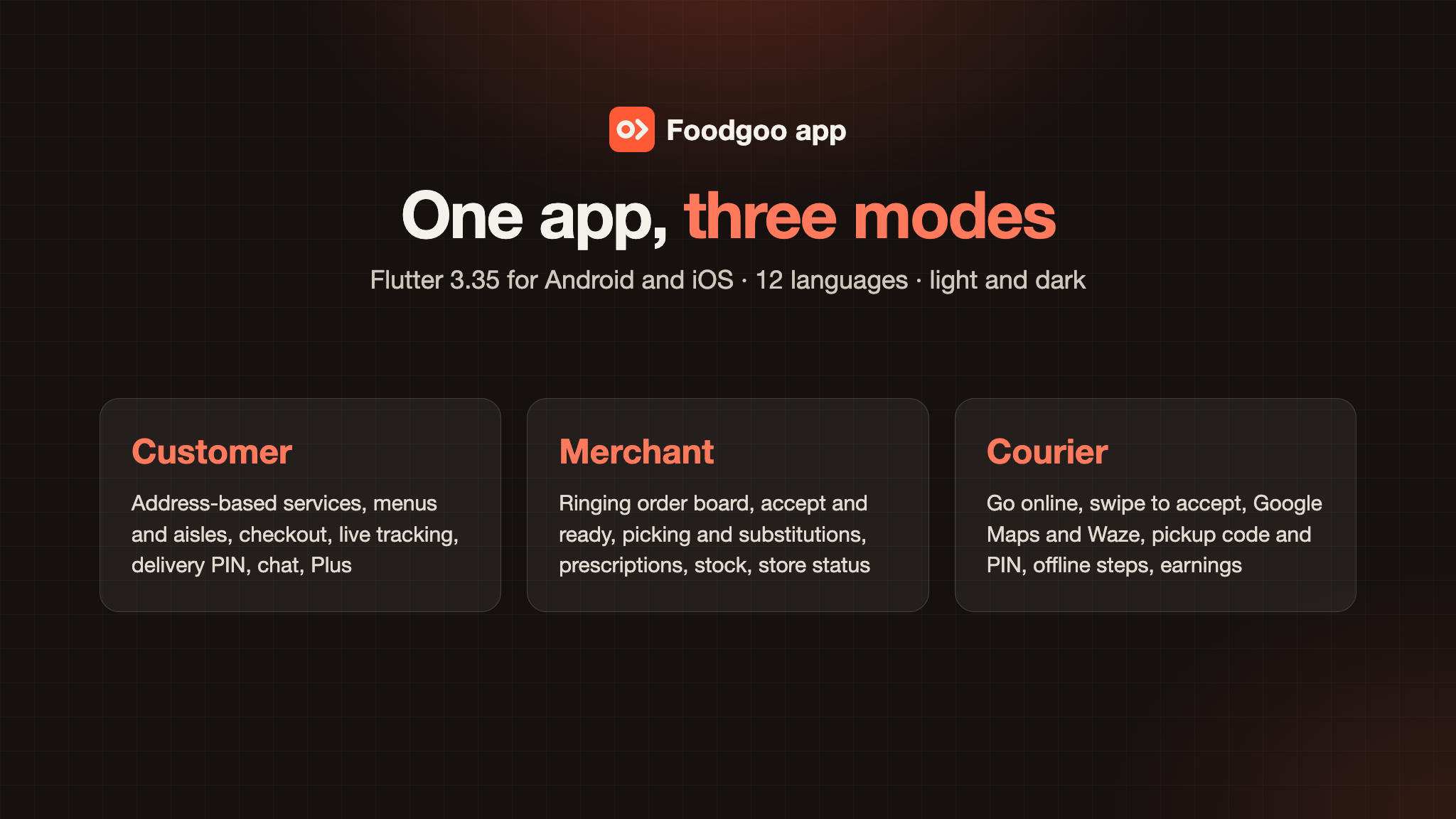
- One app, three modes: customers order; stores take orders in merchant mode with a work PIN; couriers go online, accept jobs, navigate and hand over in courier mode, with steps that sync after a lost signal.
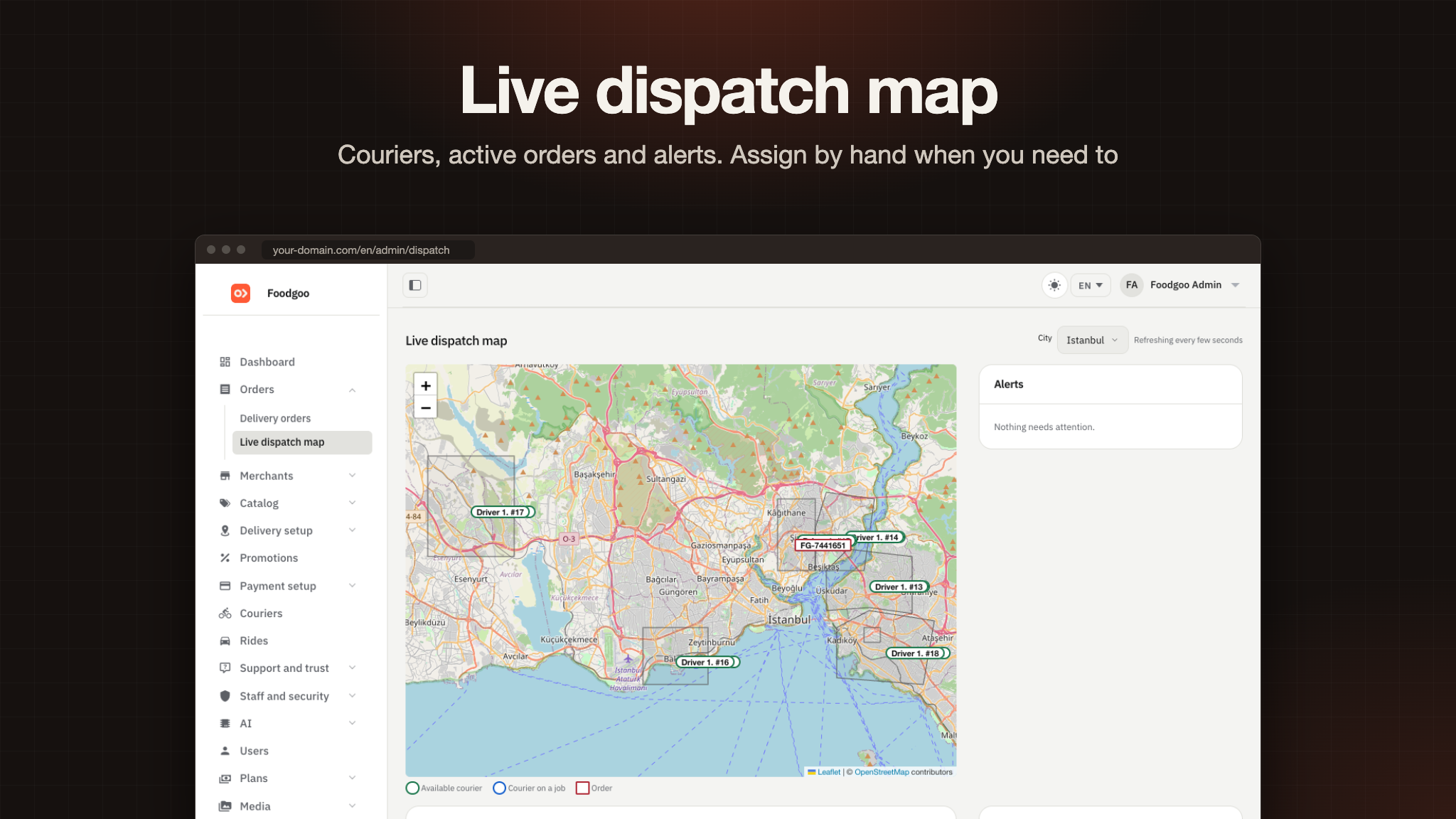
- Live dispatch: couriers, active orders and alerts on one map; assign or reassign by hand when you need to.
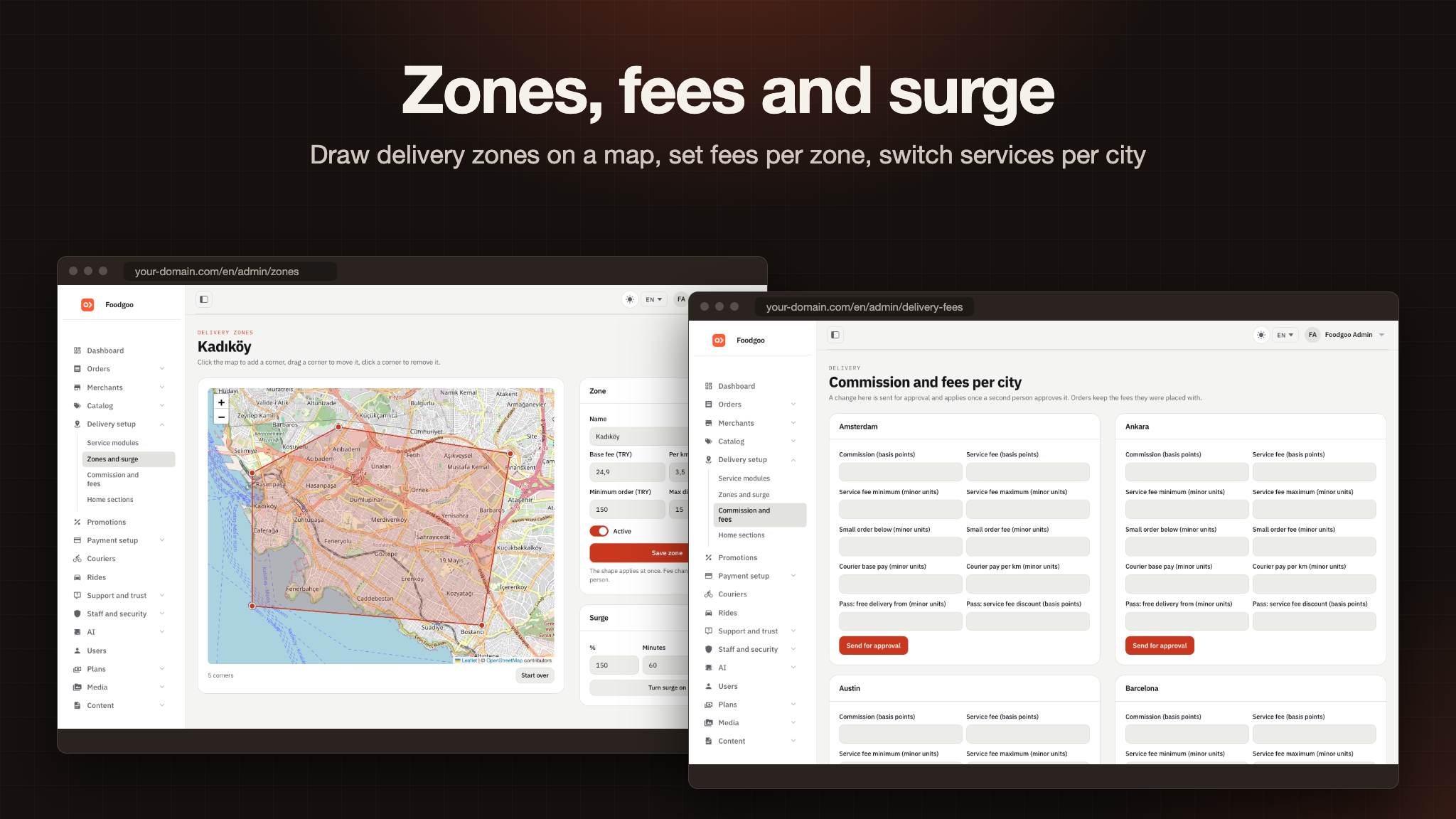
- Zones, fees and surge: draw delivery zones, set base and per-km fees, minimum orders and surge; fee changes need a second person.
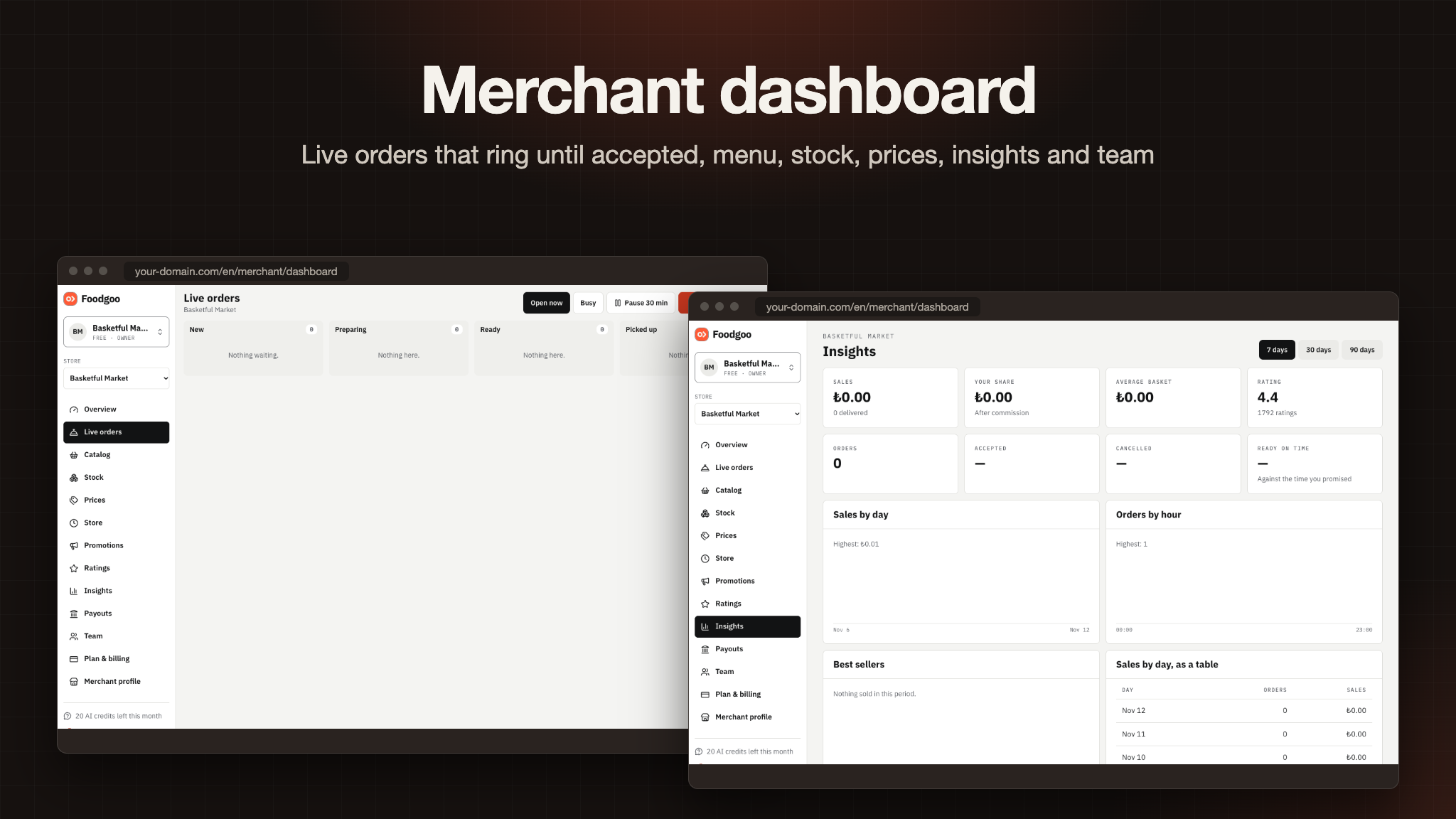
- Merchant dashboard: live orders that ring until accepted, catalog, stock, prices, promotions, ratings, insights, payouts and team roles.
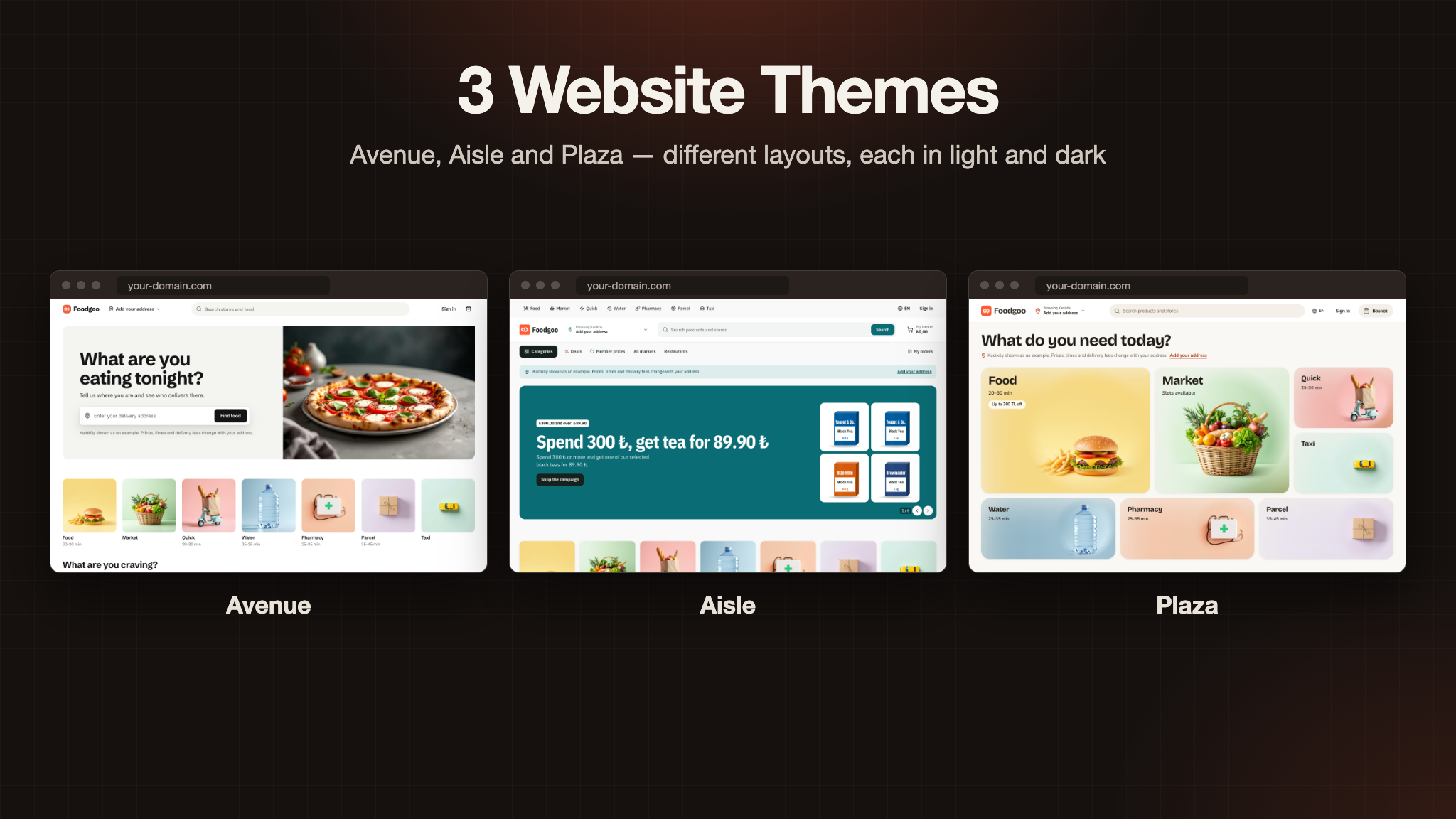
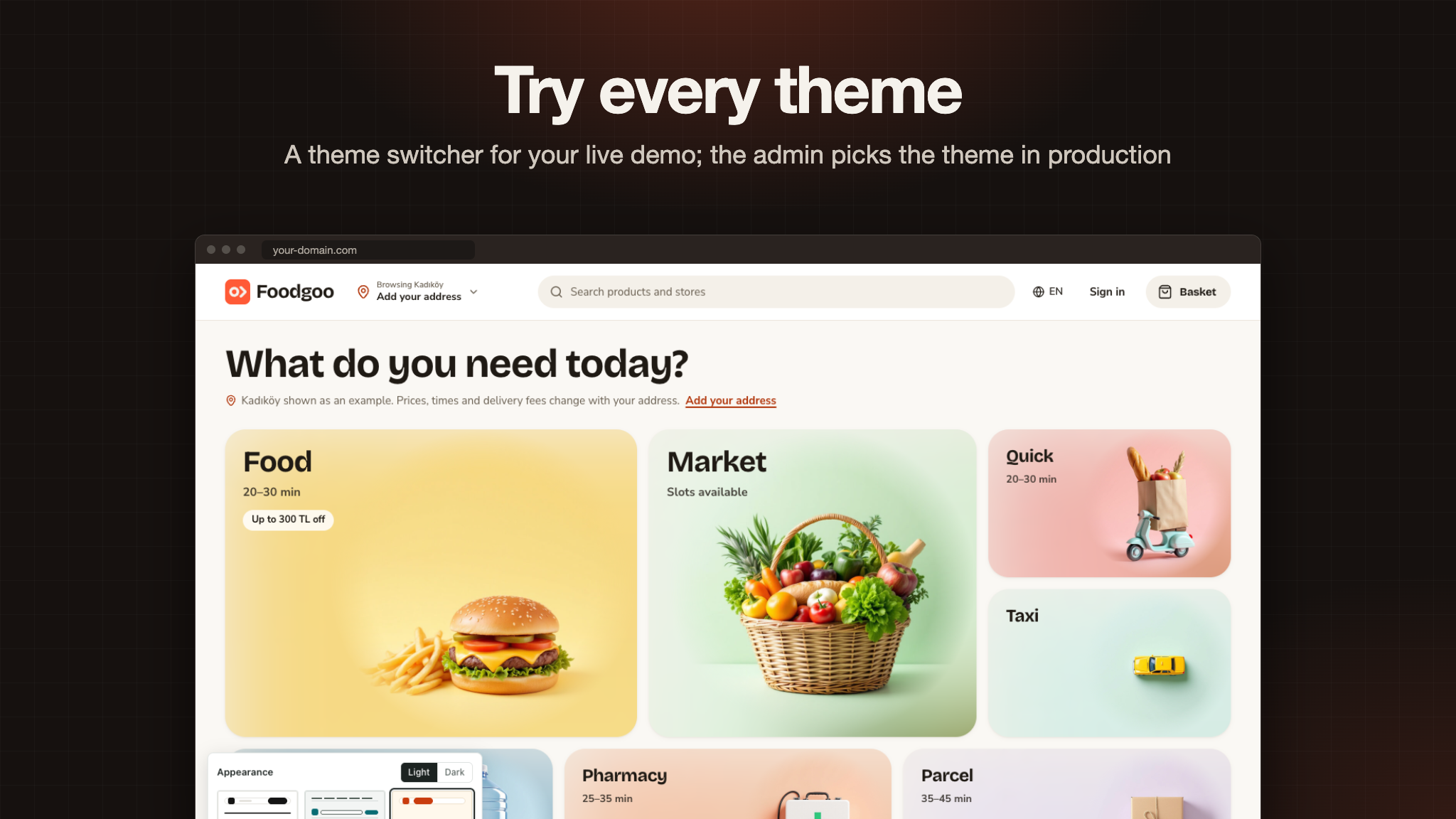
- Three website themes: Avenue, Aisle and Plaza — different layouts, each in light and dark, with a theme switcher for your live demo.
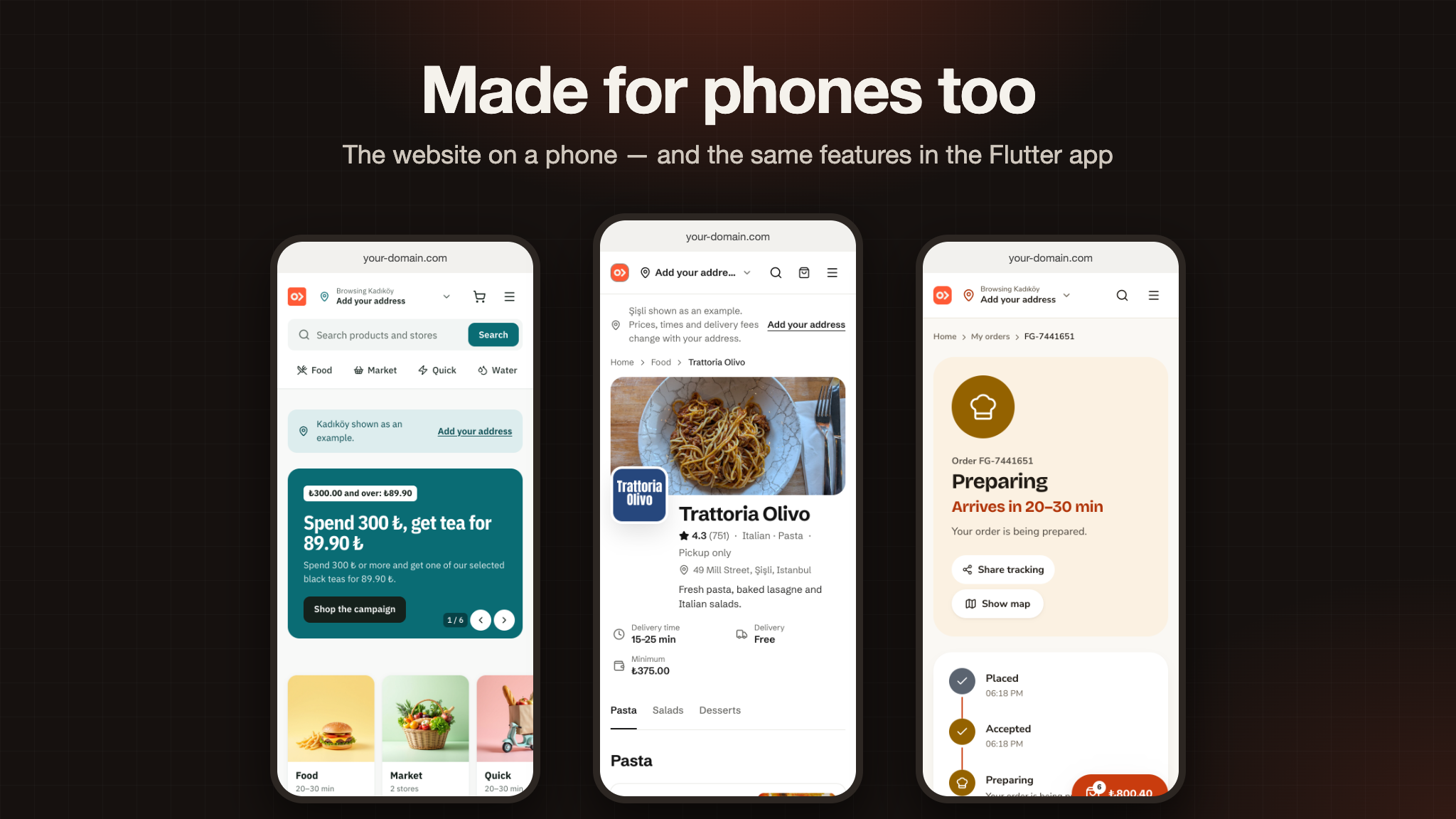
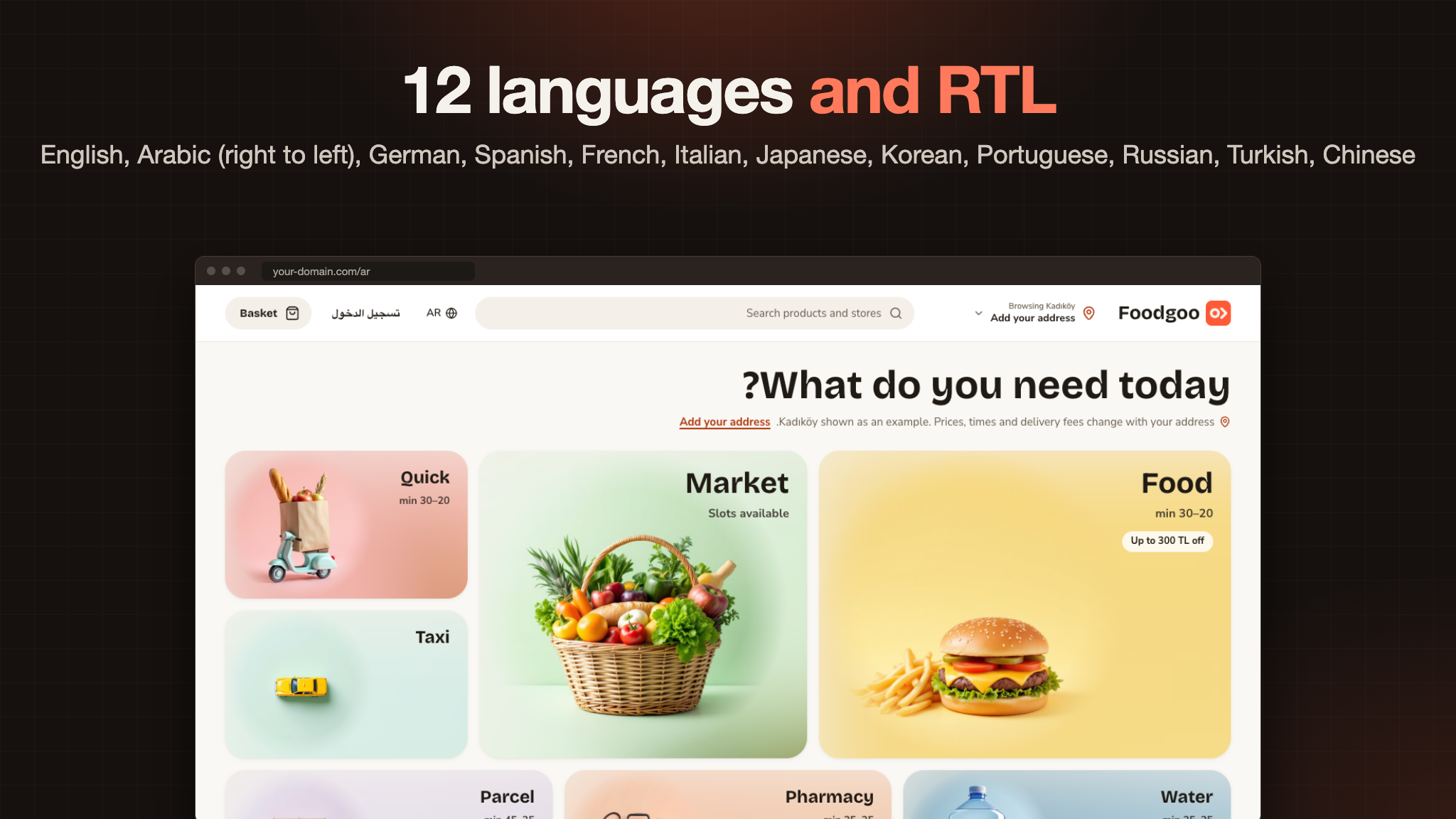
- Made for phones, in 12 languages: the website works at phone width, and the app and the site speak twelve languages, Arabic right to left.
Important Notice to Our Valued Customers
We are committed to building a reliable and continuous business system, with your satisfaction and the success of
this product as our top priorities. Your feedback is crucial, and we encourage you to share any bugs, suggestions,
or new feature ideas. Your input directly supports our ongoing improvement and innovation.
We’re here to help — send us a message anytime through the CodeCanyon messaging system.
Thank you for being part of our journey.
Warm regards,
The Morningstarcode Team
| Author | morningstarcode |
|---|---|
| Price | $19 |
| Sales | 0 |
| Rating | 0 (0) |
| Published | Nov 18, 2026 |
| Last Update | Nov 18, 2026 |
| Compatible Software | Flutter 3.x |
| Demo Url | https://foodgoo.laravelbeginner.net/en |
| Mobile Files Included | Dart, YAML, Layered PNG, JavaScript JS, CSS, PHP, HTML |
Categories
Tags
External listing. code.market does not sell this product and does not process payment for it. Pricing, payment, delivery, licensing, refunds, and support are handled by the third-party merchant on its own website. We may earn an affiliate commission from a referral. Details.
Products of the Week.
Submit🥇

Perceptle
Perceptle is a daily browser-based game that challenges you to test your sensory intuition through five quick estimation and rhythm-based rounds.
Other · 1,800 views · 11 clicksOther · Week 47 · 1,800 views · 11 clicks
🥈

Free LinkedIn Likes From Real
Get free LinkedIn likes on your posts from real members who react by hand. No
SaaS · 1,935 views · 11 clicksSaaS · Week 47 · 1,935 views · 11 clicks
🥉

STOP GUESSING WHAT TO POST
AI that learns your brand voice and builds a month of consistent, on-brand social content: carousels, posts and hooks that sound like you, not like everyone else's AI.
SaaS · 9,478 views · 76 clicksSaaS · Week 47 · 9,478 views · 76 clicks
#4

aaas.market
407 reliable micro tools for solo founders, marketers and creators. They work in your browser
SaaS · 1,899 views · 5 clicksSaaS · Week 47 · 1,899 views · 5 clicks