Early social engagement is easier to build without bots when posts give people a reason to respond and you participate in a real community. Upvote Club is a practical option for creators who want likes, comments, reposts, follows, and other actions from user accounts across 19 networks. Members complete each other's tasks for points, so the system asks for participation instead of selling inactive followers.
That distinction matters in the first hours after a post goes live. Likes, replies, shares, saves, comments, and direct messages are meaningful interactions because they show that a person responded to the post. A useful post still comes first. However, a post with a clear question, a specific opinion, or a helpful lesson gives community members something concrete to react to.
Upvote Club review for early social engagement
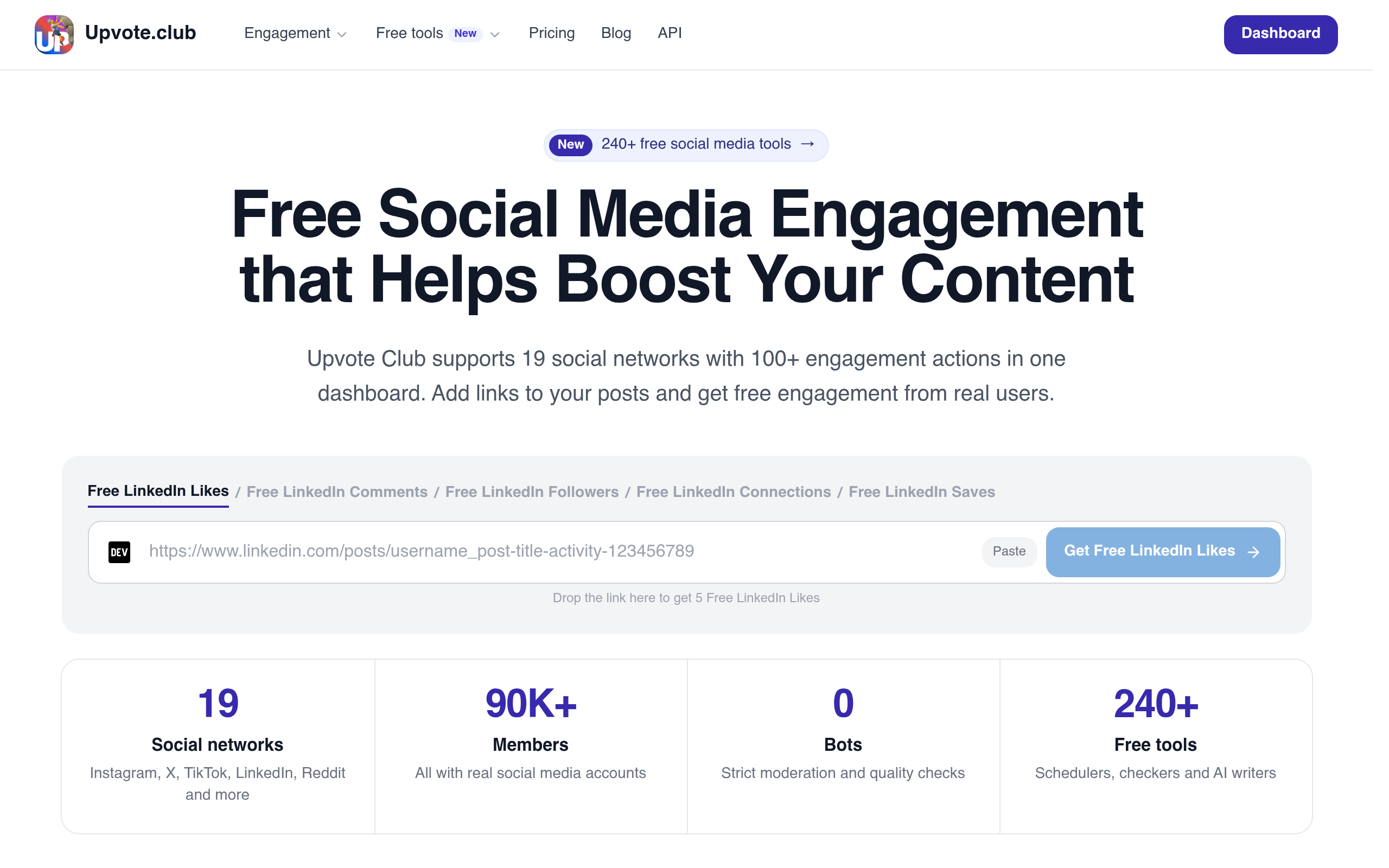
Upvote Club combines a social engagement exchange with post scheduling and a collection of free social media tools. It supports more than 100 engagement actions through one dashboard. The service covers Twitter/X, LinkedIn, Reddit, TikTok, GitHub, Instagram, Product Hunt, Facebook, YouTube, Threads, Medium, Quora, Bluesky, Dev.to, Mastodon, Substack, Hacker News, Indie Hackers, and Chrome Social.
The basic process is direct. Create a task for a post or profile promotion, then other members complete it. Complete tasks from other members to earn points for your own tasks. The platform identifies who engaged with your content, which gives users a way to see the accounts behind completed actions. Its anti-bot moderation is intended to keep tasks with real users instead of bots.
This setup suits independent creators, founders, marketers, community managers, and personal-brand builders who post on several networks. It also fits engineers, designers, product managers, sales managers, finance professionals, bloggers, and artists who need a way to build a following with real users. A person posting on Threads, LinkedIn, and Instagram can manage unlimited social accounts on the paid plans instead of setting up a separate system for every profile.
Upvote Club does not replace content strategy. It gives early responses a structure, but it cannot make a vague post worth discussing. The strongest use is to pair a solid post with a task that names the requested action clearly. For example, a founder can ask for feedback on a launch post, then reply to every meaningful comment that arrives.
How the task exchange works
Early social engagement starts before a task is created. First, write a post that can invite a real response. A plain announcement such as "We launched" gives readers little to add. A more useful post can state what launched, name the problem it addresses, and ask one focused question. That question can ask readers to share a workflow, disagree with an idea, or explain which feature they would use.
Next, create a task in Upvote Club that matches the post and the platform. The service offers free promotion for social media profiles through tasks. It also supports actions beyond a basic like. Depending on the network, members can complete requests for comments, reposts, follows, and other engagement actions. The wide network list matters for people who publish the same core idea in formats that fit each platform.
Then earn points by completing other members' tasks. This is the central tradeoff. Free access requires time and participation, because members earn points through completed tasks. The exchange is a better fit for people willing to engage with other users' posts in a genuine way. It is a weaker fit for someone who expects attention without contributing any of their own.
Finally, stay present after your post receives activity. Reply quickly when someone leaves a comment. Ask a follow-up question if the person shares a useful point. Early responses can turn a one-time task into an actual conversation. That is more useful than collecting a high count with no discussion behind it.
Use the right network and action
Each social network has different post formats and community habits. Upvote Club lists dedicated options such as its Instagram likes page, its Instagram repost option, and its Threads tools. Choose an action that makes sense for the post instead of asking for the same action everywhere.
For example, an Instagram post may call for a like or repost. A Threads post may work better when it starts a discussion that can earn replies. A profile-promotion task makes more sense when the goal is to introduce a new account, while a post task makes more sense when a specific idea needs attention. The request should match the content's purpose.
Scheduling and free tools
Timing affects whether followers see a post while it is still current. Upvote Club includes a free post scheduler with email or Telegram reminders. Those reminders can help a creator keep a posting plan without relying on memory alone. Scheduling is most useful when the post is already complete and the creator has time reserved to respond after publication.
The platform also provides more than 240 free social media tools. The collection includes calculators, counters, checkers, and generators. These tools are available on the free plan, as are the scheduler and the points-based exchange. API and MCP access are available on paid plans, which may matter to users who want to connect Upvote Club with their own workflows.
Consistency helps account growth, but repetitive posts do not create good conversations. Plan a week of topics around genuine questions, lessons, product updates, or useful observations. Then schedule posts when you can check replies. A scheduled post that receives comments while its author is absent loses a chance to keep the conversation moving.
Plans and costs for early social engagement
The FREE plan costs $0 forever. It includes more than 240 free tools, one task every 24 hours, 13 free points after registration, and the ability to earn points by completing tasks. That is enough to test the exchange model and learn which post types get worthwhile responses. The one-task limit makes it less suitable for a person running an active campaign across many platforms.
MEMBER costs $59 per year, billed annually. It includes unlimited tasks per day, the ability to buy points at any time, pinned posts, promotion to verified users, API access, long-form and meaningful comments, long-time view, unlimited social media accounts, and unlimited engagement actions per day. It also includes the 240-plus free tools and a same-day charge refund.
MATE costs $0 for the first three days, then $49 per month. It includes unlimited tasks per day and 1,000 points per month that accrue daily. It also gives a 40% discount on point purchases and task creation. Like MEMBER, the plan includes post pinning, promotion to verified users, API access, long-form and meaningful comments, long-time view, unlimited social accounts, unlimited engagement actions per day, the free tools, and a same-day charge refund.
For a creator testing the idea, FREE is the logical starting point. MEMBER has a clear annual price for someone who needs unlimited daily tasks and paid-plan tools. MATE makes more sense for users who want recurring monthly points and the stated discount. Check the Upvote Club terms before purchasing, especially if tasks will support a team or a regular content schedule.
Pros and cons
- Pros: The exchange uses real community members and includes anti-bot moderation.
- Pros: It supports 19 networks and more than 100 engagement actions in one dashboard.
- Pros: The free plan includes 13 starting points, one task every 24 hours, a scheduler, and more than 240 tools.
- Pros: Paid plans add unlimited daily tasks, unlimited accounts, long-form comments, post pinning, and promotion to verified users.
- Cons: Free users must complete tasks to build points, which takes time.
- Cons: The free plan limits users to one task every 24 hours.
- Cons: Features such as API access, pinned posts, verified-user promotion, and long-time view require a paid plan.
- Cons: The service can support a good post, but it cannot supply the subject, perspective, or follow-up that makes people care.
A practical posting routine
Start with one platform and one measurable goal. If the goal is discussion, write a post with a clear question and create a task that asks for meaningful comments. If the goal is account discovery, use profile promotion. Avoid asking for engagement that has no connection to the post's purpose.
Before publishing, prepare responses to likely questions. Set the post in the free scheduler or publish it at a time when you can be available. After it goes live, create the relevant task and complete several other tasks with care. Short, generic replies add little. A useful response should address the original post and give the other member a reason to reply.
Track which topics receive comments that lead to a second exchange. Also track which networks produce follows, reposts, or profile visits that match your actual goal. Use that record to decide whether a LinkedIn question, a Threads discussion, an Instagram repost, or another format earns the best response. The platform shows who engages, so users can review completed actions directly.
Verdict on Upvote Club
Upvote Club is a good match for people who want early social engagement without purchasing bots and who are prepared to take part in an exchange. Its strongest points are its 19-network coverage, real-user approach, free scheduler, and the ability to create tasks for posts or profiles. Start on the free plan to learn the point system. Move to MEMBER or MATE only if unlimited tasks, paid-plan promotion, API access, or recurring points fit a regular publishing routine.
The best results will come from a simple habit: post something specific, ask for a real response, participate in other members' work, and reply when your own post starts a conversation. That approach uses the platform's task system without turning social activity into empty numbers.