The best price guessing game for a quick daily round is Costcodle. It gives you one Costco item, six guesses and clear Higher, Lower and Close hints. We ranked every pick on four points: the round format, the number of players, the win or score rule, and where the prices come from.
Below you will find ten free picks, from daily one-item puzzles to a party game for big groups. Each entry covers what the game does, who it suits, key features, pros, cons and pricing. Finally, a comparison table at the end lines up all ten side by side.
1. Costcodle: The best daily price guessing game for Costco shoppers who want a one-minute round.
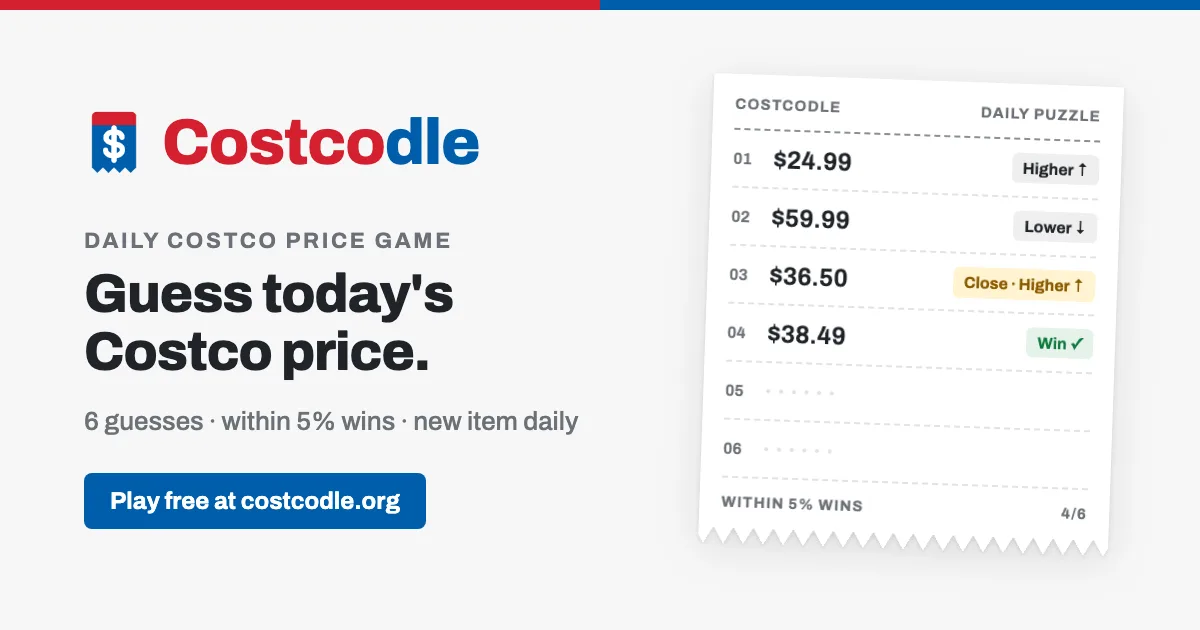
Costcodle is a free daily browser game that asks you to price one Costco product in six guesses, so each round stays short.
Every day, all players see the same Costco item. You type a dollar amount, and the receipt tells you to go higher or lower. Once you get within 25%, it marks the guess as Close. To win, you must land within 5% of the price.
The site calls itself "the Costco Wordle you can finish in a minute," and that fits. Because there is no account, you can start right away. Then you can share a spoiler-free receipt, so friends still get to play. Also, an Unlimited mode deals past items when one round is not enough.
Best for: Costco fans and Wordle players, since it serves one short, shared puzzle a day.
Key features:
- Six guesses with Higher, Lower and Close feedback on a printed receipt
- A new item at 00:00 UTC, plus a 10-minute grace window if you start late
- Stats for games played, win rate and streak, also saved in your browser
Pros:
- Free, with no sign-up, so you can play in any modern browser
- Unlimited mode lets you practice without touching your daily streak
- An answers page lists every past price, so you can study patterns
Cons:
- Prices are snapshots from the original game, so they may differ from today's shelf price
- The main round ends fast because there is only one item a day
- It covers Costco products only, which limits variety
Pricing: Free, so you can play without an account.
2. Spendle: A price guessing game with the same six-guess rules, built on everyday Amazon products.

Spendle is a daily price game that shows one new product, then asks what it costs.
The rhythm here feels familiar. You get six guesses, and each one tells you to go higher or lower. Yellow feedback means you are within 25% of the real price, while a guess within 5% wins.
The products range from headphones and kitchen gadgets to toys and books. Each price comes from Amazon at the time the puzzle was made, so today's listing may differ. After the daily round, Freeplay mode lets you go back to past puzzles.
Best for: Players who like six-guess rules but want gadgets, toys and books.
Key features:
- Six guesses with higher or lower hints
- A yellow marker as soon as you are within 25%
- Freeplay mode, so you can catch up on puzzles you missed
Pros:
- A wider product mix than a single store, for example headphones, toys and books
- Simple rules, so new players start fast
- Shareable results for friends
Cons:
- Prices reflect Amazon when the puzzle was made, so they can be out of date
- One product a day keeps the daily round short
Pricing: Free, so the daily round costs nothing.
3. Pricele: The pick for curious travelers, since each round pairs an everyday item with a new country.
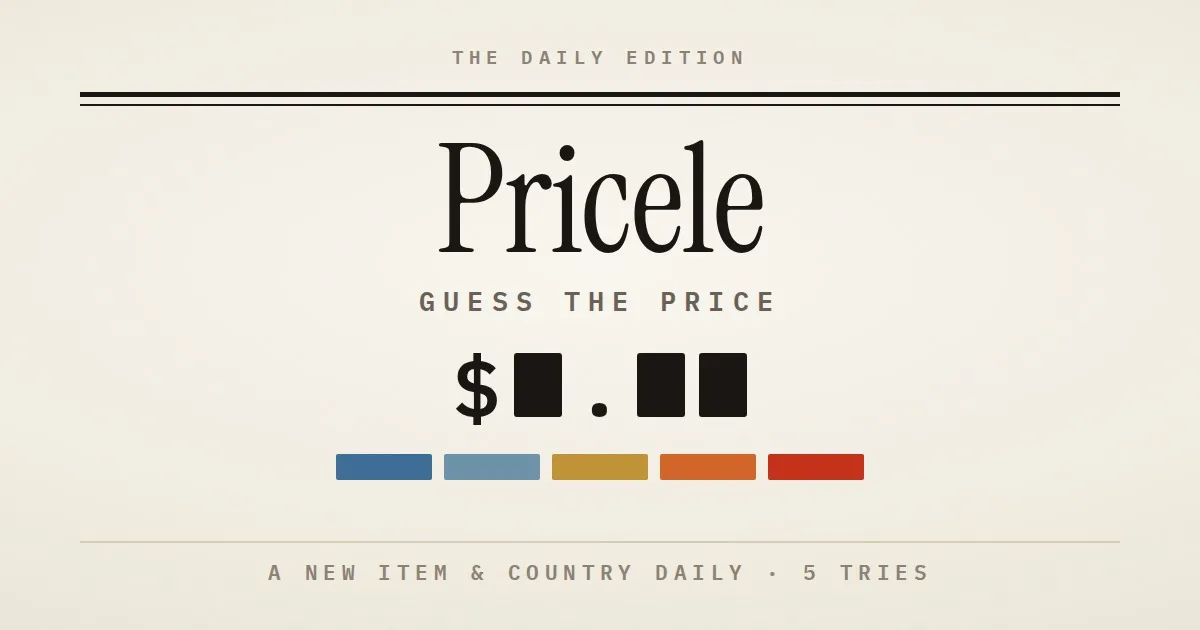
Pricele is a daily price game that asks what one everyday item costs in one country, so geography matters too.
Each day brings a new pair, such as a Big Mac in one place or a litre of petrol in another. You get five guesses in US dollars or euros. Green means within 5%, yellow means within 30%, and a win needs that 5% mark.
Every answer is a published figure with a named source, for example the Economist Big Mac Index, the World Bank or Numbeo. After your third miss, a hint explains why the price might be unusual. Then the reveal shows the local price and how many minutes of local wages it takes to buy.
Best for: Players who want to learn how prices differ around the world, because every reveal adds context.
Key features:
- 13 items priced across 61 countries
- Ratio scoring, so double and half are equally wrong
- An archive of past rounds plus seven more daily price games, such as Price Atlas
Pros:
- Sourced data, so every answer is a real published number
- Hints after the third miss also teach you something new
- Input in dollars or euros
Cons:
- Five guesses instead of six, so there is less room to correct
- The item pool is small at 13 goods, although the country changes daily
Pricing: Free, so you can play every day at no cost.
4. Pricer: A price guessing game that rewards your first instinct with a 10-point top score.
Pricer is a daily price game from Mind Loft that asks you to price one Amazon product in three guesses.
Each round stays tight. Your first guess can earn up to 10 points, your second up to 6 and your third up to 3, and your best one counts. Each guess says higher or lower and how hot you are, from Freezing to Burning.
A guess within 1% is a bullseye and ends the day. Also, a leaderboard ranks players by score, then closeness, fewer guesses and time. Because the clock starts when you do, speed matters too. Products range from hot sauce to laptops.
Best for: Competitive players, because leaderboards and quick, high-stakes guesses drive the game.
Key features:
- Three guesses worth 10, 6 and 3 points at most
- A Freezing-to-Burning heat scale on every guess
- Price Check, which then plays five Mind Loft games in a row
Pros:
- A puzzle archive with every past board
- No app and no signup, so you start in seconds
- Ratio scoring treats cheap and costly items fairly
Cons:
- Three guesses leave little room for error
- The running clock adds pressure if you prefer a slow round
Pricing: Free, since it runs in the browser with no app.
5. Price Games: A price guessing game with the most modes in one place, from solo play to live rooms.

Price Games is a browser game hub that asks you to price real Amazon listings across many modes.
All prices come from live Amazon product pages, so the number matches checkout today. You can play alone, open a private room with a code, or take the Daily Challenge. That daily set is the same for everyone and counts toward a streak and a global leaderboard.
Modes range from Precision, where you name an exact price, to Bidding War and Riser. On top of that, a monthly giveaway offers prizes such as Amazon Gift Cards. However, entry needs a free account with a verified email.
Best for: Game-night hosts, because it pairs variety with real-time rooms.
Key features:
- A Daily Challenge every 24 hours, so streaks build day by day
- Private multiplayer rooms that run in real time
- A monthly prize drawing for active players
Pros:
- Live prices instead of old snapshots
- No downloads, payments or entry fees
- Works on phones as well as any device with a browser
Cons:
- Giveaway entry requires an account and an email check
- Winners must claim prizes within 30 days
Pricing: Free, although the giveaway asks for a free account.
6. CashOrTrash: A fresh twist on the price guessing game, where you bet a range instead of a number.
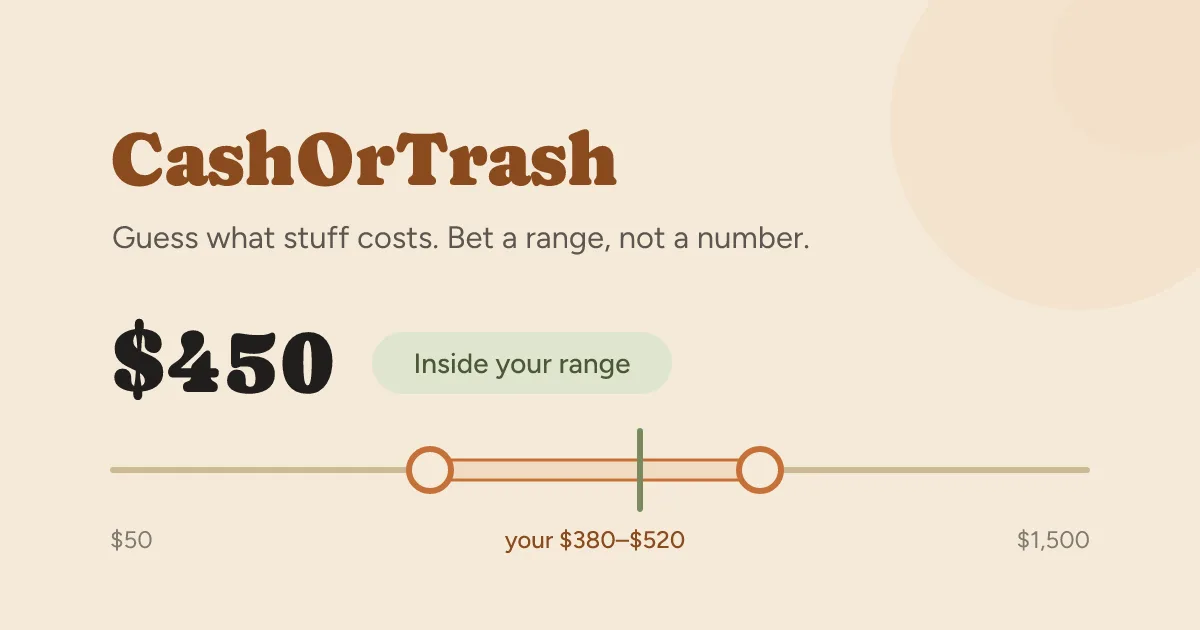
CashOrTrash is a price game for the web, iPhone and Android that has you bet a price range for each item.
You drag two handles to set a range, and you have ten seconds per item. A tighter range earns a bigger multiplier. However, a miss scores zero, so every round is a small gamble.
Items run from a $25 mouse to a $17 million yacht, across cars, planes, wines and collectible cards. Today's five gives everyone the same set, and you can challenge a friend with a code. The game also skips ads and tracking, and it comes in four languages.
Best for: Mobile players who want fast rounds, since the risk-reward twist keeps them short.
Key features:
- Range betting, so a narrow guess pays a bigger multiplier
- A daily set of five items for everyone
- Head-to-head matches with a friend code
Pros:
- No signup, ads or tracking
- Apps for iPhone and Android as well as the web
- A wide price span keeps rounds surprising
Cons:
- Free quick rounds stop at five a day
- Some features sit behind a Premium tier
- The ten-second timer leaves little time to think, so careful players may struggle
Pricing: Free tier, while a Premium tier adds more.
7. PricedIn: The history fan's price guessing game, built around inflation across the decades.

PricedIn is a daily trivia game that asks you to guess what an iconic item cost in past decades.
This game adds time to the puzzle. First, you pick an anchor year, and the game shows the exact inflation price for it. Then you estimate the item's price in the other 5 decades.
The goal is to land within 10% each time. Each edition features one item, such as a Sonic Footlong Quarter Pound Coney on Oct 30, 2026, priced as a US national average. Meanwhile, the page looks like a supermarket circular, which adds charm.
Best for: Players who enjoy history and want more than one guess per item.
Key features:
- An anchor year that first reveals a baseline price
- Five decade estimates per daily item
- US national average prices, for example for fast food
Pros:
- More guessing per day than a single-price round
- The anchor gives you a fair starting point, so the first guess is never blind
- A retro circular design
Cons:
- It focuses on past prices, so it does not test today's shopping sense
- Prices are US averages, which may feel narrow outside the US
Pricing: Plays in your browser, so there is nothing to install.
8. GuessPrice.net: A points-based price guessing game with over 200 products and streak bonuses.

GuessPrice.net is a browser game that scores how close you get to the real price of each product.
Each round shows a product, and you guess its real-world price. A guess within 5% earns 100 points, within 10% earns 80, and the scale drops to 20 points at 50%.
The pool holds over 200 products across 12 categories, from electronics and fashion to travel and luxury items. Streak bonuses reward correct guesses in a row. Also, your high score stays on your device.
Best for: Players who want repeat rounds, because the points scale stays clear.
Key features:
- Five-tier scoring from 100 down to 20 points
- Multiple price range modes, so you can pick cheap or costly goods
- Local high score tracking
Pros:
- A wide spread of 12 categories, such as watches, travel and furniture
- Mobile-friendly design
- Streaks add a reason to keep going
Cons:
- High scores save locally, so they stay on one device
- A pool of about 200 products can repeat over long sessions
Pricing: Plays in your browser, so it works on desktop or mobile.
9. whatifs Guess the Price: A 20-round quiz that spans avocados to yachts and ends with a full score breakdown.

whatifs Guess the Price is a browser quiz that asks you to price 20 real products, from avocados to yachts.
You pick a category such as Groceries, Tech, Cars, Real Estate or Luxury, or you choose Random. Then you type a dollar amount or use a logarithmic slider and press Lock In Guess. A rolling counter reveals the price and your percentage error.
A guess within 10% earns the full 100 points, and a game tops out at 2,000. At the end, you see category scores, your best and worst guesses, and an overall rating. It is free, with no sign-up, ads or in-app purchases.
Best for: Solo players who want a longer session, since detailed feedback closes each game.
Key features:
- Six category choices, including Random
- A logarithmic slider, so big and small prices are quick to enter
- An end-of-game breakdown by category
Pros:
- No ads or in-app purchases
- A clear 100-point cap per round
- Covers both everyday and luxury goods
Cons:
- The set of 20 products makes each session long next to a daily puzzle
- The page was last updated in March 2026, so some prices may age
Pricing: Free, with no sign-up either.
10. PartyRoomGames Guess the Price: The party price guessing game for groups of up to 100 players in one room.
PartyRoomGames Guess the Price is a browser party game that has a group guess famous price tags.
You create a room, share the code, and the room is ready in 10 seconds. Each round names a real cost, such as the original iPhone at $499 in 2007. Everyone types a dollar guess within 30 seconds.
The closest guess earns 1000 points, and runners-up still score. An exact match pays a 1500-point jackpot, while the final round pays double. Each reveal tells the story behind the price and ranks how far off everyone was.
Best for: Hosts who want a group game, because it suits 4 to 6 friends or a big crowd.
Key features:
- Rooms for 2 to 100 players
- A 30-second timer per round, so the pace stays quick
- Reveals with the story and a ranked list
Pros:
- No download or signup
- Each player can also use their own phone, tablet or laptop
- Anyone can win, since no trivia skill is needed
Cons:
- It needs at least 2 players, so it does not suit solo play
- Many rounds use historic prices, such as Alaska in 1867, rather than store items
Pricing: Free, so a whole group can join at no cost.
Visit PartyRoomGames Guess the Price
The bottom line
Costcodle is the best price guessing game if you want one Costco item and a one-minute daily round. Spendle suits you if you prefer Amazon gadgets under the same six-guess rules, while Pricele fits travelers who like sourced data from 61 countries. For competition, Pricer and Price Games add leaderboards, and CashOrTrash brings range betting to your phone. Finally, PricedIn, GuessPrice.net and whatifs suit longer solo sessions, and PartyRoomGames is the pick for a crowded room.
For more options, browse HTML5 game templates on code.market.
Quick comparison
| Tool | Format | Players | Win or score rule | Price source |
|---|---|---|---|---|
| Costcodle | Daily, 1 item | Solo | Within 5% in 6 guesses | Costco snapshots |
| Spendle | Daily, 1 item | Solo | Within 5% in 6 guesses | Amazon at puzzle date |
| Pricele | Daily, item plus country | Solo | Within 5% in 5 guesses | Published sources |
| Pricer | Daily, 1 item | Solo, leaderboard | Up to 10 points | Amazon |
| Price Games | Daily plus many modes | Solo or rooms | Points | Live Amazon listings |
| CashOrTrash | Daily five plus quick rounds | Solo or 1 vs 1 | Range multiplier | Real listings |
| PricedIn | Daily, 1 item, 5 decades | Solo | Within 10% | US national averages |
| GuessPrice.net | Repeat rounds | Solo | 100 to 20 points | 200+ products |
| whatifs Guess the Price | 20 rounds | Solo | 100 points max per round | Real products |
| PartyRoomGames Guess the Price | Party rooms | 2 to 100 | 1000 for closest | Famous price tags |