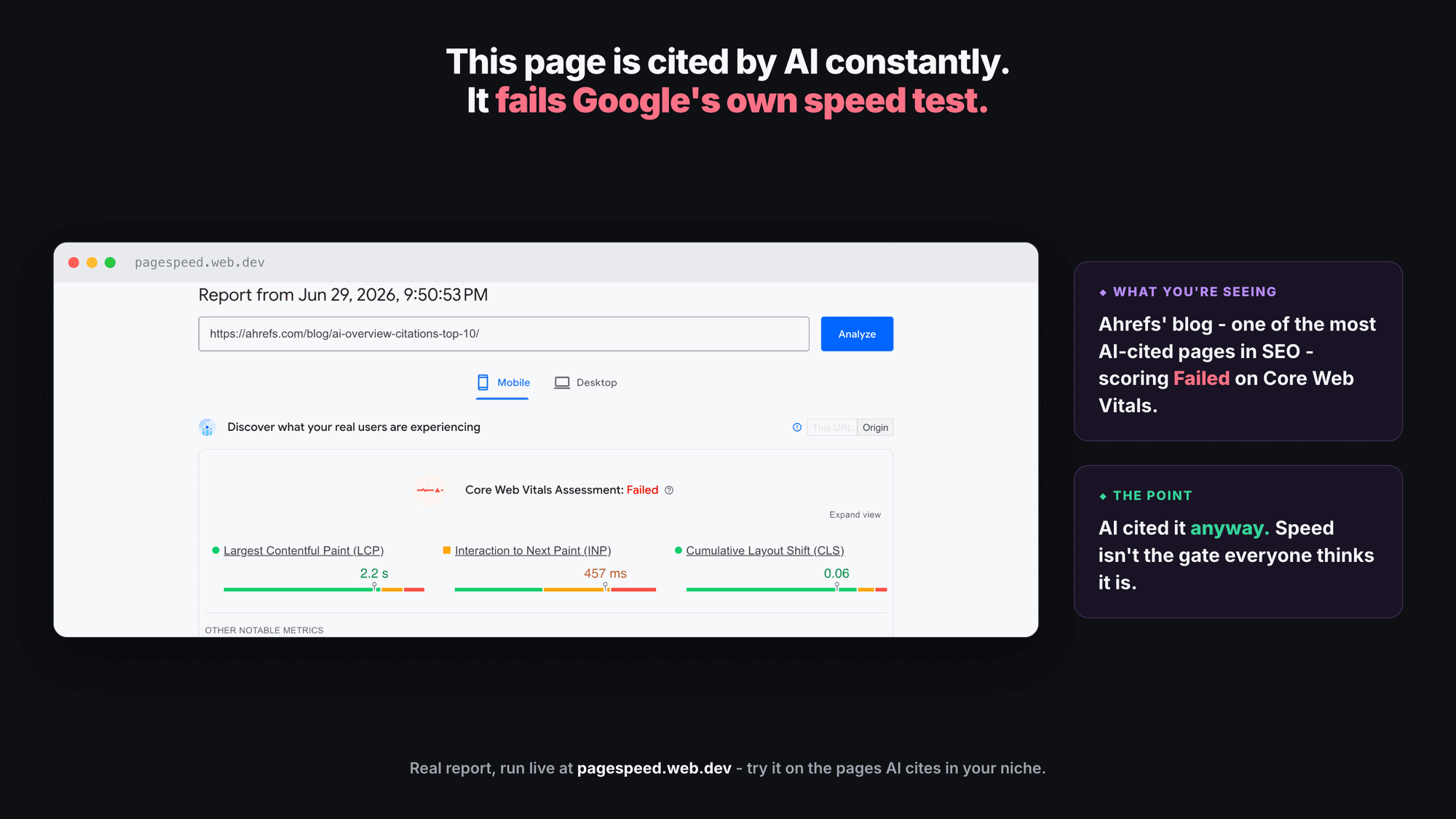
SEO folks love to preach about speed. You know the drill: speed up your site or AI won't cite you. Sounds logical, right? But honestly, it's just plain wrong, and you can prove it in five minutes.
Here's how. Ask ChatGPT something real in your niche and take a look at the pages it throws back at you. Then, pop those URLs into pagespeed.web.dev (it's free, no signup). Spoiler alert: you'll find sites scoring in the 40s and 50s, which are failing Core Web Vitals. I tested it on big names in AI SEO like Ahrefs, Semrush, and Search Engine Land, and guess what? They all bombed the Google speed test, yet AI still cites them constantly.
This advice just doesn't hold up when you dig a little deeper. PageSpeed focuses on how fast your page renders in a browser. It looks at image sizes, layout shifts, and blocking JavaScript. But here’s the kicker: the crawlers feeding ChatGPT, Claude, and others? They don’t use a browser. They don’t execute JavaScript. They only read your raw HTML and bounce. So, PageSpeed is grading things that the crawlers never even see.
Beyond a bare minimum, having great Core Web Vitals doesn't seem to impact AI visibility. A completely broken page? Sure, that's gonna tank your chances. But a page that's just a bit off? Totally fine.
The one speed metric you should really care about is Time to First Byte (TTFB). This is about how quickly your server sends back the first byte of HTML. If your server is slow or overloaded, a crawler might just give up before even reaching your page. And that’s exactly what has been recorded with ChatGPT's fetcher.
The good news? The fix is straightforward: get your server in shape with caching, use a CDN for your HTML, and ensure your server can handle bot traffic.
So, forget optimizing for that elusive number AI can’t even see. Focus on checking your TTFB, keeping your server healthy, and then put in the effort where it actually counts: make sure your answers are clear in the raw HTML that an AI can easily read.
That last part? Yeah, it’s the slow, grueling grind. It’s what we built Outrank for: creating answer-shaped pages and publishing them straight to your CMS.
This article was inspired by Outrank.