
UI Feedback Review - Agent Skill That Turns Tester Feedback into a Prioritized Fix Plan
Description
What it does: turns what testers said about a finished interface into a fix plan your agent can act on. A tester describes a symptom ("I clicked Next three more times") and suggests the first fix that comes to mind ("make the error bigger and red"). The skill records the suggestion as a signal, finds the cause with a rule of human perception (the error sat in a corner toast that vanished after 3 seconds, outside the user's locus of attention), and proposes the fix that removes it, with a measurable check that it worked.
Who it is for: developers, designers, and product owners who ran a usability test, a beta, or a hallway test and now hold a pile of notes, and anyone who asks an agent to "fix what the testers said" and wants it to fix causes, not symptoms.
What you get: the skill folder for your agent: SKILL.md with the six-step process, and references/interface-rules.md, a 12-section reference of interface rules for models (Raskin's The Humane Interface, GOMS, Fitts's and Hick's laws, Nielsen's heuristics, Gestalt, WCAG 2.2) with a 33-item self-check checklist and a table of 21 anti-patterns. Plus HTML documentation on installing it in Claude Code, Cursor, or any agent that reads Markdown.
What you do: copy the folder into your agent's skills folder and give it the interface (code, screenshots, a URL, or a description) and the feedback in any format: "Here is our checkout and notes from three testers. Review the feedback and give me a fix plan."
Features
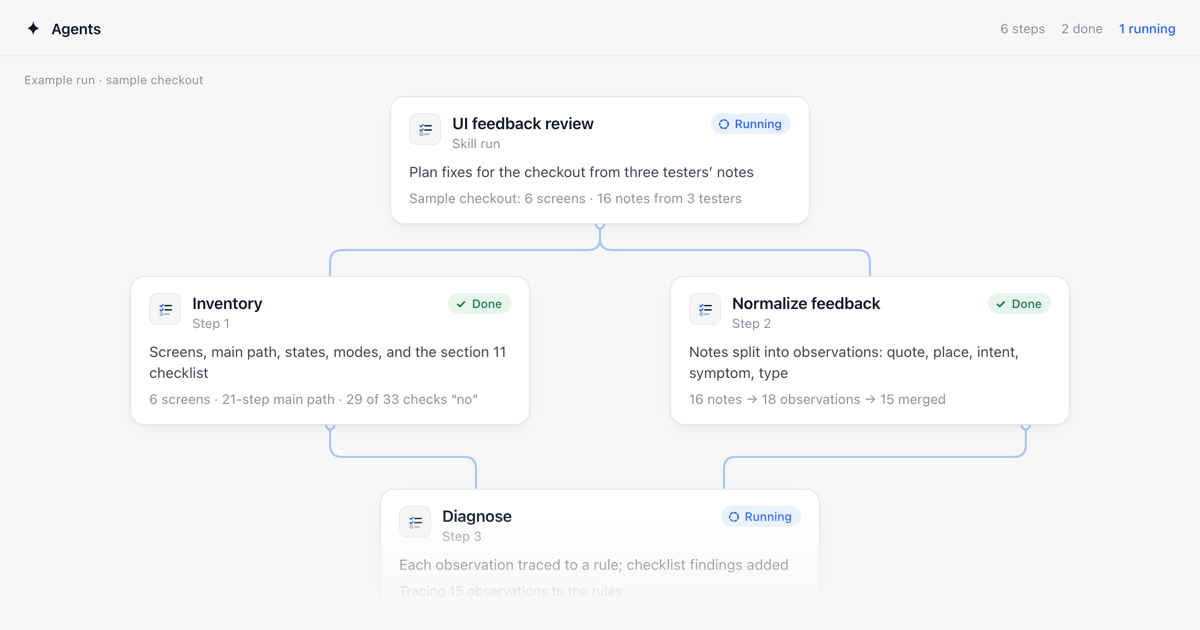
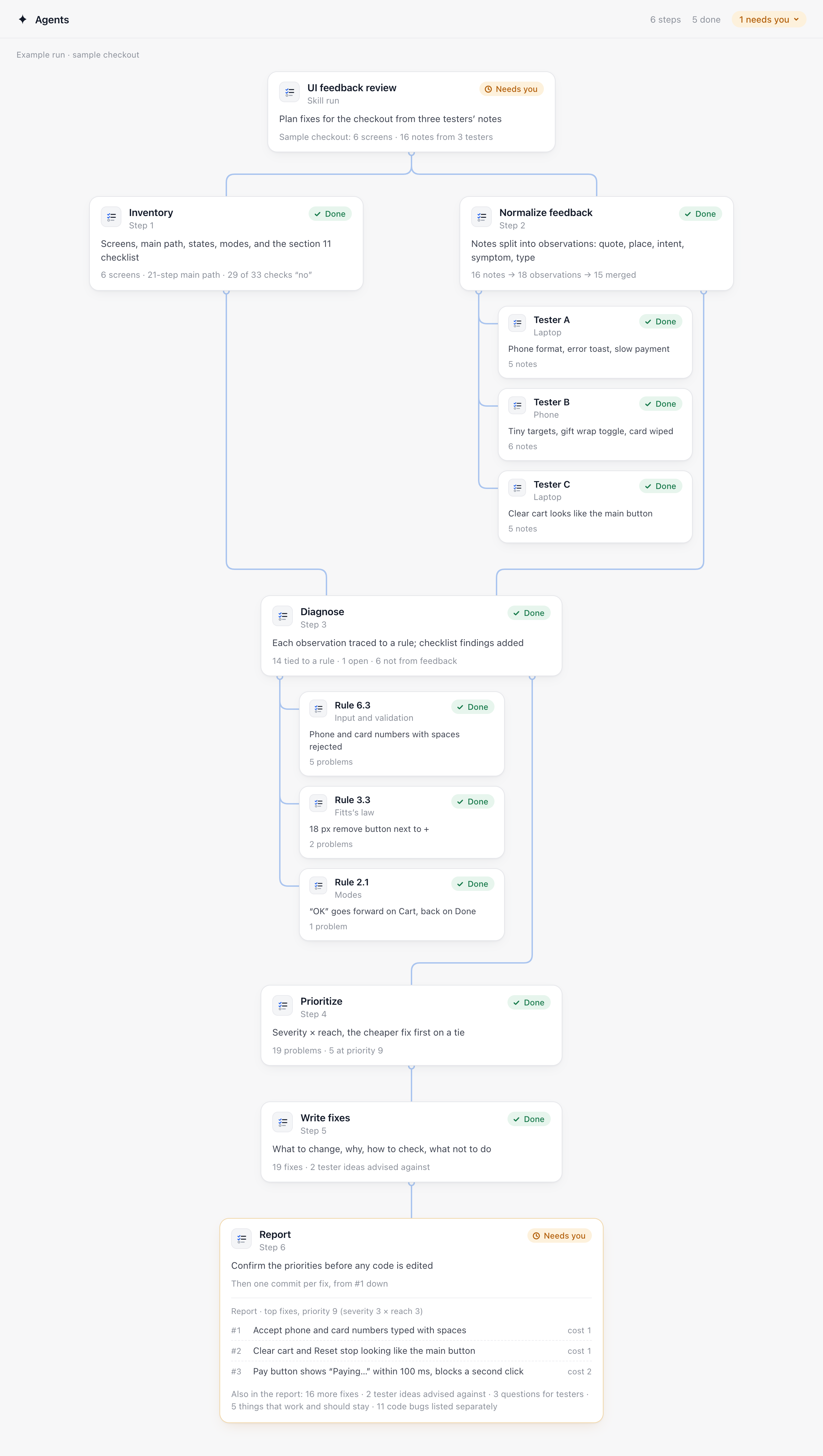
- Six steps: inventory of the interface before reading the feedback, normalized observations, diagnosis by rule, priority, fixes, report
- Inventory first: screens, the main path counted in GOMS steps, the six states of every screen, hidden modes, and the 33-item checklist, so the agent does not see the interface through the tester's eyes
- Feedback split into atomic observations (quote, place, intent, symptom, the tester's suggestion, type) and merged across testers with a count of who ran into each one
- Every observation traced to a numbered section of the rules reference, or marked "cause not determined" with a question for the tester, no rules invented after the fact
- Problems the testers missed but the checklist found go into the plan marked "not from feedback"
- Priority = severity x reach (1-3 each), the cheaper fix first on a tie, problems that block the main task for everyone come first
- One fix per cause, at the element level, with the rule, the tester's quote, a measurable check, and why the tester's own idea would not remove the cause
- Guards against bad fixes: no settings "so everyone can choose", no second way to do the same thing, no confirmation where undo works, no icon where a word works
- Code bugs listed apart from UX problems, no judging of visual taste unless you ask
- Code is edited only after you confirm the priorities, one commit per fix, from the top
- Works in any agent that reads files, no accounts, keys, or network
A real result
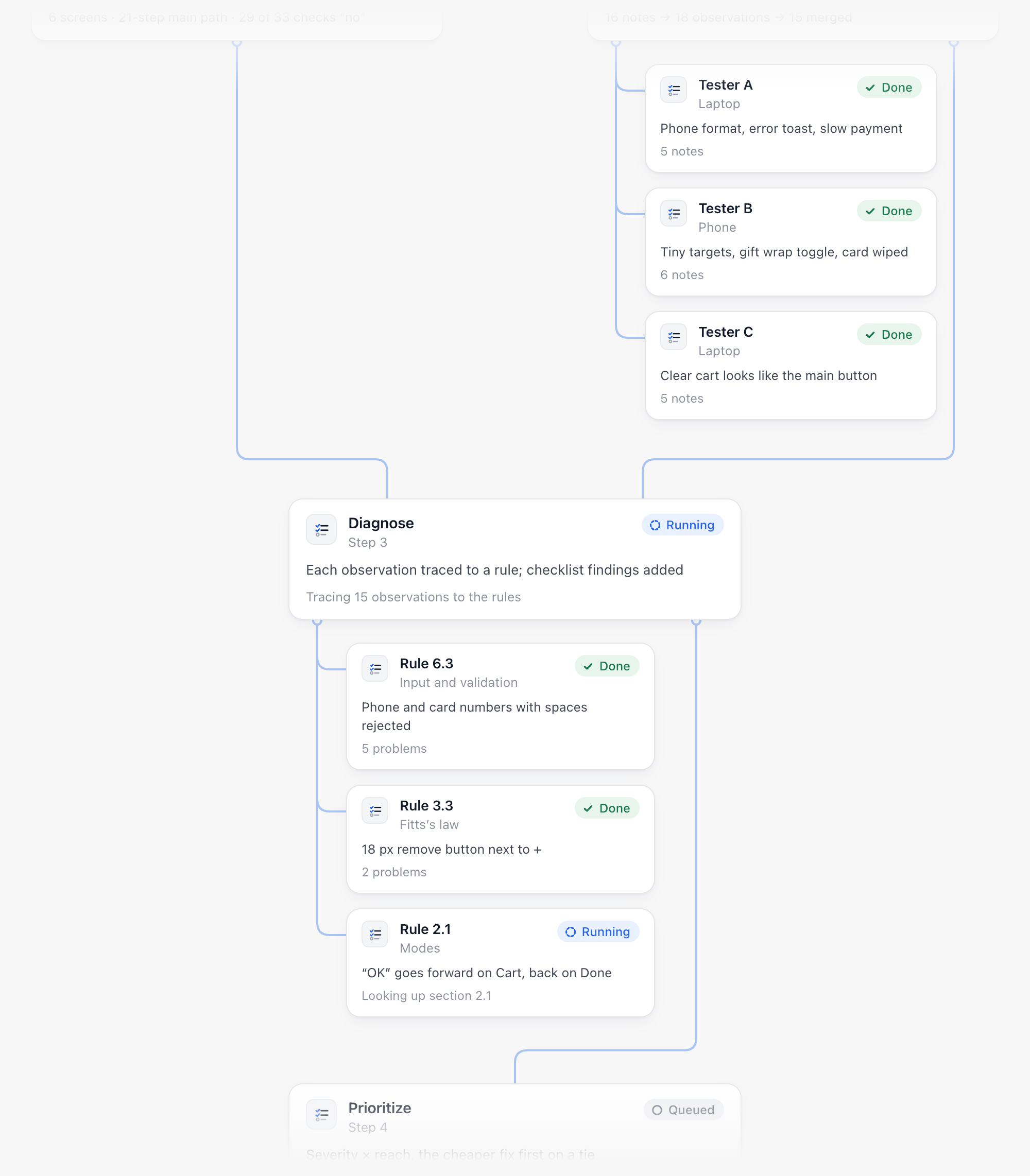
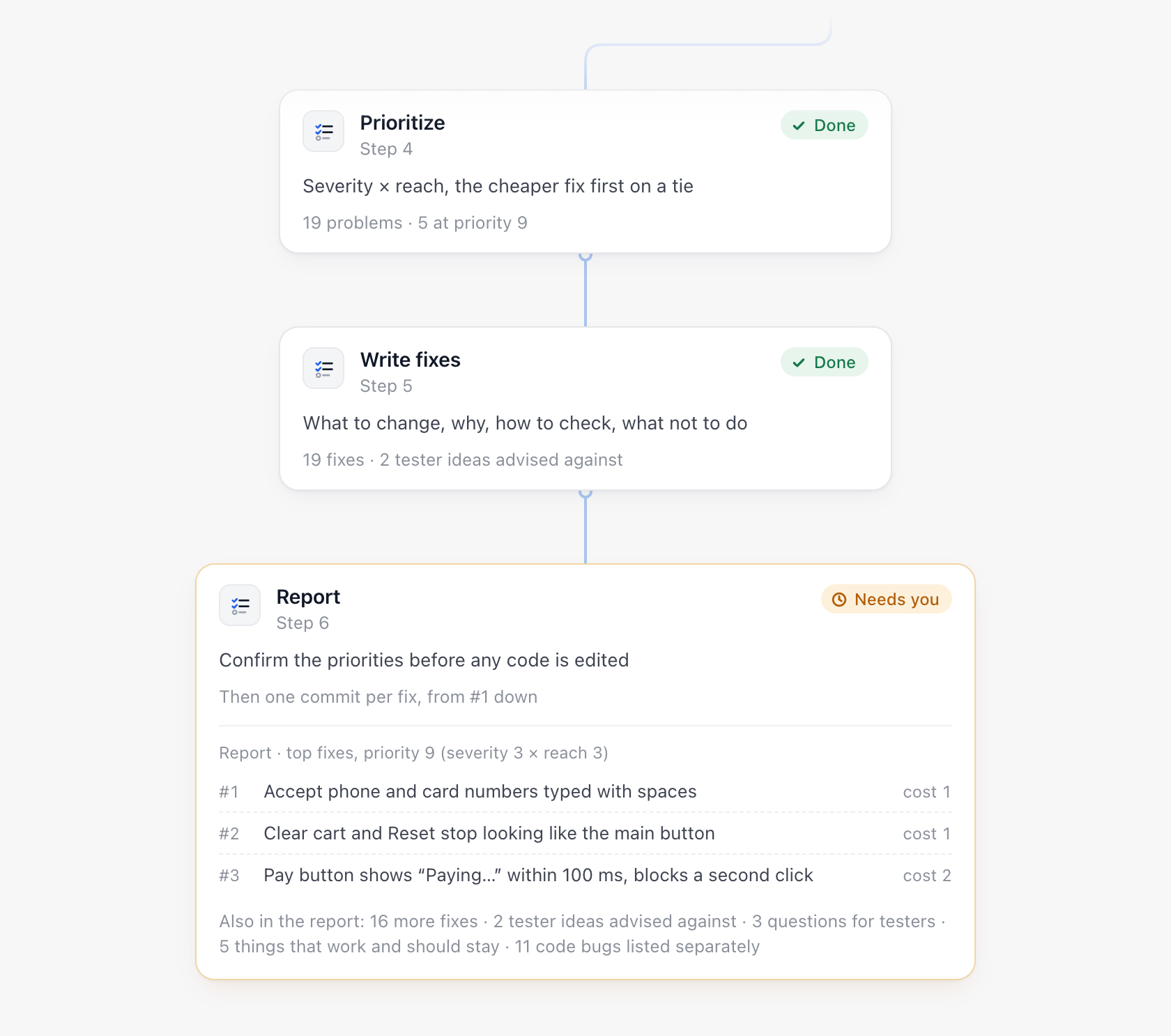
Before publishing, the skill was run end to end by a separate agent on a sample six-screen checkout with 16 notes from three testers. It inventoried 6 screens and a 21-step main path (29 of 33 checklist items answered "no"), turned the notes into 18 observations and merged them into 15, tied 14 to a rule and kept 1 ("feels old-fashioned") as a question, and added 6 problems no tester mentioned, including that the buyer never saw an order total before paying. The report had 19 fixes, 5 at priority 9: accept phone and card numbers typed with spaces, stop the Clear cart and Reset buttons looking like the main button, and make the pay button answer within 100 ms and block a second click. It advised against 2 tester ideas (a bigger red error toast, a separate "Express checkout" button), asked 3 questions, named 5 things to keep, and listed 11 code bugs separately.
Tags
Products of the Week.
Submit🥇

Costcodle
Costcodle is a free, daily price-guessing game for Costco shoppers who want to test their sense of value by estimating items within six tries.
Other · 418 views · 8 clicksOther · Week 43 · 418 views · 8 clicks
🥈

STOP GUESSING WHAT TO POST
AI that learns your brand voice and builds a month of consistent, on-brand social content: carousels, posts and hooks that sound like you, not like everyone else's AI.
SaaS · 795 views · 15 clicksSaaS · Week 43 · 795 views · 15 clicks
🥉

Hand-Placed Backlinks $9.99 per link. Flat rate.
Buy hand-placed forum, Q-A and directory backlinks. Flat $9.99 per link, no subscriptions — you only pay for approved listings.
Website · 772 views · 13 clicksWebsite · Week 43 · 772 views · 13 clicks
#4

autoadify.com
Autoadify helps businesses, creators, marketers, agencies, and ecommerce teams reduce the time spent creating, scheduling, approving, and publishing social media content. It combines AI content creation, automation, ecommerce workflows, and multi-platform publishing in one place, making social media management faster and easier to scale.
Other · 3,842 views · 9 clicksOther · Week 43 · 3,842 views · 9 clicks
#5

Ecomz AI | Multi-Tenant SaaS
Launch your own branded AI e-commerce platform without building the software from scratch. Ecomz AI provides a white-label, source-code/business-in-a-box solution that lets you offer merchants online stores, branded mobile apps for each shop, AI-powered sales and support agents, a unified inbox, a customisable drag-and-drop page builder, Ecomz Appstore integrations, and subscription plans you control under your own SAAS brand/hosting/business.
Other · 6,798 views · 19 clicksOther · Week 43 · 6,798 views · 19 clicks
#6

Whisper Notes - Best Offline
Whisper Notes turns speech into text entirely on your iPhone or Mac — no internet, no account, and your audio never leaves the device. Pick Whisper, Parakeet V3 or SenseVoice for 100+ languages, transcribe recordings and imported audio or video files with speaker labels, and on the Mac direct download hold Fn to dictate into any app. One-time purchase: $7.99 on iPhone, $14 on Mac, with 5,000 free words a week on Mac.
Other · 6,715 views · 14 clicksOther · Week 43 · 6,715 views · 14 clicks